


 Francais
 Deutsch
 Italiano
Refine Your Search
Coney Island New York 1898 stock footage and images
- Showing 8617 to 8622 of 11259 results more
more Hide
Hide
Radio broadcast following death of President Franklin Delano Roosevelt; reaction and reporting from Washington and Luxembourg (WW2)
(Audio only). Radio broadcast from Washington DC during World War II. Musical prelude before reporting of news. This is followed by reporting by correspondent Morgan Beatty on the death of President Franklin D Roosevelt and national events following it. Vice President Truman retains Roosevelt's Cabinet before taking oath of President's office. He indicates that news of the President's death was released immediately from Warm Springs. Cabinet meeting in White House. The White House Press Secretary Stephan Early makes an official announcement of President Roosevelt's death in Warm Springs, Georgia. Reports from White House radio room. Correspondent Ralph Howard Peterson summarizes events immediately before and after the death of the President. In Luxembourg: Correspondent Lowell Thomas reports President Roosevelt's death and on the war in Europe.
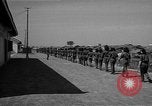
The Vietnamese WACs issue uniforms to the women recruits in Saigon, Vietnam.
Vietnamese Women's Army Corps stationed in Saigon, Vietnam. The WACs walk in long columns in a compound. A concrete building in view. American WACs Major Kathleen I. Wilkes and Sergeant Betty L. Adams serve as advisors of the Vietnam Women's Army Corps. They help the Vietnamese WACs. The Vietnamese WACs issue uniforms to the women recruits. Several new recruits wear native dress. Blouses are held against the girls for possible fit. Sergeant Adams tries a jacket on a new recruit. A Vietnamese woman works at a sewing machine. Major Wilkes, Sergeant Adams, Vietnamese WAC Sergeant and a Vietnamese girl walk out of the building. (Vietnam War period).
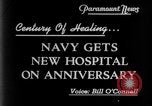
President Roosevelt's address during the dedication of Bethesda Naval Hospital in Bethesda, Maryland.
During World War 2, the new Bethesda Naval Hospital in Bethesda, Maryland is dedicated by the Naval Bureau of Medicine and Surgery (NBMS ) on its 100th anniversary. New hospital building. Guards out front marching. Patients on hospital beds. Pharmacists in a sterilization chamber. A nurse at work with equipment. A group of doctors in an operation theater performs a surgery on a patient. U.S. President Franklin D. Roosevelt arrives at the hospital in a chauffeur driven motor carriage with other personnel to address the patients on the occasion. Patients in wheel chairs with their attendants. A large gathering of doctors, nurses and other staff and patients of the hospital outside the hospital building. President Roosevelt addresses the gathering. He says that there is a national shortage of doctors and nurses. Medical, surgical and nursing care should be given to every civilian. To allow use of medical staff for the war effort, he also cautions Americans to be cautious and safe, citing those civilians who drive recklessly and those who do not take preventive measures in industrial plants.
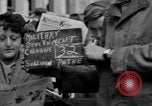
German people read newspaper Kolnischer Kurier distributed by SHAEF in Cologne Germany after World War II.
German civilians read the news of end of Hitler and Mussolini era in a newspaper in Cologne, Germany after World War II. Newspaper Kolnischer Kurier is published and distributed by the Supreme Headquarters, Allied Expeditionary Forces (SHAEF). Group of people read the newspaper and peep into it. An old man shows two young boys the news published in the newspaper.

U.S. President Nixon announces the resignation of William Rogers as the Secretary of State at a press conference in San Clemente.
U.S. President Richard Nixon holds a press conference in San Clemente. He makes an announcement about the resignation of the Secretary of State William Rogers. Nixon appreciates the quality work and time given by Roger. He addresses Roger as his close friend and advisor. President Nixon appoints Henry Kissinger as the new Secretary of State. Nixon speaks on the well known qualifications of Henry Kissinger to be appointed as the new secretary.
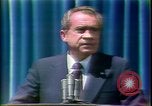
In San Clemente, California U.S. President Nixon talks about the existence of wiretaps during the Kennedy administration.
U.S. President Richard Nixon talks about the role of wiretaps in national security during a press conference in San Clemente, California. A journalist questions the President about his statement regarding the 10 additional wiretaps that could have been initiated by late U.S. Senator Robert F. Kennedy, which would have lead to the discovery of the Oswald plan and thus prevented U.S. President John F. Kennedy's assassination. The President responds that 10 more wiretaps could have found the conspiracy, if it was a conspiracy in the first place, then it would have been worth it. The President also talks about the high number of wiretaps in the National Security area during the Kennedy administration for national security purposes. The taps on news organizations, news people and civil rights leaders were all justified. The journalist then asks the President if he thought that President Kennedy's assassination threat mattered more to the national security wiretaps. The President does not agree with this and believes that the assassination was a breakdown in the President's security. He also states that he personally does not prefer to have secret service.
CRITICALPAST.COM: About Us | Contact Us | FAQs - How to Order | License Agreement | My Account | My Lightboxes | Shopping Cart | Advanced Search | Featured Collections | Website Terms & Conditions | Privacy Policy ©2026 CriticalPast LLC.
License Agreement |
Terms & Conditions |
Privacy Policy
©2026 CriticalPast LLC.