


 Francais
 Deutsch
 Italiano
Refine Your Search
Coney Island New York 1898 stock footage and images
- Showing 8689 to 8694 of 11259 results more
more Hide
Hide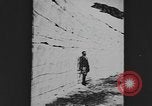
The phenomenon of the collection of the snow layers and the occurrence of avalanches in the United States.
A film depicts the causes of avalanches. Mountainous region in the United States. Snow covered mountains. Men standing and working in the area. Every new snowfall adds a new layer of snow on the crust. The phenomenon is explained. The collection of the layers of snow and the occurrence of avalanches is explained. A diagram shows the phenomenon. Men trudging through the snow. Animated diagram shows the occurrence of avalanches.

Yank Magazine staff being awarded and praised by journalists in the United States.
American journalist Quentin James Reynolds talks about the Army News Service in the United States. Officers and dignitaries gather in a hall. Quentin James Reynolds addresses them. He praises the army news service. Journalist Norman Cousins presents an award to Yank Magazine staff.
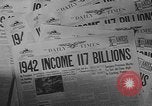
Men and women working in different war production factories for the production of raw materials and armament for World War 2 effort
The production of war materiel and supplies for soldiers and sailors in the United States during World War II. Newspaper headlines read: '1942 income 117 billions'. Men working in war production factories. Manufacture of aluminum and steel for the war effort. Sheet of aluminum rolling down conveyor in factory. View of assembly floor in a production plant building bomber aircraft. Brass being processed in factories, and hands of a worker sifting through new bullet casings in an ammunition factory. Use of copper exemplified in engine wiring and telephone communications applications. Steel being forged in factory. War ship being launched and a new Liberty ship SS Richard Bassett being launched from ship building slips on May 22, 1942. Tanks being built in a factory. Elevated view of many wood army barracks being built at an army base or camp. Then a view of homes being built as housing for war production workers. Lumber operations underway and coal miner in coal mines. A chart depicts the last year's production goals and then animated chart showing the production goals for the coming year shooting sky high. A sign on a door reads: 'Lt. Gen Brehon Somervell, Commanding General, ASF'. Lt. General Somervell seated at a desk in his office. He talks about engineers and technicians working for the U.S. Army and making materials go further to do more jobs than ever before.
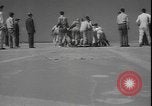
Speed racers Sir Malcolm Campbell and Gar Wood break records in the United States.
New land and sea speed records are set in the United States. People gather in Daytona Beach, Florida. Sir Malcolm Campbell seated in his race car 'Blue Bird'. He drives the car on Daytona beach and sets a new record driving at the speed of 272 miles per hour. People cheer. Close view of him smoking a cigarette in the car after his speed run. Speedboat racer Garfield Arthur Wood seated aboard his speedboat 'Miss America' on the St Clair River near Detroit Michigan. He races the 5000 horsepower mahogany speedboat and wins the Harmsworth Trophy. Close up view of Gar Wood smiling after his race. From a November 10, 1958 newsreel recounting events 25 years earlier.
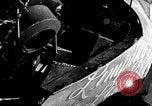
A USAAF P-38 Lightning aircraft takes off after being loaded with film magazines in Australia, during World War II
The 8th Photographic Reconnaissance Squadron in Australia during World War II. A United States Army Air Force P-38 Lightning aircraft in flight. P-38 photo recon aircraft being loaded with film magazines and then buttoned up. The P-38 Lightning aircraft takes off on a mission to photograph Japanese positions in Rabaul, New Britain, Papua New Guinea, during World War 2. The aircraft lands after returning from the mission.
American soldiers enter city of Leipzig, Germany, and take prisoners of war, during World War II.
American forces in Leipzig, Germany near the end of World War 2 in Europe. Landmarks include the heavily damaged New Town Hall, Burgplatz, and a church. At start of film, German civilians are seen running along railroad tracks, past war-damaged platform, to reach a train. Hungry German civilian men wrestle with a man on a sidewalk holding a large piece of meat. American soldiers walking across a city square in single file. Two Sherman tanks move across city square following the tracks of a tramway. The overhead electric wires for the tram are visible. More views of American soldiers walking and some in jeeps. A tilted view of the Reform Evangelist Church. Then camera straightens out and shows it properly. In front of the church, two American soldiers sit on a half-track with M45 Quadmount (Maxson) Anti-Aircraft guns installed on it. Back of the half-track has "660 AAA" stenciled on it. Many Jerry cans are held in racks along the sides of the half-track. Scene shifts to a formation of German prisoners of war with their hands over their heads. Close-up views of faces of German soldier prisoners of war. Camera pans across them, closeup. They carry all their personal gear, including bed rolls, but no weapons. View from behind them. Wider glimpse of the prisoners under guard. The severely damaged 1928 Kroch Building (Krochhochhaus) is seen in the background. Several German prisoners sit in a jeep, guarded by an American soldier with an M3 .45-caliber sub-machine gun ("grease gun"). At the end of the film, the bomb damaged 1905 New City Hall (Neues Rathaus) is seen in the background.
CRITICALPAST.COM: About Us | Contact Us | FAQs - How to Order | License Agreement | My Account | My Lightboxes | Shopping Cart | Advanced Search | Featured Collections | Website Terms & Conditions | Privacy Policy ©2026 CriticalPast LLC.
License Agreement |
Terms & Conditions |
Privacy Policy
©2026 CriticalPast LLC.