


 Francais
 Deutsch
 Italiano
Refine Your Search
Coney Island New York 1898 stock footage and images
- Showing 8989 to 8994 of 11259 results more
more Hide
Hide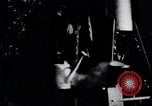
Liquid rocket research and development, led by Robert H. Goddard, in America
Robert H. Goddard with the first flight of a liquid fuel rocket on March 16, 1926, in Auburn, Massachussets. He stands next to the rocket perched high on a launching frame. Goddard uses a long pole and can of benzene to fuel the rocket. Photogaph of his camera and barograph used on July 17, 1929. An 18 meter tower being prepared. A 6 meter high test stand. The barrel could be filled with water and serve as ballast. Picture of a Performance recording device. A man in a protective bunker 15 meters from the launch point for tests in New Mexico. A man using a telescope to observe from a shed 900 meters from the launch point. Another with a telescope and recording device on a tripod. Pictures from the first gyro-controlled rocket flight on April 19, 1932
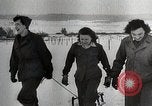
U.S. 26th "Yankee" Infantry Division celebrates Thanksgiving, 1944, during World War II.
Thanksgiving 1944 in Northeastern France, with the U.S. 26th Infantry Division, during World War 2. Several U.S. Army women nurses walk through muddy snow covered field in Northeastern France, during World War II. One of them pulls a small sled. At the same time,US troops march along sides of a nearby road. A U.S. soldier is issued a winter coat by a quartermaster.Other soldiers putting on new overcoats. U.S. troops in overcoats march along a wet road. A soldier holds up a sign reading," 26 'Yankee' Infantry Division, HAPPY- THANKSGIVING !, Europe 1944." The troops huddle over field cook stoves in a field. They smoke cigarettes. Large group of U.S. soldiers in a chow line near a cemetery in a French town (probably Dieuze, which they captured on November 20th). They receive a Thanksgiving dinner. Soldiers playing football on a snow covered field.
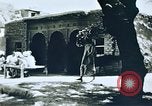
USIA film explaining its mission, inter alia, to correct misconceptions that people in foreign countries may have about America
Opening scenes shows men in in a South Asian village having intense discussions. (USIA wishes to inform such discussions.) The free world also has practical interests throughout the globe. Film shows two geologists holding up what appear to be sheets of mica. Women at work in a factory. Narrator suggests they are using scarce industrial materials (like tungsten). Men in a factory cutting mica. A man shoveling an agricultural product. Men carrying hemp and placing it on poles to dry. Impoverished Asian families. A man (ostensibly Communist agitator) speaking to Arabs. Marchers carrying large cartoon signs in Arabic, depicting "workers" striking down Uncle Sam and other Western powers. Narrator says deeds are more important than words. An American agricultural adviser is shown in a field with a native farmer. President Dwight D. Eisenhower seen standing with him, while Theodore Streibert is sworn in as first Director of the new U.S. Information Agency. Chart shows USIA absorbing information programs formerly administered by the Mutual Security Agency and State Department. Chart stating USIA mission is to: 1. Unite the free world; 2. Get the facts to people behind the iron Curtain; 3. Bring hope to captive peoples.
USIA film describing the ways it conducts its world-wide operations
Segment of U.S. Information Agency film describing its world-wide operations. Map shows 217 overseas posts in 17 countries, of the USIA (also known abroad, as the U.S. Information Service). Animated map zooms in on one post, in Rio de Janeiro, Brazil. Aerial view of Sugar Loaf Mountain overlooking the harbor and city. Street scene in Rio. USIA Public Affairs Officer, William A. Wieland, is seen walking along a sidewalk in the city. Next he is seen in the office of Ambassador James S. Kemper, briefing him about USIA activities. View of the Brazilian Foreign Office building. Mr. Wieland meets with the Chief of the Cultural Division there. Book stacks in the USIA Thomas Jefferson Library in Rio de Janeiro. Mr. Wieland conferring with a librarian. He is also seen at the USIA broadcast facility in the U.S. Embassy. Film shifts to street scene in Cebu, the Philippines. A building displaying American and Philippine flags, is labeled: " United States Information Service." Inside, and American and a Filipino worker give bundles of literature to local workers for distribution. One, a bus driver, carries his bundle onto his open-sided bus, displaying the name, "Cebu, Autobus." He waves as he drives away. The USIA Public Affairs Officer is seen visiting the Mayor of Cebu City, Vincente S. del Rosario; giving a news release to the editor of a newspaper; broadcasting on local radio;and socializing with local editors. USIA drive a mobile movie van into a remote village where many children are playing. They set up a screen and projector. Almost everyone in town attends the showing. Scene shifts to USIA headquarters building at 1778 Pennsylvanis Avenue,in Washington, DC. Director Theodore Streibert holds a staff meeting. View of President Eisenhower addressing U.S. public media leaders about confronting the Soviet Union with truthful information about the U.S. and the West, on April 16, 1953,in Washington, DC. A USIA technician transmitting text of the speech to its public affairs officers around the world. Views of newspapers carrying the story in Paraquay, Ireland,Algeria, and Burma. The President's speech was printed in a pamphlet entitled "The Peace We Seek," ahd sent abroad where it was translated into Arabic,Japanese, Persian, and 20 other languages. Four million copies were distributed. Posters about the speech were also distributed.
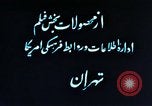
United States sends crop duster aircraft to combat a locust plague in Iran.
The United States sends aircraft to enable Iran to spray against a locust plague, in 1951. Iranian farmers are seen trying to cope with a plague of locusts, seen covering everytning in sight. The farmers chase them with cloths and use watering cans to dispense chemicals. A DC-4 transport aircraft taxis in after landing in Iran. The aircraft carries several small Piper Super Cub 135 airplanes and a croip duster, all equipped for aerial spraying. View of Piper Cub being removed from the DC-4. A bi-wing crop duster airplane being assembled. Several Super Cub aircraft flying low and spraying against locusts. (Note: The DC-4 aircraft is owned by United States Overseas Airlines, a non-scheduled air carrier based in Cape May New Jersey, that was contracted to combat the locust plague. The project was undertaken as part of President Truman's Point Four Program. approved by the United States Congress on June 5, 1950 in the Foreign Economic Assistance Act. )

Efforts by United States Information Agency to provide information to populations behind the "Iron Curtain."
Chart shows USIA information endeavors to send information behind the "Iron Curtain," including libraries, films, newspapers, and broadcasts involved in anti-Communist propaganda during the Cold War. Other charts cite cooperation with private enterprise, including 750 groups, such as businesses, schools, etc. Illustration shows letters written by Americans to family and friends abroad that can inform them of the truth. Town and city affiliation program is shown, with the example of Montclair, New Jersey, in the United States, and its relationship with Graz, Austria. The Mayor of Graz is seen being honored at a dinner in Montclair. Chart illustrates program of salvaging and sending American magazines abroad.
CRITICALPAST.COM: About Us | Contact Us | FAQs - How to Order | License Agreement | My Account | My Lightboxes | Shopping Cart | Advanced Search | Featured Collections | Website Terms & Conditions | Privacy Policy ©2026 CriticalPast LLC.
License Agreement |
Terms & Conditions |
Privacy Policy
©2026 CriticalPast LLC.