


 Francais
 Deutsch
 Italiano

Refine Your Search
Coney Island New York 1898 stock footage and images
- Showing 9085 to 9090 of 11285 results more
 Hide
Color Sound

U.S. troops of the 1st Division, AEF, train with light artillery piece during World War I
Troops of the First Division, American Expeditionary Forces (AEF) move down a hill with a horse-drawn caisson and small artillery piece, at their training grounds in Gondrecourt, France, during World War 1. In the next scene two gunners crouch behind the shield of a Vickers Q.F. Mark II 40mm Gun. An instructor stands over them and they fire the gun at his command, several times. The hot expended shells drop between the gunners. The assistant gunner loads a new round through the gun breech, for the next firing. Several other soldiers sit in the background observing and presumably awaiting their turn to practice firing the Vickers gun.

French jet aircraft Baroudeur, launched without landing gear, from a mobile platform, at airfield in France.
The SNCASE S.E.5000 Baroudeur, a new French jet aircraft, lacking conventional landing gear, is launched from a special mobile platform, at an airfield in France. The jet takes off, leaving the mobile launch platform rolling along the runway. A drag chute deploys to brake the launch platform. Aerial views of the jet in flight.

USS Frament, DE-677,and other U.S. Destroyer Escorts in shakedown maneuvers during World War II
Scenes aboard U.S. Navy Destroyer Escort USS Frament (DE-677) during shakedown cruise, with other new Destroyer Escorts, in World War 2. Sailors occupy off-duty time reading and writing letters. Captain looks through binoculars. Sailors stand beside him. Another Destroyer Escort comes abeam the Frament. View of radar antenna of the ship. Radar operator operates radar instrument. Operation of sonar device aboard the ship. Radio Shack device to maintain contact with other ships. Aerial views of several destroyer escorts underway. Crewmen signal through signal lamp. The Frament practices zigzaging through the water. Destroyer escorts practice coordinated actions, one pursuing would-be subs while the other lays a smoke screen.
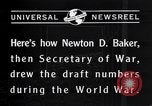
Second draft of World War I draft numbers is drawn by United States Secretary of War, Newton D Baker; Draftees report for duty
The United States Secretary of War, Newton D Baker during the second draft ceremony for World War I. His eyes are covered with a blindfold and he draws draft numbers from a bowl. The drawn draft number is read. General Enoch H. Crowder oversees the ceremony. A large number of draftees -- men dressed in suits and hats -- passes along a roadside. Men disembark a railroad train at a military training facility. Men march along tracks carrying the U.S. flags in hands. New recruits, including men and a few women practice marching in formation, still wearing civilian clothes.
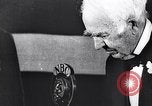
At a recognition ceremony in 1928, Thomas Edison operates the first tinfoil phonograph he invented.
Thomas Edison with his original tin foil phonograph (recording and playing device), that was produced in December 1877. Edison stands near a NBC microphone and shows operation of his tinfoil phonograph, also referred to in press of the late 1800s as a Talking Machine. This footage was shot on the occasion of a recognition ceremony for Edison on October 20, 1928, where he was also presented the Congressional Gold Medal by President Calvin Coolidge. This original tinfoil phonograph had been given by Edison in 1880 to a representative of the English Patent Office who visited the Menlo Park lab. The machine had been exhibited in England. It was repatriated for this 1928 event by the South Kensington Museum in London. British diplomat Ronald Ian Campbell, partially visible on the left in this footage, presented the phonograph back to Edison. Today it is on display at the Edison National Historic Site in West Orange, New Jersey.
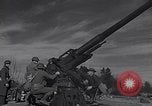
Eddie Rickenbacker, President of Eastern Airlines, hosts Cyrus R. Smith, President of American Airlines, after both airlines acquire DC-3 airplanes
Glimpse of U.S. Army gun crew operating a 3-inch M3 Anti Aircraft gun. Glimpse of 1st Lt Joseph H. Eastman and Captain Eddie Rickenbacker standing beside Rickenbacker's SPAD S.XIII #1 parked in front of a hangar at Foucaucourt Aerodrome, France, 1918. Sequence shifts to 1936, and office of Rickenbacker, now President of Eastern Airlines. A poster on the wall contains memorabilia from the 94th Aero Squadron, with which Rickenbacker flew in World War I. Camera pans over photographes bordering the poster. Next, Rickenbacker is seen conversing with his guest, Cyrus R. Smith, President of American Airlines, as they look at a picture of Rickenbacker and his Spad airplane, signed by numerous pilots who also served with the 94th Aero Squadron. A mounted model of a Douglas DC-3 airplane sits atop a table in the foreground. Rickenbacker and C.R. Smith, both hold onto the DC-3 airplane model as they shake hands. Closeup of the DC-3 model as Rickenbacker rotates it before the camera. (Note: Both Smith and Rickenbacker, presidents of their respective airlines, had mutual admiration for the Douglas DC-3 airliner. In 1934,Smith arranged to purchase 20 new DC-3 airplanes from the Douglas Aircraft Company. American's first DC-3 "Flagship Illinois," had its maiden flight on June 25, 1936. Eastern Airlines took delivery of its first DC-3 in December 1936.)
CRITICALPAST.COM: About Us | Contact Us | FAQs - How to Order | License Agreement | My Account | My Lightboxes | Shopping Cart | Advanced Search | Featured Collections | Website Terms & Conditions | Privacy Policy ©2026 CriticalPast LLC.
License Agreement |
Terms & Conditions |
Privacy Policy
©2026 CriticalPast LLC.