


 Francais
 Deutsch
 Italiano
Refine Your Search
Coney Island New York 1898 stock footage and images
- Showing 9121 to 9126 of 11259 results more
more Hide
Hide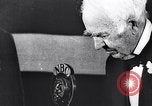
At a recognition ceremony in 1928, Thomas Edison operates the first tinfoil phonograph he invented.
Thomas Edison with his original tin foil phonograph (recording and playing device), that was produced in December 1877. Edison stands near a NBC microphone and shows operation of his tinfoil phonograph, also referred to in press of the late 1800s as a Talking Machine. This footage was shot on the occasion of a recognition ceremony for Edison on October 20, 1928, where he was also presented the Congressional Gold Medal by President Calvin Coolidge. This original tinfoil phonograph had been given by Edison in 1880 to a representative of the English Patent Office who visited the Menlo Park lab. The machine had been exhibited in England. It was repatriated for this 1928 event by the South Kensington Museum in London. British diplomat Ronald Ian Campbell, partially visible on the left in this footage, presented the phonograph back to Edison. Today it is on display at the Edison National Historic Site in West Orange, New Jersey.
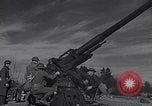
Eddie Rickenbacker, President of Eastern Airlines, hosts Cyrus R. Smith, President of American Airlines, after both airlines acquire DC-3 airplanes
Glimpse of U.S. Army gun crew operating a 3-inch M3 Anti Aircraft gun. Glimpse of 1st Lt Joseph H. Eastman and Captain Eddie Rickenbacker standing beside Rickenbacker's SPAD S.XIII #1 parked in front of a hangar at Foucaucourt Aerodrome, France, 1918. Sequence shifts to 1936, and office of Rickenbacker, now President of Eastern Airlines. A poster on the wall contains memorabilia from the 94th Aero Squadron, with which Rickenbacker flew in World War I. Camera pans over photographes bordering the poster. Next, Rickenbacker is seen conversing with his guest, Cyrus R. Smith, President of American Airlines, as they look at a picture of Rickenbacker and his Spad airplane, signed by numerous pilots who also served with the 94th Aero Squadron. A mounted model of a Douglas DC-3 airplane sits atop a table in the foreground. Rickenbacker and C.R. Smith, both hold onto the DC-3 airplane model as they shake hands. Closeup of the DC-3 model as Rickenbacker rotates it before the camera. (Note: Both Smith and Rickenbacker, presidents of their respective airlines, had mutual admiration for the Douglas DC-3 airliner. In 1934,Smith arranged to purchase 20 new DC-3 airplanes from the Douglas Aircraft Company. American's first DC-3 "Flagship Illinois," had its maiden flight on June 25, 1936. Eastern Airlines took delivery of its first DC-3 in December 1936.)
Takeover and censorship of the press during reenactment of Nazi martial law in Anderson South Carolina.
Group of armed men storms the newspaper publishing facility in Anderson South Carolina during a reenactment of martial law measures practiced in Nazi Germany. Press workers are escorted away. Man throws large power switch and lights go out. New edition of the "Anderson Daily Mail" newspaper is seen rolling off the presses, under guard by armed men. Newspaper headline is "Clemsonia Captures Anderson". Numerous articles are blacked-out and labeled "censored." Article is seen entitled "It Can Happen Here. In Fact it Did."

Contribution of WPA federal buildings projects in Ohio, United States, during the Great Depression.
From a film titled "A better Ohio". Scenes of Great Depression period in the United States: Idle men, closed factories, men searching through trash, sleeping on sidewalk. Scenes of post depression recovery: Smoke from factories, lines of workers, ample food, happy families. Views of Works Progress Administration (WPA) projects in Ohio: Airstrip construction of runways at Cleveland Airport; construction of Dayton Airport runways and aerial view of the Dayton Airport area; pipe capping and sealing work at abandoned coal mines to prevent pollution of local water supply; remodeled orphanage in Defiance, Ohio, with orphan children playing on the grounds of the Defiance County Children's Home; repaired and updated buildings at the Home for Sailor's and Soldier's Orphans at Xenia, Ohio; newly built dairy farm at the Sailor's and Soldiers Home; Rebuilt wing of the old people's home for care of the elderly in Napoleon, Ohio; view of the newly constructed tuberculosis sanatorium in Toledo, Ohio (the William Roche Tuberculosis Hospital). Scenes of fast moving flood waters during flood of Spring 1936 in Ohio. Flood water rushing past flooded buildings. WPA -constructed dams, levees, and retaining walls are seen during building process. African American and white workers seen digging together with shovels on the project. New trees are planted at the sites.
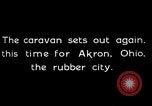
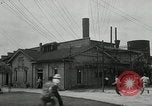
Pan American Highway Commission delegates visit a rubber tire manufacturing facility in Akron, Ohio
Delegates of The Pan American Highway Commission visit rubber tire manufacturing facilities in Akron, Ohio. Two motorcyclists lead the caravan of official cars and buses passing by fields approaching Akron. Commission members standing in a field overlooking the city of Akron. Women working with rubber sheets in a tire manufacturing plant. In another view at the tire plant, men place new rubber tire tubes over spinning wheels and then shift them to an assembly line. Workers with finished rubber tires.
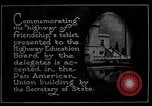
Pan American Highway Commission presents a commemorative plaque at the Pan American Union in Washington DC
Delegates of the Pan American Highway Commission present a gift after a month-long tour of the United States in 1924. Ceremony at the Pan American Union in Washington DC. Tablet is unveiled inscribed with the title 'Highway of Friendship', and presented as a gift to the Highway Education Board. The first line of the tablet reads, "Commemorative of the Official visit of the Pan American Highway Commission to the District of Columbia and the states of North Carolina, Kentucky, Illinois, Minnesota, Wisconsin, Michigan, Ohio, Pennsylvania and New Jersey June 2 to July 3, 1924. The happiness and prosperity of the people of the United States have been greatly enhanced by your definite program of Highway education...." U.S. Secretary of State Frank B. Kellogg accepts the tablet and speaks to those gathered.
CRITICALPAST.COM: About Us | Contact Us | FAQs - How to Order | License Agreement | My Account | My Lightboxes | Shopping Cart | Advanced Search | Featured Collections | Website Terms & Conditions | Privacy Policy ©2026 CriticalPast LLC.
License Agreement |
Terms & Conditions |
Privacy Policy
©2026 CriticalPast LLC.