


 Francais
 Deutsch
 Italiano
Refine Your Search
Coney Island New York 1898 stock footage and images
- Showing 9547 to 9552 of 11283 results more
more Hide
Hide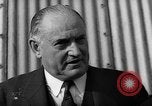
Arriving passenger extols virtues of German Zeppelin, Hindenburg .He shares his experiences about traveling on Zeppelins
A passenger arriving at Lakehurst, New Jersey United States, shares his experience about airship trip in the German Zeppelin Hindenburg (LZ-129). He compares it with a first class hotel and compares it favorably to a previous trip on the Graf Zeppelin (LZ-127). He tells about its trip to Chicago and other places.

People and children in gardens as they walk and relax at rebuilt Town in Russia
Development of New Towns in Soviet Union. Rebuilt town of Volzhsky, near Volgograd, Russia. A view of a river and dry land. Bridge under construction across the Volga River. Men work at cranes. A ship underway on the Volga River, beneath the bridge steel cables and skeleton. A view of buildings in the town. Bus on road. People on streets. Traffic on a road. People in a garden. Children outside a building. Children ride bicycle. They are seated. A baby in a pram. A few fountains and a garden. People look at the fountains. Spectators seated in a stand. People on a beach. They play in the water.

Hitler Youth boys and girls work and gather stacks of hay at a farm in Germany (WW2)
Mobilization of Hitler Youth in Germany during World War II. Hitler Youth boys work to gather crops. A Hitler Youth member handles horse drawn reapers . Both boys and girls of Hitler Youth work and gather stacks of hay. The bundle of stalks being loaded onto a bullock cart. Total mobilization shows : German newspaper. Newspaper on a street for display. People read a newspaper. Theaters, cabarets and night clubs closed for the duration. Women being interviewed for work in war munitions plants, as German war labor recruitment extends into groups formerly excluded to due old age or health reasons. A munitions factory instructor teaches women war production workers their new jobs. Women at work in a factory.
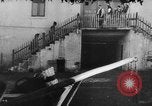
Europe begins to normalize as World War II comes to an end; scenes in Serbia, Spain, and Czechoslovakia.
A Slav festival in Serbia. People climb stairs to enter a Greek Catholic Church, where a priest is seen waving a container of incense, as part of the ritual. (Narrator notes that the theme is protection of native cultures, including protection of religion.) The Priest slices a large piece of bread for the Mass. Next an accordion is seen and dancers assemble for the "Kolo" (a Serbian national dance). View of dancing, that marks end of the festival. Scene shifts abruptly to a sailboat race in Malaga, Spain. Narrator says it "suggests the idea of normal living with a prosperous new Europe." Film shifts to mountains of the high Tatras, in Czechoslovakia, where Ski troops of the Czech army demonstrate their abilities.

U.S. Vice president Henry A. Wallace being greeted by Soviet leaders and meets children in Yakutsk, Russia.
A film titled ' Soviet Siberia and Central Asia Americas new gateway to Asia' depicts U.S. Vice President Henry A. Wallace journey to China through Soviet union. Animated map of the world. A portion of the globe. A U.S. Army Air Forces C-54 Skymaster takes off from Bering Strait and lands in Yakutsk. U.S. Vice President being greeted by Soviet leaders and chairman of council of the people's commissars of the Yakutsk Republic. The Vice President with other leaders look at the original wooden tower left in the city. They stand in front of a library. Civilians in the background. The children meet Vice President Wallace. He visits an agricultural station and talks to the people who carry agriculture in the north.

Psychedelic drug Lysergic acid diethylamide discovered by Dr. Albert Hofmann is used for mind control in the United states.
Documentary depicts development and administration of LSD (Lysergic acid diethylamide ) by the CIA (Central Intelligence Agency) as a tool for mind control (Project MKUltra). Scenes of swirling colors and lights meant to simulate the experience of someone being under influence of a hallucinogen. Prostitutes and late night city street scenes. A bull in a bull fighting ring that narrator says has electrodes implanted in its head to control it. A man sitting in a chair while under the influence of a drug speaks emotionally and cries. A close up of George White who worked on the CIA program. On September 21, 1977, Stansfield Turner, Director CIA, speaks about Mission Mind Control. Members are seated in a hall. News correspondent Paul Altmeyer stands in front of the Headquarters of OSS (Office of Strategic Services, and precursor to the CIA) in its original World War 2 era location in Washington DC. The first mind control work began from this Headquarters. The members who are the part of this mission are the shapers and molders of the OSS. Still photos of U.S. General, William Joseph Donovan, nicknamed 'Wild Bill', and Boston industrialist Stanley Lovell, who is the Head of OSS Research and Development efforts into mind control. Still images of OSS Captain George H. White, formerly of the Bureau of Narcotics. Correspondent shows and reads from the diary of George White and talks about his training and schooling. J. Michael Burke, President of Madison Square Garden Center is seen walking across the basketball court in the Center. He was a former colleague of Mr. White, and Burke talks about George White and his technical knowledge. Another colleague of White who is a narcotics officer talks about him. A close up of George White. A note written in White's diary. George White worked on a truth drug at St. Elizabeth's Hospital in Washington DC where experiments were conducted. View of exterior of Saint Elizabeth's psychiatric hospital in Washington DC. A 1952 CIA memo says the aim is "controlling an individual to the point where he will do our bidding against his will." Exterior views of the Sandoz Laboratory buildings in Basel, Switzerland where doctor Albert Hofmann believed that they had discovered and found a psychedelic drug and the discovery was LSD. Retired Chief Psychologist for CIA, John Gittinger, talks about the powerful drug and is being interviewed publicly. CIA's interest in LSD was intense but they were worried that the Russians would get hold of it. Commentator notes that mistaken intelligence reported that Sandoz Laboratory was going to put 100 million doses of LSD on the open market. Concerned, the United States was prepared to buy the entire supply. However, through information learned from Freedom of Information Act filings, John Marks, author of The Search for the Manchurian Candidate, tells the interviewer that this was mistaken information caused by a mixup when an American military attache confused milligrams versus kilograms, so there were in fact only 100 doses on the market. Brief footage of CIA chemist, Dr. Sydney Gottlieb.
CRITICALPAST.COM: About Us | Contact Us | FAQs - How to Order | License Agreement | My Account | My Lightboxes | Shopping Cart | Advanced Search | Featured Collections | Website Terms & Conditions | Privacy Policy ©2026 CriticalPast LLC.
License Agreement |
Terms & Conditions |
Privacy Policy
©2026 CriticalPast LLC.