


 Francais
 Deutsch
 Italiano

Refine Your Search
Coney Island New York 1898 stock footage and images
- Showing 9637 to 9642 of 11283 results more
 Hide

Streamlined train the Comet moving along a railway track in the United States.
A film on U.S. electric power resources. New streamlined railroad train called the Comet, in the United States. View in locomotive of engineer and his point of view looking out in front of the moving train. Engineer at the controls of the train. The train on a railway track.
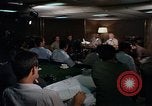
Newsmen take notes during a press conference aboard USS Ranger underway in the South China Sea.
Operations of U.S. Navy A-7A Corsair 2 aircraft aboard USS Ranger underway in the South China Sea during the Vietnam War. A press conference in progress by United States Navy Vice Admiral William F. Bringle. Several newsmen in the foreground. A newsman jots notes. Newsmen sitting at the tables in a wardroom listen to the briefing conference. Vice Admiral Bringle seated at a desk in the background. A news cameraman in the foreground takes movies. Many newsmen in the wardroom during the press conference.

U.S. President Coolidge and Secretary of State Kellogg sign the Kellogg-Briand Pact in the United States.
U.S. President John Calvin Coolidge, Jr. signs the Kellogg-Briand Pact in the United States. He signs the pact with U.S. Secretary of State Frank Billings Kellogg. Men entering a building. Officials seated at a desk. Other stand behind them. The President signs the pact. Other personages include Secretary of the Treasury Andrew W. Mellon, Secretary of War Dwight Filley Davis, Secretary of the Navy Curtis Dwight Wilbur, Secretary of Labor James John Davis, Secretary of the Interior Roy O. West, Secretary of Agriculture William Marion Jardine, Secretary of Commerce William Fairfield Whiting, Postmaster General Harry Stewart New, Attorney General John Garibaldi Sargent, Vice President Charles Gates Dawes and Senators William E. Borah, Charles Curtis, Frederick Huntington Gillett, Thomas J. Walsh, Hiram Bingham, and Charles A. Swanson.
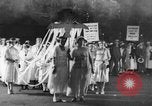
Pacifists, mostly women, march in a night time torchlight parade promoting Peace and Disarmament in the United States
A torchlight parade protesting war. Marchers are principally women. At start of film, a group of about 10 Women, all dressed in white, hold white streamers descending from a dove-like symbol of peace. The parade is conducted along a city street. Smoke rises all around from torches or bonfires beside the line of march. Some women carry a large banner reading: "Thou Shalt Not Kill." Other signs held by marchers appeal to Chemists and others who create tools of war, such as poison gas, to cease and desist such activities One sign reads: "Scientists Use Your Genius for Peace, Not War." A Bahai banner is carried by some marchers. Police officers monitor the march and marchers. Several women drape themselves in American flags. They are accompanied by a Civil War Union Army officer, carrying a sword. Many in the parade carry the same or similar signs and banners. Some are more legible when seen several times. Examples include: "Chemists, Help World Peace, Refuse to Make Poison Gas" and "Exploitation Leads to War, Abolish it." Other notable signs and slogans include: "Mothers pay the Heaviest War Tax;" "War is Not Inevitable. Human Nature does change;" "Immediate Universal Complete Disarmament;" and "We stand with Gandhi for World Peace." The last new one seen reads: " We will not give our children for another war."
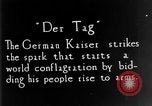
Troops in Germany leave for a war front at the outbreak of World War I.
Outbreak of World War I as a consequence of Archduke of Austria-Este Francis Ferdinand's assassination in Sarajevo. Troops gather in Germany on the bidding of Kaiser Wilhelm II. Soldiers leave Berlin. Soldiers of the Alexandria Regiment march. Family members bid farewell as new recruit soldiers board a railroad train and leave for a war front. Smiling soldiers. A huge crowd at a platform to bid farewell to the soldiers. The train carrying the soldiers pulls away.

Views of Emperor Hirohito and dignitaries aboard the battleship Mutsu during review of the Japanese Naval fleet in 1927
Opening slate reads:"Yokohama, Japan- 1927. The Empire's entire Naval forces are assembled for review. Emperor Hiro Hito [in uniform saluting he walks] attends." (Note: this is not entirely correct. The Emperor does not salute. He is saluted, by Navy personnel, as he walks to a gangplank. The Next slate reads:"Guns roar out as the Emperor boards the battleship 'Matsu'."(Note this is the battleship "Mutsu.) View of her twin 41 cm (16.1 inch) guns firing a salute from the ship. View of a Fubuki-class destroyer firing guns in salute. Smoke from gunfire partially obscuring her. Smaller guns firing from another ship. Japanese statesmen in formal attire with high hats, stand on the deck of the battleship Mutsu. The ship's funnel is at their right, and life boats on davits to their left. Camera backs away showing other participants in the events. Bow view of the battleship Matsu, heading toward the camera. She turns and provides a stern view. Slate reads: "New types of warship construction, the angled stack and pagoda-like foremast are unique developments by the Japanese." The battleship, Nagato, is then seen with her unique "s" shaped funnel. Aerial views of the Japanese fleet at sea.
CRITICALPAST.COM: About Us | Contact Us | FAQs - How to Order | License Agreement | My Account | My Lightboxes | Shopping Cart | Advanced Search | Featured Collections | Website Terms & Conditions | Privacy Policy ©2026 CriticalPast LLC.
License Agreement |
Terms & Conditions |
Privacy Policy
©2026 CriticalPast LLC.