


 Francais
 Deutsch
 Italiano
Refine Your Search
Coney Island New York 1898 stock footage and images
- Showing 9673 to 9678 of 11283 results more
more Hide
Hide
French antiaircraft battery firing during World War I. Burning airplane spinning down. Sinking ship. Battleship bombed and sunk
Various dramatic scenes captured by newsreel cameramen. French antiaircraft batteries firing during World War I. Aircraft in flame tailspins into earth after being struck by gunfire. Bombs falling towards earth. A capsized ship sinks in water. Bombing of the obsolete battleship New Jersey (BB-16), by one of General Billy Mitchell's bombers, during test, in 1923. View from directly above the battleship as it is hit by a bomb, and view as it capsizes and sinks.
U.S. form the Berlin Airlift to supply the city over pre-arranged air corridors.
Summary of events after World War II. Statistics shows reduction in armed forces after WWII. Reduction in arms shows submarines, ships and other arms. Bombers are destroyed. Blasting planes on airfield. Junk piles and wreckage of equipment. Factories are converted to peacetime production. Workers operating various machinery in factories. Delegates seated in the UN assembly. Andrei Gromyko walks out of a debate on the Iranian question. The U.S. proclaims the Marshall Plan. Various delegates at Paris meet including Winston Churchill. Animated map of Europe demonstrates the expansion of communism and the iron curtain post WW2. Supplies for Europe are loaded on ships at docks as part of Marshall Plan. Reconstruction work progresses in Europe. Farmer rides new American tractor (Massey Harris tractor) away from ship docks and back to his farm. Communists demonstrate and blockade Berlin. Russians reinforce blockade. U.S. planes flying supplies to blockaded city in Berlin Airlift operation. U.S. military planes landing on airfield of Germany. Berlin Blockade is lifted by Russians.
Women volunteers with the Auxiliary Territorial Service receive aviation training, in World War 2
Women of Auxiliary Territorial Service,in flight overalls, followed by new volunteers,in street clothes, march to a hangar at aviation training facility. Words on top of hangar read 'The Gordon Dove'. Women in line enter the hangar. A biplane and a monoplane land on field. Two women watch and autogyro take off. Four women work on framework of an airplane. They are dressed in flight overalls and wear caps with a type of ATS insignia on them. Several women walk to the hangar from the autogyro, carrying tools.
Expansion and modernization of Intercontinental Ballistic Missile Force and Minuteman I transfer.
A report covering the expansion and modernization of U.S. ICBM force, Norton AFB. Minuteman II missile on trailer truck. ICBM crew working around Minuteman II. Minuteman II erected. Test launch of Minuteman II at Cape Kennedy space center in 1964. Missile base under construction at Malmstorm AFB in Montana. Deactivation of first generation Titan I and Atlas D missiles, updating of Atlas for space boosters. Shrouded missile on trailer truck. Animated map of U.S. showing 14 air bases from where Titan I and Atlas D missiles are transferred to Norton AFB in California. Map shows Minuteman I turnover to SAC (Strategic Air Command) at Warren AFB in Wyoming. Minuteman I transfer ceremonies attended by military, state, and local dignitaries. Major General J. L. McCoy speaking at microphone. Minuteman control center building at Norton AFB. General McCoy with other officers discussing in conference. Officers on field looking over drawings for building new missile launch site.
American Military Government commences the reconstruction of Cologne after World War II.
Reconstruction of Cologne, Germany. Aerial views of Cologne, Germany in 1930, before its destruction in World War II. Shows pre-war Cologne Cathedral and Hohenzollerm Bridge on the Rhine river. Various buildings in Cologne including train station. Scene change to Fuhrer Adolf Hitler speaking. Aerial and street views of damaged bridges and buildings in Cologne after World War II. Destroyed sewer pipes, piles of rubble in Cologne. American Military Government men, also known as "MG" lined up in streets, in uniform, wearing soldier helmets. They salute. The U.S. flag is raised. Signs behind men read, ""Militarregierungsamt" and "military government" Close up faces of MG soldiers. Large groups of civilians crossing the newly named McNair bridge. Sign reads, "Lt. Gen. Lesley J. McNair Bridge Designed by 1067 Eng. Const. Gp". A U.S. military government officer wearing a lip microphone addresses a crowd of civilians. Close-up views of German civilians as they listen. Truck equipped with horn-loaded PA speakers amplifies speech. German men, women, and children are deloused using DDT, which is sprayed in power form into their clothing. A German man with a SS blood type tattoo under his left arms is examined. The tattoo identifies him as a former Nazi German SS soldier. Germans in line to be interviewed for new military government positions. A man stopping and examining papers of a German citizen. Germans civilians at interview table being questioned. They sign the interview papers using a fingerprint. The first German police force of Cologne, Germany following World War II. They are given arm bands reading, "MG-Police." The former head of the Prussian Senate on camera, identified as one who fought the Nazis.
Model community, growth in cities, and town meetings in the United States.
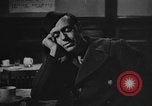
A U.S. Army soldier seated on a chair takes a nap. A cup kept in front of him on the table. Children walking on sidewalk in small town America. Downtown view of small Indiana town. View of an American family of a small town seated in dining room for a dinner meal. Children exit a one room school house. Both a well-kept high school building and a rural simple school are shown, with boys and girls in bare feet exiting the poor rural school down a wooden ramp. Men lined up for work. Children playing in slum and tenement areas in poverty stricken areas. Quick views of skyscrapers, new schools, buildings, colleges (including view of Rice University in Houston Texas) and art galleries in the United States, including the National Gallery of Art entrance. A Texan in a cowboy hat delivers a John Randolph famed "Texas Brag" saying, "If all the hogs in Texas were one big hog, he could dig the Panama Canal with three roots and a grunt.” The National Gallery of Art in Washington, D.C. Labor organizer John L. Lewis, president of the United Mine Workers of America (UMW) states, "The American Federation of Labor can help if it will, it can uphold anything, but we shall carry on." An American town hall meeting in progress. (World War II period).
CRITICALPAST.COM: About Us | Contact Us | FAQs - How to Order | License Agreement | My Account | My Lightboxes | Shopping Cart | Advanced Search | Featured Collections | Website Terms & Conditions | Privacy Policy ©2026 CriticalPast LLC.
License Agreement |
Terms & Conditions |
Privacy Policy
©2026 CriticalPast LLC.