


 Francais
 Deutsch
 Italiano
Refine Your Search
Coney Island New York 1898 stock footage and images
- Showing 9691 to 9696 of 11283 results more
more Hide
Hide
Nixon-Agnew election campaign stresses on choosing the right leader in United States.
Richard Nixon-Spiro Agnew election campaign for the office of Presidency in United States. A huge crowd gathered at Democratic National Convention. Hubert Humphrey is seen.Civil unrest. Fallen soldier in Vietnam. Ammunition dump in the jungle. People stand with the U.S. flags. A sign reads 'Illinois'. A sign in the background reads 'NBC News'. A fire in a building. People protest on streets. Hubert Humphrey gives a speech. Dead bodies of United States soldiers. Sandbags in the background. Damaged material lay on the ground. Unemployed citizens and poor people in United States. A man stands in a building. A woman with her child sits on chairs. The campaign stresses on choosing the right leader in United States. (Vietnam War period).
Bud Wilkinson invites Richard Nixon in front of a panel in a television program, Michigan, United States.
Presidential candidate Richard Nixon appears in front of a panel in a television program, Michigan, United States. The television program is named 'Man in the arena'. A panel sits in the center of the studio. The panel of citizens consists of a columnist, a news editor, a man from a community center, a housewife, a student, a dermatologist and a Public Relation Counsel. Audience seated in the studio. Bud Wilkinson acts as a moderator. Audience applauds Richard Nixon as he enters the arena. Richard Nixon introduces George Romney, Governor of Michigan and his wife. Nixon also introduces his wife and two daughters. Judd Arnett asks him about his program plans. Nixon answers that he will start programs for jobs, tax credit to private enterprises and houses for citizens.
Nazi leaders honor German civilians with awards. Principal honoree reviews honor guard in Court of Honor (WW2)
Reich Marshal Hermann Göring returns salutes with his baton, as standing audience of mixed military and civilians render Nazi salutes while he leads a cadre of officers down the center aisle in a full auditorium at the new Reich Chancellery in Berlin during World War II. At the front of the assembly he greets young German officers. Next, uniformed men, holding flags of various organizations, stand before a Nazi banner backdrop. Next a woman is seen smiling and shaking hands with Albert Speer, as she receives an award from him. Change of scene shows German Field Marshal Wilhelm Keitel pinning War Merit crosses on civilians. Then, Hermann Goering is seen from behind as he shakes hands with a woman who has just been awarded the War Merit Cross. Goering speaks to an old woman who has just received an award. A middle-aged civilian man is led to the front of the auditorium, where a citation for his award is read aloud by an officer in the background. Views of the audience listening. A young officer places a ribbon with decoration around the neck of the man. Glimpse of the flag bearers at front of the auditorium. Hermann Göring steps forward to personnaly shake award recipient's hand. Drummers in a German Army band begin to play in the courtyard, as this last award recipient is led out of the hall by Goering, past a very large honor guard of Army and Navy personnel in The Honour Courtyard.(The statue by Arno Breker called "The Army" is seen near the doorway.) Goering and the awardee walk past the honor guard formations. As they draw closer to the camera in the courtyard, the award can be seen around the neck of the recipient. It resembles an eagle with wings outstretched, upward.
Plenipotentiary French Army General visits Levant States and calls a press conference (WW2)
French Army General Beynet in Beirut, Syria during World War II. General Raymond Humblot and General Beynet talk and listen to radio news. General Humblot dials radio. He is Commander-in-Chief of French troops in Levant States. He leaves Residency and after conference with General Beynet gets into a car. Druze Guard presents arms as the car drives through gardens. They play trumpets. Plate at entrance of building reads 'Here was proclaimed on September 1, 1920, the independence of Great Lebanon'.
Alaskan railroad re-opened by United States Army in World War 2, to carry supplies.
Supplies are carried by trains and trucks in Alaska. Ships unload food and supplies at Skagway, Alaska. Smoke rises from smokestack of the ship. Men unload the supplies. Train of the Yukon railroad, under operation by the United States Army is loaded with food and supplies for troops guarding arctic outposts in World War II. A Yukon Railroad train moves along railroad tracks. A sign reads "Whitehorse, Yukon" at the Whitehorse stop in Yukon territory of Canada. Truck on the new Alaska Truck Highway passes by with freight it received at Whitehorse.
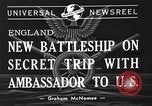
Lord Halifax travels aboard HMS King George V on a secret trip to United States during World War 2.
Lord Halifax arrives in United States aboard a new British warship. British Ambassador to United States, Lord Halifax travels aboard HMS King George V on a secret trip. Lord Halifax and his wife aboard the ship. Sailors stand on deck of the ship. United States President Franklin Roosevelt meets Lord Halifax before the warship reaches the port. Lord Halifax and his wife give a speech. Lord Halifax states that it was a great honor as President Roosevelt came to meet them.
CRITICALPAST.COM: About Us | Contact Us | FAQs - How to Order | License Agreement | My Account | My Lightboxes | Shopping Cart | Advanced Search | Featured Collections | Website Terms & Conditions | Privacy Policy ©2026 CriticalPast LLC.
License Agreement |
Terms & Conditions |
Privacy Policy
©2026 CriticalPast LLC.