


 Francais
 Deutsch
 Italiano

Refine Your Search
Coney Island New York 1898 stock footage and images
- Showing 9751 to 9756 of 11283 results more
 Hide

Russian Bolshevik leader Vladimir Lenin reviews marching Russian troops in Moscow, near time of Russian Revolution.
Clip features multiple views of Soviet leader Vladimir Lenin near time of Russian Revolution. However, opening scene is from 1923, showing cars parked near the Kremlin in Moscow during time of the XII Congress of the Russian Communist Party which Lenin did not attend due to illness. Views of office and desk area. Russian Bolshevik leader Vladimir Lenin in his office. Lenin reviews an honor guard after the October Revolution by the Bolsheviks in Russia. Soldiers salute Lenin during a ceremony at the Red Square in Moscow. Soviet workers at a ship port, working to load goods onto ships at harbor. More scenes of Lenin viewing soldiers including some who appear to be new recruits marching and undergoing drills in training. Lenin leans out of train car or truck and talks with his secretary sitting in his wagon. Soviet Russian soldiers assembling near Kremlin in Soviet Union.
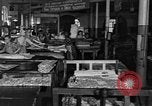
People in Moscow, Russia, return to civilian pursuits and ending war time production following end of World War II
The end of World War 2 is reflected in cheerful faces as Russian women workers fold bolts of cloth at a fabric plant. Civilian production has started up again as factory workers and production turns from war production to peace time commerce. Scenes of new ZIS 110 luxury automobiles being manufactured on a Russian production line. Soviet workers place a hood on a car. Mechanics check engines of cars. Cars move along assembly line. A marriage ceremony in the countryside. An artist makes painting of Soviet leader Joseph Stalin. A crowd of civilians cheers and waves their hands as a parade procession passes through streets. Marchers carry large portrait of Joseph Stalin. Girls greet war heroes with flowers as the parade moves along a tree-lined boulevard, stopping at an equestrian statue, where the portrait of Stalin is placed.

Newspaper headlines about death of Vladimir Lenin and Soviet leaders near his dead body at Lenin's villa in Gorki, Russia.
Vladimir Lenin dies at Lenin's villa in Gorki, Russia. Russian newspapers publish the news of Lenin's death. Thick snows cover on roads, houses and trees. The dead body of Lenin at his home. A chandelier in the house. Soviet leader Leon Trotsky stands near the dead body of Vladimir Lenin.

Two handmade 1946 model Ford cars in their two and four door variants during their test drive on roads in Detroit, Michigan (WW2)
Two handmade 1946 model Ford cars during their test drive on roads in Detroit, Michigan. Four and two door models of the Ford car during their exhibition run. Narrator describes the post war production effort for new Ford cars and speaks to how Ford had not forgotten cars for American consumers after retooling following its war production work in World War II.
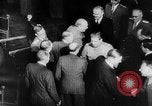
Allied leaders at the Potsdam Conference and military and police patrol East Germany after the partition of Germany.
New government formed in Germany after the defeat of Nazis during the World War II. Leaders of the Allied nations meet and talk during the Potsdam Conference. Stalin, Truman, and Churchill seen greeting each other. Soviet Marshall Joseph Stalin's partition plans and aspirations shown on a map. Russian troops march in East Germany and Stalin and Khrushchev with other communist leaders of East Germany review a parade. Military and Civil Police guards march on roads of East Germany. Women police officers during the patrols. An investigative police officer or Stasi police escorts a detained civilian through a doorway marked, "Untersuchungs Haftanstalt Wittenberge" (Investigative Detention Wittenberg).

Richard Moore testifies during hearings of Senate Watergate Committee on Watergate scandal
Hearings of Senate Watergate Committee on the Watergate scandal in Washington DC. Richard A. Moore, Special White House Counsel, testifies before the committee chaired by Senator Sam Ervin. The Assistant Chief Counsel Terry Lenzner questions Moore. Subjects discussed include White House meetings as Linzner attempts to show that Moore knew more than he claimed to know. Moore stuck to his story that Nixon knew nothing about the Watergate cover-up until John Dean told him about it. The chairman Sam Ervin thanks counsel Moore and declares a recess. News anchor Douglas Kiker reports about the committee hearings.
CRITICALPAST.COM: About Us | Contact Us | FAQs - How to Order | License Agreement | My Account | My Lightboxes | Shopping Cart | Advanced Search | Featured Collections | Website Terms & Conditions | Privacy Policy ©2026 CriticalPast LLC.
License Agreement |
Terms & Conditions |
Privacy Policy
©2026 CriticalPast LLC.