


 Francais
 Deutsch
 Italiano

Refine Your Search
Coney Island New York 1898 stock footage and images
- Showing 10021 to 10026 of 11281 results more
 Hide

Film depicting threat of disease due to destruction of German infrastructure at end of World War 2. Populace treated with DDT.
Scenes of destruction in Germany at end of World War II, including Destroyed dwellings and rubble and rubbish-filled bomb craters. A U.S. soldier medic steps across a destroyed structure. German citizens line up to obtain water from a small tank trailer. A bucket being filled. A German civilian work crew laying new water pipes. A large trash heap displaying a sign in German reading: Drinking strictly forbidden. Danger from Typhus!(Trinken Strengstens verboten. Typhusgefahr!). Germans wearing gas masks as they lead horses drawing corpse-laden carts, along a road. Allied military spraying German civilians with DDT (Dichloro-Diphenyl-Trichloroethane) at a delousing station. They give each treated person a certificate certifying their treatment. The treated include men, women, and many mothers with their children. A nurse holds a small child as the mother is treated.
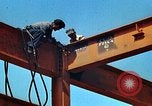
American people working, enjoying recreational activities, and voting in the United States after World War 2
A film about contribution of the U.S. Navy personnel for better life of Americans in the United States after World War II. Scenes of former soldiers, sailors, and military personnel returning to civilian life after the end of World War 2. Men drill on metal structure erecting a new building. Men load sacks in a cart. A man works on a typewriter. People worship in churches. A couple sits on a swing. A man plays chess. People read newspaper sitting outdoors. A man fishing in a river. Men play golf. People on a sailing yacht. Paintings displayed on a wall. A statute in a garden. A man sits on his front porch, plays guitar and sings. A jazz band of African American musicians plays music including piano, drums, clarinet, bass, trumpet (playing part of song "Pop goes the Weasel."). Piano player is smoking a cigarette while playing. Audience watching an orchestra play on stage. A man speaks and presents his view to a gathering. Exteriors of a church. People walk out of the building. Children play on swings in a school playground. Children inside a house run down stairs to the Christmas tree on Christmas morning. A woman drops her completed ballot in a ballot box on voting day, as a man waits to receive his ballot. He enters a voting booth and a uniformed police officer closes the curtain behind him. View shows him marking a check box on the ballot document.

Milo Burcham operates propeller switches, a circuit breaker and a booster pump of a P-38 Lightning aircraft in the U.S.
A film about the United States Army Air Force Lockheed P-38 Lightning aircraft in the United States. The instruction version of the P-38 aircraft. A new recruit talks to American aviator Milo Garrett Burcham. Burcham sits in a cockpit. He operates the brakes to control the speed of the propellers. Propeller switches are operated to control revolutions per minute (RPM ) of the aircraft. Warning lights glow. A circuit breaker trips up as a short circuit occurs. The circuit breaker is pushed down. The aircraft taxis. Propeller system is operated, a booster pump is switched on and toe brakes are held. The brakes are applied to get the desired speed. Manifold Pressure Gauge on a panel. The aircrafts takes off. The warning lights blink. The circuit breakers trip. The RPM gauge shows increased propeller speed. The RPM is reduced to desired value. A circuit breaker switch is pushed. The aircraft in flight. The pilot operates handles and switches for single engine operation in case of an engine failure.
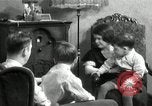
A family at home, in Chicago, Illinois, listening to their radio
A typical American family gathered around their radio, at home. This is the Springer family in Chicago, Illinois. Mr. George N. Springer and Bernadette Wiley Springer are seated on chairs in a living room with their children, George and Arthur, as they listen to their large wooden console radio. George tunes the radio. A close up of Bernadette with her child, Arthur. (This was filmed in their home on 79th Street in Chicago. George worked for the Daily News in that city.)

Vehicles drive past on a road and a puddle of water alongside the road in Vietnam.
Vehicles move on a new road from Bien Hoa to Saigon, in Vietnam. This highway was the main link between the main military airbase at Bien Hoa, and the capital, Saigon. Cars, an auto rickshaw and a van drive past on the road. A puddle of water alongside the road.Travelers ride motorbikes. Trees in the foreground. Heading towards Saigon from Bien Hoa, the South Vietnamese National Military cemetery (equivalent to U.S.Arlington cemetery) is visible, on the right hand side.
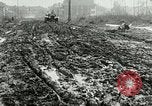
Effects of Ford Model T automobiles on American life; scenes of early road and highway development and sightseeing trips
A man driving a 1917 Ford model T roadster along a severely rutted mud-filled street. A 1917 Ford Model T, one ton truck, trapped in mud. Frustrated driver gets out and kicks a rear tire. Road building crews at work with horse-drawn equipment. Road construction with large steam powered machinery. A 1917 model T roadster driving along a new smooth concrete road. Women making purchases at a sidewalk stand and placing them into their Ford Model T sedan. A doctor arrives at house of a patient, in a Ford Model T roadster. Americans driving Ford Model T cars in the National Parks circa 1920s. Cars driving past a giant redwood tree. Man in a Ford Model T stopped beside woods and feeding a bear in a National Park, as a Park Ranger stands nearby. Ford Model T driving through the tunnel cut in the "Wawona" giant sequoia tree, in the Mariposa Grove of Giant Sequoias at Yosemite National Park. A 1918 Ford Model T touring car parked at a picnic site, with family sitting at picnic table nearby. Families with Ford Model T cars, engaged in outdoor activities, picnicking, and gathering wild flowers. Two men making their Model T into a shelter for overnight camping. Family picnicking at a beach; their Model T parked on road above. A man in a 1920s era swim suit carries a basket for a picnic to others in his family seated near rocks. 1920s or 1930s boy and girl children playing on a beach; picking up seaweed; and wading in the surf, near large rocks.
CRITICALPAST.COM: About Us | Contact Us | FAQs - How to Order | License Agreement | My Account | My Lightboxes | Shopping Cart | Advanced Search | Featured Collections | Website Terms & Conditions | Privacy Policy ©2026 CriticalPast LLC.
License Agreement |
Terms & Conditions |
Privacy Policy
©2026 CriticalPast LLC.