


 Francais
 Deutsch
 Italiano
Refine Your Search
Coney Island New York 1898 stock footage and images
- Showing 10147 to 10152 of 11282 results more
more Hide
Hide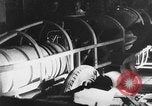
Rocket cars developed at the German Heylandt factory in Berlin-Britz, Germany
Momentary opening slate (in German) cites a new rocket car, the largest in the world, designed by German chief engineer Alfons Pietsch. Closeup of the liquid-fueled rocket car at the Heylandt factory in Berlin-Britz (Heylandt-Gesellschaft für Apparatebau mbH). The rocket engine is ignited and creates a huge flame behind the car. It travels for a while in the industrial yard of the Heylandt factory until the flame dies. (Note: At the beginning of 1930, rocket engineer Max Valier was given the opportunity to develop a liquid rocket engine at Heylandt in Britz. He was assisted by the Heylandt development engineers Alfons Pietsch, Walter Riedel and Arthur Rudolph, who built the rocket motor in a test vehicle called "hellhound" after Valier's accidental death in May, 1930.) Change of scene shows a rocket car of Max Dalier being refueled from a liquid oxygen tank. Next, the car, with "Heylandt" painted on its side, is seen with Max Valier at the controls, driving about the Heylandt factory grounds, propelled by a moderate thrust from its liquid fueled engine. It circles about the yard several times.
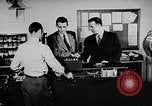
Instructor briefs Secret Service agents about treasury check fraud and protection of the President during tour in Washington D.C.
Activities of the United States secret service agents in Washington D.C., United States. Scenes of citizens in different places: U.S. soldiers ascending a coastal hill. An elderly couple wearing coats and seated on the deck of a ship at sea. A farmer using a tractor to plow a farm field. A sidewalk filled with pedestrians in a busy city, with some entering doors of an office building. View of U.S. Treasury issued checks being printed in a stack by a machine. Woman presents a check for cashing. Narrator talks about ways of verifying identity for check cashing and notes that all documents can be forged, and that another person vouching for someone's identity is preferred. View of Social security card which is is not meant as a personal identification for cashing checks. A man trying to cash a check fraudulently approaches a grocer and presents his check for his purchase. The grocer doubts him and asks him questions. Close-up view of part of U.S. Treasury issued check. Man is unable to answer the grocer. Grocer calls up policemen. Police conducting fraud investigation and asking questions of the accused in a a police department interview room. His answers are recorded on a lie detection machine (polygraph machine). Secret Service agent instructs a new agent about forgery practices. They open drawer and look at cases the secret service agency has. Chief tells that a primary job of the secret service is the protection of the President. They arrive at the White House to get the details. Uniformed White House police stand at entrance. Secret Service agent on the White House executive mansion and ground. Portraits of the various Presidents of the United States. Local police help the secret service agents. Police and Secret Service make a security plan about an upcoming Presidential visit for a banquet. They are seen reviewing building maps and paths of travel. They keep a record about the routes of travel and timings. Buildings are inspected and preparation of food is supervised before the President visits.
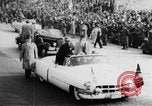
Secret service agents classify and analyze threatening letters sent to the President before his motorcade in Washington D.C.
Activities of the United States secret service agents in Washington D.C., United States. President Dwight D. Eisenhower rides in an open cadillac convertible car,in a motorcade through streets, as Secret Service agents walk alongside. Important part of protection is classification and analysis of the threatening letters sent to the President. Letters are processed in the units of secret service known as the Protective research section. At the hand writing classification section, writers posing potential danger to president are identified. New letters are compared with previously received files and investigated.
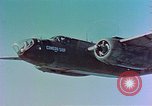
USAAF Martin B-26 medium bomber is seen in during an extended sequence. An old farm building is blown up.
Extended sequence showing closeup of a U.S. Army Air Forces Martin B-26 Marauder medium bomber in flight, photographed from another aircraft flying in formation. "Camera ship," is painted on the plane's fuselage, below the cockpit. Pilot, copilot, and crew member in nose are clearly visible. As the sequence progresses, clouds appear above and the ground below. The nose position is now empty. The B-26 continues in flight over varied terrain including hills, agriculture field, and a large town. Scene shifts to a loose formation of 7 B-26s in the distance. Next, a new sequence shows open field with patches of shrubs and trees. A dilapidated farm building seen in foreground. It explodes with fire and smoke. As the smoke drifts away, only debris is seen remaining. Cause of the explosion is not evident from the film. (World War 2 period).
Large crowd gathered at Trafalgar Square to celebrate Victory in Europe day in London,England at the end of World War II.
Victory in Europe Day celebration in London, England at the end of World War II. Crowd gathered watches two Norwegian soldiers seated on top of a monument waving flag of Norway. American soldiers walk holding American flag. Men gather beside an “Evening News” van. Flags flutter in wind atop a building. French cosmetics company Bourjois advertisement unrolls from building which reads 'Bourjois Creators of Fine Perfumes and Toilet Soap'. Crowd gathered at Trafalgar Square for Victory in Europe (V-E) day celebration. They hold British flags in Trafalgar Square (Trafalgar Sq, London WC2N 5DN, United Kingdom). Children seated on shoulders of their parents. View of the Big Ben in London.
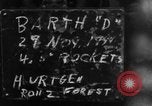
American soldiers aboard trucks mounted with multiple rocket launchers in Hurtgen Forest,Germany during World War II.
Soldiers advance in Hurtgen Forest,Germany during World War II. Soldiers get into trucks mounted with multiple rocket launchers. They move along the edge of the forest to new positions. Trees in the background.
CRITICALPAST.COM: About Us | Contact Us | FAQs - How to Order | License Agreement | My Account | My Lightboxes | Shopping Cart | Advanced Search | Featured Collections | Website Terms & Conditions | Privacy Policy ©2026 CriticalPast LLC.
License Agreement |
Terms & Conditions |
Privacy Policy
©2026 CriticalPast LLC.