


 Francais
 Deutsch
 Italiano

Refine Your Search
Coney Island New York 1898 stock footage and images
- Showing 10327 to 10332 of 11281 results more
 Hide
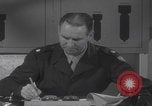
Incendiary bombs moved from United States to England during WW2.
Chemical Warfare Service (CWS) handles the distribution of incendiary bombs in Europe during World War II. Lieutenant Colonel R. N. Isbell of the Chemical Warfare Service (CWS) makes calculations from his desk. An incendiary order addressed to the Commanding General is typed on a typewriter. Buses arrive at the motor pool of the United States War Department, now known as the Pentagon. Women disembark from the buses and head to the War Department. Employees working in the office inside the War Department. Men prepare bombs at an arsenal. Men hauling carts with large incendiary bombs in warehouse. A man stencils labels onto bomb that read, "PT-1 Incendiary," and "Bomb Burster." The United States flag waving on a ship. Ships carry a shipment of incendiary bombs to the United Kingdom. Incendiary bombs inside wooden crates are unloaded from ships. Steam locomotive train running on track as railroad signal activates. Incendiary bombs are removed from train cars. Two munitions are suspended on a crane. Trucks loaded with bombs drive out of the depot, passing past village cemetery. An Air Division Chemical Officer receives new shipment information. The Air Division Chemical Officer reads the document and updates bomb listings on chalkboard.
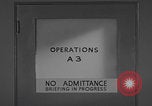
United States Eighth Air Force command headquarters WW2.
United States Eighth Air Force officials deliberate and issue field orders to drop bombs during World War II. Writing on the frosted glass door reads “Operations A3”. A sign in door reads “No Admittance Briefing in Progress”. Daily operations conference headquarters of the Eighth Air Force. The commanding general shares his plan of action. Map of the United Kingdom and Ireland is seen behind the general. The assistant of the commanding general uses a long stick to point to a wall map. Eighth Air Force officials review a map on the desk. An official shows the commanding general a place on the map. The general makes a decision. An officer from the general’s officer makes a call. Men and women using teletype to write field orders and messages. Operational staff of air division headquarters discuss important details regarding the new field order. Operational staff member points to a large wall map. Other officers listen during a meeting. The chemical officer puts down his phone after a call.

Test launch of the Model 601 and Model 602 missiles in the United States
Men stand at the entrance of the Boeing GAPA project building at the Holloman Air Force Base, New Mexico. A small high-velocity rocket is fired prior to launching. Launching of the Model 601 missile. Streak of smoke arises from the missile in the blue sky. Men using theodolite to track the rocket. A radar dish rotating while tracking rocket. Rocket smoke trail forming an arc-shape. The 602 Model missile launches from launchpad.

The funeral for British Commanding Officer Admiral Sir Bertram Ramsey (WW2)
A tribute to the passing of British Commanding Officer Admiral Sir Bertram Ramsey. Funeral of Sir Bertram Ramsey in Saint-Germain-en-Laye New Communal Cemetery during World War II. Sir Ramsey deliberating plans to invade Sicily with Field Marshal Bernard Montgomery in North Africa. Sir Ramsey exits a building with United States General Dwight D. Eisenhower before the invasion of Normandy. Sir Ramsey and General Eisenhower talking. Military officials and troops attend the funeral and internment of Sir Bertram Ramsey in Saint-Germain-en-Laye. The coffin of Sir Ramsey is draped with the Union Jack flag and is carried on a gun carriage on a snow covered road. General Eisenhower and other Allied generals attend the funeral march. British Auxiliary Territorial Service (ATS) women stand at attention in the snow. A chaplain leads the funeral service. Troops fire the three-volley salute during the military funeral. Dwight Eisenhower and other generals salute and pay their respects.
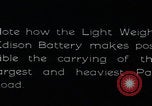
The rugged durability and characteristics of Edison Batteries under testing and in use.
A diagram compares the payload capacity between vehicles powered by lead battery versus Edison battery. A WW1 era United States battleship sailing in an ocean. Steel beams of a skyscraper under construction. Vibration testing of Edison battery to check durability under use. A man operating an electric motorized cart carrying packages crosses a train track and loses one of the packages. Animation demonstrates the benefits of the Edison Battery, noting that it can be overcharged, overcharged, and even reverse charged. Photo of Edison battery array in a control room. A ‘Mrs. Wagner’s Pies- The Wagner Pastry Co.’ Edison battery electric delivery van is started and drives in the midst of a blizzard, thus demonstrating battery resistance to freezing conditions. This is probably near Newark, New Jersey, headquarters for the company.
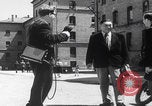
Dr. Sandcha Stepanow ; Kalmyk refugees work as artist, barber, and teachers in Ingolstadt, Germany
A photographer takes pictures of Dr. Sandcha Stepanow, a Russian-born lawyer and leader of the 600 displaced Kalmyks in Ingolstadt Displaced Persons Camp, West Germany after World War II. Dr. Stepanow meets with journalists in the camp. A Kalmyk family inside their flat in the refugee camp. A woman uses a sewing machine. The man plays with a young toddler. A woman tries on a new dress as a dressmaker adjusts the dress sleeves. An elderly Kalmyk man holds an infant playing with keys. An artist draws a charcoal illustration of an elderly man in traditional Kalmyk attire. A Kalmyk woman applies shaving cream on a man’s face at a barber shop inside the Ingolstadt Displaced Persons Camp. A Kalmyk man walks through The Kreuztor gate in Ingolstadt on his way to work. A German man greets the Kalmyk man. Displaced refugees, including a young woman, study at vocational training school in Ingolstadt. Kalmyk professor teaches in class. The Kalmyk instructor assists a man during a lesson.
CRITICALPAST.COM: About Us | Contact Us | FAQs - How to Order | License Agreement | My Account | My Lightboxes | Shopping Cart | Advanced Search | Featured Collections | Website Terms & Conditions | Privacy Policy ©2026 CriticalPast LLC.
License Agreement |
Terms & Conditions |
Privacy Policy
©2026 CriticalPast LLC.