


 Francais
 Deutsch
 Italiano
Refine Your Search
Coney Island New York 1898 stock footage and images
- Showing 10477 to 10482 of 11281 results more
more Hide
Hide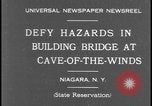
Workers build wooden bridges near Cave of Winds at foot of Niagara Falls
View of the Cave of Winds at base of Niagara Falls. Workmen build Cave of Winds wooden bridges while they endure rapids and dangerous water at the base of the Niagara Falls. Workman saws wood while covered with heavy mist at the base of Niagara Falls. Workman crawls carefully on wooden bridge to cross rapids. Heavy mist covers view of workmen in wooden bridges at Cave of Winds. Torrential rapids fall and mist covers the Cave of Winds and Niagara Falls.
The Guadalcanal campaign in World War II
Major General Alexander Vandegrift, USMC, who, as Commanding General of the 1st Marine Division, also commanded other U.S. military units involved in the invasion of Guadalcanal in World War 2. He discusses those joint U.S. military operations. The U.S. Destroyer, USS Blue (DD-387) seen bombarding Guadalcanal.A B-17 bomber overhead. U.S. Marines decend rope net into landing craft of the attack transport, USS George Clymer (APA-27), later seen with the USS Harry Lee (APA-10) and numerous landing craft around them. A landing craft from the Harry Lee arriving and Marines jumping out. Many U.S. troops wading ashore from landing craft. Troops carrying supplies ashore. Officers salute as American flag is raised on rugged flag pole. Numerous Japanese prisoners of war marching and in outdoor confinement. Japanese prisoners being processed. Japanese soldier using shoe clamps to quickly climb a tall palm tree. Admiral William Frederick Halsey, Jr.decorating a flyer with the Distinguished Flying Cross. View of the medal.Halsey decorating marines, including Major General Alexander Vandegrift, USMC, seen wearing the Navy Cross. Sign on palm tree reading: "Hospital Station C-1-Med." Wounded inside hospital tent. Troops gathered for religious service. U.S. troops dug in and moving along jungle path. Fallen Japanese soldiers on shore of Guadalcanal.Smoke rising from Japanese bombing of Henderson Field and construction continuing with heavy equipment. A B-17 bomber landing on the field. Names on B-17s at the field, including: "Spook," "Leis-Lady,"and "Boomerang." A Douglas SBD Dauntless aircraft taking off from Henderson field. Film concludes with parade of warships and overflight of warplanes (including a biplane).
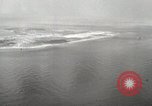
C-47 Skytrain aircraft in flight over water en route from Angaur to Leyte, Philippines. (WW2)
C-47 Skytrain aircraft in flight over water en route from Angaur to Leyte, Philippines. Aerial view of airstrips, ships offshore. Number of C-47 Skytrain fly in formation. (World War II period)
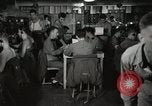
Interior of the Combat Information Center (CIC) aboard USS Mount McKinley, near Peleliu, Palau, during World War 2
Group of United States Navy sailors seated inside the Combat Information Center (CIC) aboard the USS Mount McKinley (AGC-7) during World War 2, during operations nears Peleliu, Palau in the Pacific. U.S. Navy sailors wearing headphones type dispatches on typewriters. They are lined up on either side of the Operations Room. Officers and sailors in the center of the room at a table process paperwork. Two sailors plot information on a radar plotting board.
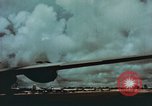
B-29 Superfortresses of the 314th Bomb Wing taxi to runway for takeoff during World War II.
U.S. B-29 Superfortresses of the 314th Bomb Wing, on Guam, during World War 2. They taxi to the runway for takeoff. B-29 Superfortress aircraft parked at North Field, Guam. Bombers seen taxiing include some displaying tail codes of Square O and Square P. Note: 314th Bomb Wing consisted of: 19th Bomb Group (BG) with tail code Square M; the 29th BG, tail code Square O, 39th BG, tail code Square P; and 330th BG, tail code Square K.
B-29 Superfortress aircraft of the 314th Bomb Wing taxi on North Field, Guam, during World War II
Several B-29 Superfortress bombers are seen taxiing for takeoff on North Field, Guam, in World War 2. Many B-29s, with Square O tail codes of the 29th Bomb Group, are parked on the field. The aircraft taxing include two from the 19th Bomb Group, one displaying the Square M tail code and one showing only its identifcation number : 42-93967. (This B-29 is named the "City of Lansford.")
CRITICALPAST.COM: About Us | Contact Us | FAQs - How to Order | License Agreement | My Account | My Lightboxes | Shopping Cart | Advanced Search | Featured Collections | Website Terms & Conditions | Privacy Policy ©2026 CriticalPast LLC.
License Agreement |
Terms & Conditions |
Privacy Policy
©2026 CriticalPast LLC.