


 Francais
 Deutsch
 Italiano
Refine Your Search
Coney Island New York 1898 stock footage and images
- Showing 10501 to 10506 of 11281 results more
more Hide
Hide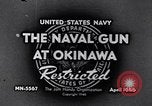
U.S. Fifth Fleet commanded by Vice Admiral Spruance, and U.S. 10th Army, commanded by Lieutenant General Buckner, at Okinawa.
Animation depicts Okinawa in relation to Japan,China,Formosa, and Iwo Jima. U.S. landing ships carry troops who make unopposed landings on Hagushi beach, U.S. troops seen pouring ashore. Okinawa. Lieutenant General Simon Bolivar Buckner and Vice Admiral Raymond A. Spruance seen looking through binoculars on the deck of the amphibious Flag Ship. U.S. troops move inland from the beachhead. Troops bringing bulldozers. U.S. Army infantry of the 24th Corps engage Japanese defenders. Japanese bunkers and fortifications seen. U.S. battleships and other ships of the line begin intense bombardment of the Japanese positions. U.S. army artillery fire large howitzers. U.S. tanks attack Japanese fortifications and suffer counter fire. Troop movements impeded by rain and mud. Ammunition ships seen having difficulty on congested beachhead. Animation shows how naval gunfire could successfully strike Japanese fortified positions because of flat trajectory. (World War II period).
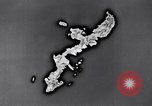
U.S. Battleships fire at Japanese defenses during the battle for Okinawa, Japan, in World War II.
U.S. Battleships fire at Okinawa, Japan. A map shows the area of operation of the land forces. 483 Japanese artillery pieces located in the area. U.S. tank destroyed by Japanese artillery fire. Japanese antiaircraft fire interferes with U.S. observation planes. U.S. naval gunfire from ships was able to destroy 120 Japanese artillery emplacements. An airplane in flight. Many views of U.S. naval gunfire. Views of destroyed Japanese heavy artillery.
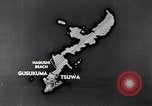
U.S. naval guns are directed against fortifications in Shuri and Naha, Okinawa
Main battery Battleship fire is directed against Japanese fortified towns of Shuri and Naha in Okinawa, Japan. They are pounded by 14 inch and 16 inch naval guns for two days. U.S. troops find a mass of rubble when they enter the city of Shuri. The city of Naha is pounded by U.S. naval heavy guns for 40 days and nights. Low level aerial views of destroyed buildings in Naha. U.S. assault on the Naha airfield includes fire from U.S. navy rocket and mortar craft, seen in operation. Views of U.S. ground forces maneuvering to capture the Naha airfield, using grenades, and flamethrowers. (World War II period).
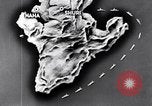
U.S.warships fire at Japanese targets during the battle for Okinawa, Japan.
Animated graphic shows how U.S. naval gunfire prevented Japanese forces from capitalizing on their extensive network of roads on Okinawa, Japan. U.S. navy rocket and mortar craft firing at Japanese positions. Animated graphic illustrates how U.S. naval forces surrounded the main force of Japanese defenders. Views of U.S. firing of star shells at night to illuminate Japanese targets. Many views of U.S. Battleship and Cruiser main battery firing at night and day. Stacks of expended 14 and 16 inch shells are seen on decks. Scenes of destroyed Japanese fortifications. (World War II period).
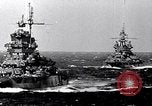
Role of U.S. Naval gunfire during battle for Okinawa, Japan, during World War II.
U.S. Battleships cruising in the Pacific. Close views of naval 16 inch gun barrels Navy personnel manning radio and teletype stations in a communications center. (They are shirtless, presumably due to heat.) They receive a message from General Bruckner, Commanding General, 10th Army, to Admiral Turner, Commander, Task Force 51,praising the active naval support for U.S. ground forces. Scenes of naval gunfire of all types. Japanese aircraft hit and burning. A U.S. naval 16 inch gun fires and produces a giant smoke ring.
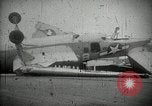
Damage to superstructure of U.S. Navy ship USS Register (APD-92) as a result of enemy suicide plane attack off Okinawa
Damage to superstructure of the high speed transport ship USS Register near Okinawa. The damage caused as a result of a Japanese kamikaze A6M zero fighter plane attack. Views of the toppled kingpost which the plane struck, and which subsequently crashed over #3 40MM gun (remains of it are shown). Welders cut away wreckage of kingpost and hoists. Section of mast bent over 40 mm gun mount. Fueling operations alongside. (World War II period).
CRITICALPAST.COM: About Us | Contact Us | FAQs - How to Order | License Agreement | My Account | My Lightboxes | Shopping Cart | Advanced Search | Featured Collections | Website Terms & Conditions | Privacy Policy ©2026 CriticalPast LLC.
License Agreement |
Terms & Conditions |
Privacy Policy
©2026 CriticalPast LLC.