


 Francais
 Deutsch
 Italiano
Refine Your Search
Coney Island New York 1898 stock footage and images
- Showing 217 to 222 of 11257 results more
more Hide
Hide
35th anniversary of Wright Brothers' first flight. Advances in travel due to rail and airplane. Howard Hughes' round the world flight.
Film notes 35th anniversary of Wright Brothers' first flight and reviews history of transportation and advances in transportation brought about by railroad and aircraft. An animated map of the United states before the advent of mechanized transport methods. It illustrates the difficult and long overland journey to travel from the East Coast to the West Coast. Travel by horse and wagon over the Santa Fe Trail in 1849 is recreated in a brief film clip. Next, a locomotive is shown pulling a passenger train at high speed along a railroad at the base of a mountain. Animated map charts fairly direct path from Coast to Coast, taking only 4 days by railroad. Next a nearly straight course is traced across the map illustrating the path of an airplane taking only seven and a half hours for the journey. Change of scene shows aerial view of Howard Hughes' Lockheed 14 Super Electra Special, Model 14-N2 ( NX18973), christened "New York World's Fair 1939," in flight over New York harbor with the skyline of Manhattan, New York City in the background. Camera follows the plane as it passes over lower Manhattan. The Empire State building is seen prominently with other skyscrapers below the aircraft. This was filmed, on July 14, 1938, as Hughes and his crew were returning from Minneapolis, Minnesota, to Floyd Bennett Field, on Long Island, at the conclusion of their around-the-world flight (circling the Northern Hemisphere) from July 10 - July 14, 1938.
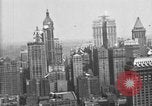
Oil products are used as a fuel for transporting goods and for cooking food in the United States.
Oil and petroleum products being used for different purposes in the United States. Low flying aerial view of skyscrapers in New York City. The Statue of Liberty. Aerial view of skyscrapers of Manhattan Island, New York City, including the Woolworth Building and the New York Municipal Building. A part of a wing of an aircraft seen in the aerial shots. Various uses of petroleum for transportation: A black locomotive train which uses petroleum as fuel is seen approaching camera at high speed, pulling train cars. A natural gas storage tank. Steam comes out of a kettle atop a vintage 1920's stove and oven, depicting use of natural gas as a fuel in homes.
Cold War commences in Europe and UN takes military action against North Korean aggression
Opening scenes show people of East Germany escaping from the Soviet-controlled zone, to the West, through forests. Whole families are seen carrying whatever they could in back packs and suitcases. Early in Korean War period: An animated map is inserted showing a map centered on Korea, with the 38th Parallel dividing Communist North Korea from South Korea. View of a line scratched in a dirt road, designating the 38th Parallel, leading to a temporary border with guard post, established for administrative purposes. View of Ducksoo Palace, in Seoul, Korea, headquarters of the United Nations (UN) Commission on Korea. Diplomats inside its chambers, trying (in vain) to negotiate the withdrawal of Soviet forces from North Korea. United States troops are seen evacuating from South Korea, after the establishment of the Republic of Korea. Carrying duffel bags and all their gear, they board trains to evacuation ports. General scenes of landscape and South Korean people going about their normal activities, under the new government. Smoke rising from surprise attacks by North Korea against the South. Republic of Korea (ROK) troops march to defend against the North's aggression. ROK troops in trucks and trenches fire small arms against the invaders. Huge numbers of refugees are shown fleeing the North. Soldiers raise international flags at the headquarters of the United Nations, in Lake Success, Long Island, New York. Inside, diplomats meet to deal with the crisis. View of empty place at the table labeled "Union of Soviet Socialist Republics." Warren Robinson Austin, U.S. Ambassador to the UN is seen as well as other UN representatives. (Narrator states that after its cease fire order had been ignored by the Communists, the Security Council voted for united military action against the aggressor, and provided for a unified command of United Nations forces.) View of the delegates voting with raised hands. U.S. General Douglas MacArthur is seen receiving the first UN battle flag. Aerial views of the Port of Pusan, Korea. The U.S. Navy transport ship, USS Pickaway (APA-222) is seen being moved by tug boats in the port. View of the troop ship loaded with American troops headed to the port of Pusan, Korea. Color guards waving flags of the UN, the U.S. and the Republic of Korea, as they lead a military brass band marching along the pier. Change of scene to American troops marching along opposite sides of a road in Korea, as jeeps drive in the middle. Troops, including ROK soldiers, engage North Koreans with small arms, mortars, machine guns and artillery field pieces. Back in America, troops parade along Constitution Avenue in Washington DC, with capitol building seen in background. American soldiers boarding a train. Camera focuses on shoulder emblem of a Canadian officer boarding a train and then shows Canadians marching to a port of embarkation. Turkish troops pass in review on their way to Korea. Troops of the Netherlands on the march. Australian troops assembled before sailing to Korea. Swedish doctors and nurses boarding a ship to Korea, where they will set up hospitals to treat the wounded. British sailors boarding ships for action in Korean waters. Glimpse of a British Colossus class aircraft carrier, underway in Korean waters. Views of other UN forces headed to Korea. The UN General Assembly building in Lake Success, Long Island, New York. View of delegates inside the building. Film ends showing a rotating globe of the world, with flags of Nations participating in UN actions in Korea, being shown as the globe passes their respective countries.

Wrecked ships, cars and a train after the Great New England hurricane of 1938
Damage due to the September 21, 1938 New England Hurricane (also called the Long Island Express Hurricane) in the United States. Buildings along streets in New York City in driving rain and winds. Cars moving on a street. Rain falling in the city and deep water ponding in roads. Rubble in the area. A large tree that crushed a car. Wrecked ships and boats along a coastal port. Men look at the boats, many of which are partially sunken or aground. Aerial view of wrecked cars and other vehicles. Destroyed bridges. Wind wrecked homes on coast. A wrecked train on a railroad line, derailed off the tracks.
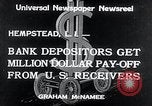
Bank depositors get a million dollar pay-off from U.S. receivers in Hempstead, Long Island.
Customers deposits are returned to them under the auspices of officials who have placed the bank under Federal Receivership. Depositors hadn't been able to make withdrawals,due to the National Financial Crisis. U.S. receivers in Hempstead, Long Island, New York. Interior of bank and people inside. An official speaks on 'repayment of frozen deposits in National bank'. He credits Federal Government for this positive action made possible by enactment of the Reconstruction Finance Commission Act and the Home Owner's Loan corporation Act.
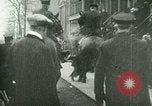
Policemen arrest suspected anarchists and transfer them by ferry boat to Ellis Island
The Palmer Raids in the United States during the so-called "Red Scare" period. Police in New York City arrest men and women, suspected of being anarchists and radicals. Police wielding clubs raid their homes, arrest them and place them in police vans. The arrested suspects are taken to Ellis Island by ferry for deportation.
CRITICALPAST.COM: About Us | Contact Us | FAQs - How to Order | License Agreement | My Account | My Lightboxes | Shopping Cart | Advanced Search | Featured Collections | Website Terms & Conditions | Privacy Policy ©2026 CriticalPast LLC.
License Agreement |
Terms & Conditions |
Privacy Policy
©2026 CriticalPast LLC.