


 Francais
 Deutsch
 Italiano
Refine Your Search
Coney Island New York 1898 stock footage and images
- Showing 2821 to 2826 of 11259 results more
more Hide
Hide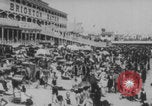
Brighton Baths and Beach, in Brooklyn, New York City
New Yorkers crowd the beach at Brighton Beach in Brooklyn NY. USA. Sunbathers in front of a building written with “Brighton Baths”. Two women, wearing black “Bathing dresses”, lying on the beach. People diving from a springboard and sliding from a water slide to a pool. Beachgoers taking a swim on the beach. Beachgoers swimming on choppy water. Two beachgoers securely hold on to a rope fence while waves crashing on the beach. A man waves his arms while sitting on another man’s shoulders before falling as waves crash on them and other rowdy beachgoers.
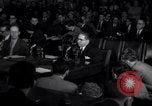
Excerpts from Kefauver Hearings in New York
Excerpt from Kefauver Hearings. Senate's Kefauver Committee investigating crime and interstate commerce. Panel including Chairman Kefauver (Tennessee) in the hearing along with other committee members Herbert R. O'Conor (Maryland); Lester Hunt (Wyoming); Charles Tobey (New Hampshire); Alexander Wiley (Wisconsin). Microphones are placed in front of the members of the Committee. A witness has begun testifying, when people present in the hearing room are told that no demonstrations are permitted, Cameramen take pictures. Another witness appears briefly.Then, FBI Director, J. Edgar Hoover, and his assistant, Louis B. Nichols, appear before the Committee. Hoover is silent. Mr. Nichols does all the testifying. He discusses issues with gambling, narcotics, prostitution. Discussion of effect of crime news on children.
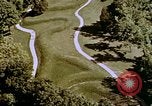
Various Buildings, Monuments and Landmarks of United States.
Views of various projects depicting man's creative engineering skills across the United States, including: The Indian Serpent Mounts, Ohio; Phoenix Mutual Life Insurance Headquarters, Connecticut; Mackinac Bridge, Michigan; Green Bank Radio Astronomy Antenna, West Virginia; Tanker "Manhattan" in the Northwest Passage; Chicago's Marina Towers, Illinois; NASA launch complex 39 in Cape Canaveral, Florida with a rocket in place; Watts tower, California; John Hancock Building, Illinois; Washington Monument; Dworshak Dam while under construction, Idaho; Newport Bridge, Rhode Island; U.S. Steel building, Pennsylvania; Mt. Glory Arch Bridge under construction in Wyoming; Johnson Wax Headquarters building, Wisconsin; Boeing 747 Factory Building Complex, Seattle Washington; A model of the proposed New Orleans Super Dome in Louisiana; Chesapeake Bay Bridge Tunnel; Dulles International Airport, Virginia; Tyrone Guthrie Theatre, Minnesota; Westinghouse Headquarters building, Pennsylvania; Rio Grande Gorge Bridge, New Mexico; Gulf Life Tower, Florida; Annunciation Greek Orthodox Church, Wisconsin; a paddle style River boat on the Ohio River; an artist depiction of the under construction Mobile River Highway Tunnel, Alabama; the Westinghouse Desalinization Plant, Florida; Model of master plan for the city of Gary, Indiana; Gulf Oil's "Big Brutus" crane at work on a dig site (The 160-foot tall coal shovel known as the 1850-B was designed and built by Bucyrus-Erie in Hallowell Kansas, for the Pittsburg & Midway, or P&M Coal Mining Company. It is the only one of its kind ever built. The mining company was purchased by Gulf Oil in 1963, and subsequently went under The Chevron Mining umbrella); Knights of Columbus headquarters building, Connecticut.
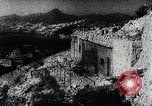
Japanese troops occupy Hong Kong after British forces surrender on Christmas day 1941 (WWII)
The Japanese occupation of Hong Kong following British surrender on Christmas day, 1941 (World War II). Japanese propaganda newsreel, narrated in accented English: Japan occupies the entirety of Hong Kong and British surrender on December 25, 1941. Destroyed British island defenses including bunkers and pill boxes. Wrecked buildings and oil storage tanks in Hong Kong. Japanese troops pose as a group and shout “Banzai” for the camera. Destroyed British tanks and artillery. British military prisoners gathered in a courtyard. Japanese officer inspects captured artillery. Japanese troops pile up shells from surrendered British forces. Captured British soldiers and sailors crowd British officers exit the "New Oriental Building" (Formerly 2 Connaught Road, Central, Hong Kong) after surrender discussions with Japanese forces. White flag hoisted on top of the New Oriental Building. Aerial view of Hong Kong area. Japanese aircraft in formation over the city making their formal occupation entry. Japanese troops parade through the streets with commanding officers on horseback.
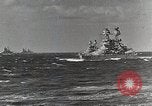
Montage of scenes related to the China-India-Burma theater during World War II
Two U.S. Pennsylvania class battleships underway at sea, with other warships in background, during World War 2. One fires to starboard with her 14-inch guns from the forward triple turrets. U.S. Army Air Forces B-24 Liberator bombers flying in formation over mountains. Glimpse of General Douglas MacArthur with General Joseph (Vinegar Joe) Stilwell in gunner's station of a bomber. Montage of brief glimpses showing U.S. forces engaging Japanese forces in: amphibious assaults; firing weapons in New Guinea and other Pacific islands. U.S. warship firing naval guns. U.S. ship firing at attacking Japanese aircraft, with sky full of black flak clouds. Admiral William (Bull) Halsey. Mitsubishi A6M Zero kamikaze aircraft blown up close to flight deck of U.S. aircraft carrier. It misses the ship and crashes in flames, exploding in the water, astern. U.S. General Joseph Stilwell, Madame Chiang Kai-Shek, British Allied commander Lord Louis Mountbatten, and Chinese Generalissimo Chiang Kai-Shek, photographed together in India. Chinese Generalissimo Chiang Kai-Shek seated for a picture with U.S. President Franklin D. Roosevelt. Camera moves back revealing British Prime Minister Winston Churchill, and Madame Chiang Kai-Shek, also seated. Behind them stand key allied military leaders, including (from the right) Field Marshal Archibald Percival Wavell, Commander-in-chief in India; Admiral Louis Mountbatten, Supreme Allied Commander of South-East Asia forces; George Giffard — commander of Eleventh Army Group; U.S. General Daniel Isom Sultan, deputy to General Stilwell; General Joseph Stilwell, Commander China-Burma-India (CBI) Command; and General Albert Coady Wedemeyer, Chiang Kai-Shek's Chief of Staff. General Joseph Stillwell is seen stepping from a military cargo plane, and being greeted by another officer. Stilwell is wearing a campaign hat. He has the CBI patch on his jacket shouder. A B-24 Liberator bomber takes off from a Chinese base at Liuchow, or possibly, Luiliang, China. (ostensibly carrying Chinese soldiers to India for training). U.S. marked P-40 aircraft are parked beside the runway. They display the shark teeth nose art of the Flying Tiger All volunteer Group of Claire Chennault. But this is 1944 and the aircraft are from the U.S. 23rd Fighter Group. Chinese soldiers are seen being armed and trained in India, with modern small arms. They are also seen fording a river with military supplies and moving in jeeps through jungle-like settings. Various views of Ledo Road construction in Burma. bulldozers, trucks, caterpillar tractors, explosives and men are shown in construction work. A jeep rides along a muddy section of the new road while U.S. and Chinese soldiers patrol on either side to protect it. Allied soldiers firing a small field piece. A C-47 aircraft airdrops supplies to the road builders. General Stilwell, standing with a Chinese officer, looks skyward at the aircraft. A C-46 Commando plane taking off from a field in India carrying supplies. Men loading a jeep aboard a C-46, plus ammunition and other supplies. Rare sight of supplies being loaded into nose cargo compartment of the one-of-a-kind XC-108A transport plane (modified B-17 bomber, tail number 41-2593). A formation of USAAF C-45 transport aircraft flying "over the Hump." Chinese P-36 Hawk aircraft in formation demonstrate firepower. Newly trained Chinese pilots marching and walking on flightline where solid-nose B-25s and P-40s are parked. Chinese and American pilots wave to each other from their P-40 aircraft. A B-25 takes off flanked by two P-40s. Bombs being dropped by Chinese B-25s. Japanese ship being strafed by Chinese fighter plane. Chinese laborers at work building an airfield without machinery. A large group pull a paving roller by hand. Chinese troops in combat with Japanese forces. One firing a Czech ZB vz. 26 light machine gun. Madame Chiang Kai-Shek addressing the U.S. Congress, 18 February, 1943.
Construction of houses for people involved in defense activities and workers at industrial centers in the United States.
Film 'Homes For Defense' on the construction of homes for war workers under the Division of Defense Housing Coordination in the United States during World War 2. Houses constructed for soldiers and war production workers through the Federal Defense Housing Program. Houses for the people who construct planes, ships and guns for the protection of America. View of run down tenements and slum housing in a city or town. A car parked outside a house. Children stand near a fence outside the house. A map shows industrial centers. Men move to various industrial centers. Newport News: workers work on machinery for the Battle of Atlantic. Hartford: workers work on machine guns. Detroit: workers in an auto industry. Rock Island: workers in industry make coastal field artillery. Rolla Waynesville: army men at a training center. Corpus Christi: Army men at a new airfield to accommodate the expanding air force. Aircraft in flight. San Diego: workers construct planes in a factory. Signs of the various housing agencies that are doing a special job under the coordinated program.
CRITICALPAST.COM: About Us | Contact Us | FAQs - How to Order | License Agreement | My Account | My Lightboxes | Shopping Cart | Advanced Search | Featured Collections | Website Terms & Conditions | Privacy Policy ©2026 CriticalPast LLC.
License Agreement |
Terms & Conditions |
Privacy Policy
©2026 CriticalPast LLC.