


 Francais
 Deutsch
 Italiano
Refine Your Search
Coney Island New York 1898 stock footage and images
- Showing 3121 to 3126 of 11259 results more
more Hide
Hide
New Yorkers indulge in several activities to get relief from the scorching summer heat.
New York City residents deal with Summer heat by opening fire hydrants. Kids play in the water sprayed on the street. Young men driving an open top vehicle are sprayed with the fire hydrant. A woman crossing the street loses one of her shoes when it becomes stuck in the hot asphalt. Men and women drink chilled beer.
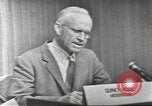
Vice President Nixon talks about Communist influence in the Western Hemisphere prior to presidential elections in the U.S.
The fourth presidential election debate held between Democratic nominee Senator John F. Kennedy and Republican nominee U.S. Vice President Richard Nixon in New York, United States on 21st October 1960. ABC news correspondent Quincy Howe speaks during the fourth Kennedy-Nixon presidential debate. He speaks that the candidates would answer and comment upon questions put by these four correspondents: Frank Singiser of Mutual News, John Edwards of ABC News, Walter Cronkite of CBS News and John Chancellor of NBC News. Frank Singiser puts the first question to Vice President Nixon. He asks Nixon the way he would handle Fidel Castro's regime and prevent establishment of Communist governments in the Western Hemisphere and why his policy is better for peace and security of the United States in the Western Hemisphere. Nixon answers that Senator Kennedy's policies and recommendations for the handling of Castro regime are dangerously irresponsible recommendations that he's made during the course of this campaign. Nixon speaks that what Senator Kennedy recommends is that the U.S. government should give help to exiles and to those within Cuba who oppose Castro regime, provided they are anti-Batista. Nixon says the United States have five treaties with Latin America, including the one setting up the Organization of American States in Bogota in 1948, in which the U.S. has agreed not to intervene in the internal affairs of any other American country. He further says that if the U.S. follows recommendations of Senator Kennedy then the country would probably be condemned in the United Nations and it would result in an open invitation to Soviet Premier Nikita Khrushchev to come into Latin America and to engage the U.S. in a civil war. He speaks about quarantining Cuban Prime Minister Fidel Castro by cutting off trade and diplomatic relations with Cuba.
New Soviet Leadership, following death of Stalin, makes public appearance in Red Square. Military parade
New Soviet leadership appears in public, following Stalin's death, in 1953. Russian Officers and troops in formation on Red Square in Moscow. Quick view of people assembled , in the evening, outside UN headquarters in New York. at sunset. View of Spasskaya Tower of Kremlin in Moscow. New Soviet Defense Minister, Bulganin, stands in open automobile, and salutes, as it moves along Red Square where Soviet troops line the way in formation. Huge sign with images of Lenin and Stalin displayed behind troop formation.Quick overview of Moscow, from a height. View of troops in massed formation seen from a height above Red Square. Civilian spectators in organized groups, dressed warmly against the cold. Top Soviet leaders emerge from inside the Kremlin to take their place in the reviewing balcony. Spectators applaud. Leaders including Nikita Khrushchev and Georgi Malenkov. Spasskaya Tower clock strikes. Bulganin is joined by a Soviet military Marshal, also standing in an open car. They drive about, reviewing the troops from the open cars. The cars stop and Bulganin and the Army Marshal get out. Defense Minister Bulganin, in military uniform of a Marshal, climbs to the Kremlin balcony and gives a speech. Cannons fire salutes.Sound track plays national anthem. Armored vehicles and troops fill a broad boulevard. Soviet armed forces put on a grand parade. Soviet leaders salute. Lavrentiy Beria stands to Bulganin's right and to his left, Malenkov and, his far left, Krushchev.
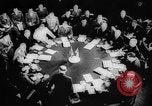
V-J Day: New Yorkers celebrate as President Harry Truman announces Japanese surrender during World War II.
Events surrounding the surrender of Japan during World War II. Scene from the Potsdam Conference meeting. Group of dignitaries together including Clement Attlee, Harry Truman, and Joseph Stalin. U.S. President Harry S. Truman and the General Secretary of the Communist Party of the Soviet Union, Joseph Stalin, in discussion. A parade in Moscow showing Soviet military might (these scenes are from the May 1, 1945 May Day parade just before Germany's surrender). Scene changes to Japanese Emperor Hirohito riding on a white horse in a procession. Next scene shows dignitaries arriving for meeting at the White House in Washington D.C. U.S. Secretary of War Henry Stimson, Secretary of State James Byrnes and Secretary of Navy James Forrestal meet at the White House. Close up view of Secretary Forrestal. View of President Truman with his cabinet in a meeting. Scenes from prior months showing dignitaries involved in the war: Close up of the late President Franklin Roosevelt. A scene of President Roosevelt shaking hands with several Soviet military officers. General Douglas MacArthur seated and talking to President Roosevelt. Close up view of Chairman of Nationalist Government of China, Chiang Kai Shek. View of U.S. Navy Admiral Chester Nimitz shaking hands with a sailor. Views of President Truman meeting in emergency session with his cabinet, and his announcement of the Japanese surrender. View of former Secretary Hull at that meeting. President Truman standing as he reads from a bulletin confirming the Japanese acceptance of the terms of the Potsdam Agreement and their agreement to unconditional surrender. View of media, press, and newsmen running from the White House to file the happy news story. New Yorkers rejoice at the end of war. Daytime scenes of happy, jubilant celebrations on Victory over Japan day, or V-J Day, in the Times Square area of New York City. Crowds cheering, people dancing, soldiers, sailors, and citizens waving hands and American flags. A neon sign with message "Japs Surrender". View of night time celebrations at Times Square as the crowd continues to celebrate VJ Day.
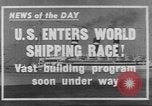
Joseph Kennedy proposes a plan to build new merchant ships to replace ships like the Leviathan in the United States.
A vast ship building program to be undertaken by the Maritime Commission in the United States. The newly appointed Chairman of the Maritime Commission Joseph P. Kennedy, speaks on the proposed plan to build new merchant ships. He emphasizes the necessity for a complete refurbishing of the Merchant Marine. Outmoded merchant ships built during World War I. Several ships docked at the New York harbor. People cheer and wave as the new ocean liner SS Rex sets sail. Flagship of the United States Line, the Leviathan, in dry dock. The British ocean liner Queen Mary leaves for Europe. Foreign merchant ships entering and leaving the harbor.
U.S. aircraft carriers USS Belleau Wood and USS Bunker Hill, and battleship USS New Jersey are launched in the United States.
Launch of two aircraft carriers and a battleship in the United States during World War II. People gathered at shipyards of New York Shipbuilding Corporation for the launch of the USS Belleau Wood (CVL-24). Sponsor Mrs. Thomas Holcomb seen with U.S. Marine Corps General Thomas Holcomb. Mrs. Holcomb christens the ship as it launches. Scene shifts to Fore River Shipyard in Massachusetts and launching of the USS Bunker Hill (CV-17). The aircraft carrier slides down skids into the water. Scene shifts to Philadelphia Naval Shipyard on the same day, December 7, 1942, as the launching ceremony for the Battleship USS New Jersey (BB-62). Carolyn Edison, wife of New Jersey Governor Charles Edison is seen christening the ship and it then slides into the water. Two boats underway in the background assist with positioning the Battleship.
CRITICALPAST.COM: About Us | Contact Us | FAQs - How to Order | License Agreement | My Account | My Lightboxes | Shopping Cart | Advanced Search | Featured Collections | Website Terms & Conditions | Privacy Policy ©2026 CriticalPast LLC.
License Agreement |
Terms & Conditions |
Privacy Policy
©2026 CriticalPast LLC.