


 Francais
 Deutsch
 Italiano
Refine Your Search
Coney Island New York 1898 stock footage and images
- Showing 3265 to 3270 of 11259 results more
more Hide
Hide
People eat and drink aboard the new streamlined luxury Mercury Train in Chicago, Illinois.
The New York Central Mercury locomotive and train designed by Henry Dreyfuss is seen in Chicago, Illinois. The modern, futuristic Mercury luxury railroad train moves down a track. Exterior views of the moving train as seen from another moving train and from stationary viewpoint. Interior view of the rear observation car. Passengers on board the Mercury train read newspapers while they are served by African American waiters. An African American bar tender shakes a flask to prepare cocktails at the bar. A man smoking a cigar on the train.

News media military analysts discuss the problems of Allies invading Europe to defeat Germany in World War II
Map of Europe and label "Invasion." Westbrook Van Voorhis leading a panel discussion about the problems arising from the Allied invasion of Europe in World War 2. He introduces panelists: Hanson Baldwin (military editor of the New York Times) Dewitt MacKenzie (Associated Press military analyst), and Paul Schubert (of Mutual Radio Network). He asks Mr. Baldwin about the importance of aerial bombing campaigns. Baldwin also stresses importance of a land invasion of Europe. Relief map of Europe highlighting major German cities. Asked about the merit of invading Italy on the way to Germany, Mr. Schubert cites the problem of the Alps and suggests other more effective invasion routes. Van Voorhis asks Mr. MacKenzie about best route into fortress Germany. He considers the criterion of ease of supply as most important, and suggests the Atlantic coast, near a good port and not far from England. Animated map shows this idea. When asked about this, Mr. Baldwin agrees completely, calling the conflict "a quartermaster's war." He adds, "The problem of victory is the problem of supply."
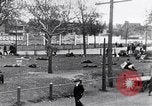
Homeless people and scenes of destruction after T. A. Gillespie Company Shell Loading Plant explosion
Displaced homeless people and refugees gather in grassy area near a railroad station, following explosion of the World War I shell loading facility. The T. A. Gillespie Company Shell Loading Plant explosion, sometimes called the Morgan Depot Explosion, occurred in October 4, 1918. The plant was one of the largest munitions facilities in the world at the time. Damage was extensive in the South Amboy and Sayreville area. Clip shows a refugee family posing together, sitting in the grass. Many billboard signs are on nearby fences and a grass and sidewalk area beside railroad tracks. The Perth Amboy Railroad Depot (train station) building on Smith Street is seen behind them (this building has since been moved to Lewis Street). With Martial Law imposed, the next scene shows a Coast Guard or Navy sailor on patrol to keep law and order and prevent looting in front of destroyed shopping area stores on Smith Street in Perth Amboy, including the Reynolds Brothers store (Reynolds Bros), at 134 Smith Street (also 136 Smith Street and 138 Smith Street), where the windows are blown out and debris are seen inside the store. The explosion of the Gillespie plant was one of three similar events in the New York-New Jersey area during World War 1: The Black Tom Explosion in 1916, the Kingsland Explosion in 1917, and then the Morgan Depot Explosion in 1918.

Radio reporter John Charles Daly reports on U.S. Navy in Pacific Front War under command of Admiral Nimitz (WW2)
(Audio only). Radio reporter John Charles Daly reports on U.S. Navy operations in Pacific Front War under command of Admiral Chester W Nimitz in World War II. News about bombardment of Okinawa and attack on Japan by U.S. troops. New York weather report and news about Easter celebrations. News about war in Italy.
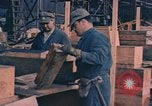
Keel laying and construction of the nuclear-powered commercial ship, NS Savannah.
Keel laying of the nuclear-powered cargo and passenger ship, NS Savannah, at shipyard of the New York Shipbuilding Corporation, Camden New Jersey. Mrs. Pat Nixon, wife of Vice-President Richard M.Nixon, is seen at the keel laying of the ship, a center piece in President Eisenhower's "Atoms for Peace" initiative. Scene at the Babcock and Wilcox company, where steel parts are being fabricated for the Savannah's nuclear reactor. The reactor head being molded. Uranium oxide fuel pellets being manufactured. Core filled with fuel pellets being lowered into the reactor. Animated diagram illustrates how the ship's reactor and propulsion system will work.View of shock-absorbing collision protection and radiation shielding being placed around the reactor shell. views of the ship under construction in the ways at the shipyard.Views of the ship's turbines manufactured by the De Laval Steam Turbine Company. A technician uses a brush to dust the precision gears of the DeLaval manufactured turbines. Meshed gears turning.
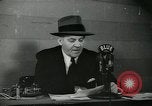
Walter Winchell 's radio broadcast about Nazi German atrocities (WW2)
Newspaper columnist and broadcaster, Walter Winchell, is filmed making a radio broadcast in New York City, United States, during World War II. He talks about the hard facts of war. He also states that any American who feels that America is being cruel to Nazi Germany should visit the American Military hospitals. He talks about the hardships and starvation suffered by women and children under German leader Adolf Hitler. There are several takes during this filming.
CRITICALPAST.COM: About Us | Contact Us | FAQs - How to Order | License Agreement | My Account | My Lightboxes | Shopping Cart | Advanced Search | Featured Collections | Website Terms & Conditions | Privacy Policy ©2026 CriticalPast LLC.
License Agreement |
Terms & Conditions |
Privacy Policy
©2026 CriticalPast LLC.