


 Francais
 Deutsch
 Italiano
Refine Your Search
Coney Island New York 1898 stock footage and images
- Showing 4051 to 4056 of 11259 results more
more Hide
Hide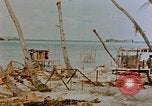
Wreckage on island after battle between marines and Japanese troops, Tarawa Island in Pacific.
Shores of Tarawa Atoll in Pacific Ocean. Wreckage on island. Trees after bombardment. Marines mill around. Tents put up on beach. (World War II period).

U.S. Nuclear test "Cherokee" in Operation Redwing, off Namu Island, Bikini Atoll, Marshall Islands.
First air drop test of a thermonuclear weapon. The Hydrogen bomb nuclear weapon was dropped from a USAF B-52 bomber (not seen) that flew from Fred Island, Eniwetak (sometimes spelled Enewetak or Eniewetok), on May 21, 1956. View appears to be from an aircraft flying above altocumulus clouds, below higher stratiform layers. The film begins with a complete whiteout from the initial fireball. As that subsides, local stratiform clouds take on a rosy hue and the center fireball is seen rising above them. As the fireball rises, it takes on a somewhat hemispherical shape, flat on the bottom, from which a straight stem-like column extends toward the ground. The light of the explosion slowly fades and complete darkness ensues. Official accounts state that the intended ground zero was directly over Namu Island, but the flight crew mistook an observation facility on a different island for their targeting beacon with the result that the weapon delivery was grossly in error. The bomb detonated some 4 miles off target over the ocean northeast of Namu. As a result essentially all of the weapons effects data was lost. ( Note: According to ancillary reports, the delivery error resulted in blast overpressures and thermal effects on the 6 structural response targets between Iroij and Namu Islands, greatly exceeding specifications for any use in scientific military modeling of high yield aerial detonations. Plans for graded damages analysis failed when all the structures collapsed. Effects cameras also failed from the intense fireball heat.)
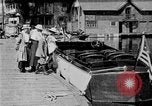
Tourists board sightseeing launch, and views of island and Chateau in St. Lawrence Island.
Tourist visit St. Lawrence Island. Tourists board the sightseeing launch. Views of island from the launch. Buildings on the island. Trees and greenery on the island. Large Chateau of some wealthy owner with yacht.
Icebreaker, USS Burton Island, reaches St. Lawrence Island, Alaska, during annual ice reconnaissance cruise
View from ice-covered bow of the icebreaker ship, USS Burton Island (AGB-1) moving northward into region of larger ice sheets. Several walrus off to starboard, sitting on ice flows and diving into the water. Rime ice getting heavier on the ship's railings as she begins breaking through ice sheets. St. Lawrence Island in the midst of ice. A welcoming committee of Siberian Yup'ik Eskimos from village of Savoonga arrive by dog sleds to greet the USS Burton Island. They are invited and climb aboard the ice-covered vessel, where they are seen gathered on deck. Several Women in their group are invited to climb to the ship's bridge, where they pose looking over the railing. The Eskimos walking out to their respective sleds and dog teams (the dogs look like husky or malamute). Several crew members from the USS Burton Island are taken on a dogsled rides by the Eskimos. Afterwards, those crew members are seen walking back to their waiting ship.
Equipment being unloaded with the help of a crane in the Aleutian Islands, Alaska during the Aleutian Islands Campaign.
The Aleutian Islands Campaign of World War II. U.S. Army Service Force (ASF) provides logistical support to fight the enemy. A flag of the United States. A United States Army Air Forces B-25 Mitchell bomber flies. Various goods like timber, vehicles being unloaded from a cargo ship with the help of a crane. A ship carries troops. Soldiers disembark from a ship. A soldier carries a guitar.

Scenes of U.S. Army Air forces operations on Adak Island during the Aleutian Islands Campaign of World War II
As film begins, organ music is heard. Camera pans across tops of tents showing sky above. Scene shifts to a Chaplain conducting Sunday services in the open. A soldier plays a field organ as soldiers and airmen participate in the service. Closeup of the Chaplain kneeling before a makeshift altar where objects are placed to facilitate communion in a mass or service. Complete change of scene shows airmen arranging bombs for loading aboard an open truck that then backs up to an airplane, into which they are loaded. Narrator notes that these are all purpose bombs weighing 250, 500, and 1000 lbs, respectively. Closeup of a 1000 lb bomb in foreground marked "GP 1000 lb AN-M44." Airmen arnorers install fins and fuses before loading the bombs aboard the aircraft. An airman loads belts of machine gun ammunition at a gun turret of the airplane. others load guns elsewhere on the aircraft. Closeup of pilots being given final briefing about the mission, before departure. Narrator notes that the mission will involve two flights of B-24s and one of B-17s. Planned altitudes and routes of the bombers are drawn on a map in colors. They are to attack a Japanese installation on Kiska Island. Fighter support is described. A Flight crew assembles near their B-24 Liberator bomber. Closeups of individual crew members waiting on the airfield ramp. Scene shifts to fighter pilots who will be accompanying the bombers. They converse in front of a row of fighter aircraft. They are wearing flotation gear over their flight suits. The area is paved with Marsden matting (pierced steel planking). Closeups of men in the group, including: Lieutenant George I. Rudell, Lieutenant Holy P. Mail, Lieutenant Lial A. Bean, Major Willson Aston, Lieutenant Henry J. Strencops and Colonel Jackson.
CRITICALPAST.COM: About Us | Contact Us | FAQs - How to Order | License Agreement | My Account | My Lightboxes | Shopping Cart | Advanced Search | Featured Collections | Website Terms & Conditions | Privacy Policy ©2026 CriticalPast LLC.
License Agreement |
Terms & Conditions |
Privacy Policy
©2026 CriticalPast LLC.