


 Francais
 Deutsch
 Italiano
Refine Your Search
Coney Island New York 1898 stock footage and images
- Showing 4111 to 4116 of 11259 results more
more Hide
Hide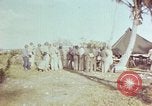
Admiral Chester Nimitz and his party visit American soldiers after Kwajalein Island is wrested from the Japanese in World War II.
U.S. Navy Admiral Chester William Nimitz visits fKwajalein Island, Marshall Islands, in World War 2. . Admiral Nimitz and his party casually visit various places on the island, Remnants of Japanese barracks and fortifications are seen. Tents and palm trees in the background. The party in jeeps. They inspect debris and remnants of Japanese flags.
U.S. Forces capture Japanese held Munda in the Solomon Islands.
U.S. Forces capture Japanese held Munda in the Solomon Islands. U.S. landing force in boats striking at Munda. Enemy planes try to stop the U.S. Marine troops. Marine advance towards coast. Marines get away from the boats. Tanks moving on to island from landing barge. Marines fire rifles amidst enemy fire. U.S. Marines dig to bury dead soldiers. Bombing by planes. Mortars and machine guns fired. Scenes of wrecked tanks. (World War II period).
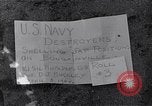
United States Navy destroyer fires at Japanese positions in Bougainvilie, Solomon Island
A United states destroyer in harbor shells at Japanese positions in Bougainvilie Solomon Island during World War II. Barbed wire barricades on the islands. A soldier looks through binoculars and speaks over a handie talkie to an officer of 132nd Infantry. The officer speaks over a field phone from behind a sandbag mound.
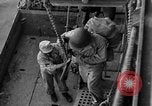
United States soldiers embark on an amphibious truck and move towards a beach in Bougainville, Solomon Islands.
United States soldiers leave ship by companionway and embark amphibious truck DUKW in Bougainville, Solomon Islands. Soldiers aboard a ship. The amphibious truck moves away from the ship towards the island. Flat bottom vessel LST (Landing Ship, Tank) in the background. A truck loaded with lumber. Trucks loaded with lumber move to and from beached LCV (Landing Craft, Vehicle). View of the harbor. LCT (Landing Craft, Tank) in the background. A landing craft shuttle between supply ship and shore. Soldiers on beach. (World War II period).
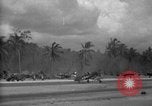
Aerial views of Torokina Air Strip, Piva Yoke and Piva Uncle airstrips, and environs, Bougainville Island, during World War II
Interior view from right side of an aircraft taking off from Torokina Air Strip on Bougainville Island, during World War 2. Numerous aircraft are seen parked near trees beside the runway, including U.S. Marine Corps F4U Corsairs; P-38 Lightnings; RNZAF P-40s; and USAAF Piper L-4 Grasshoppers. F4U Corsairs are taxiing beside the runway. Aircraft interior backward view from the departing aircraft's tail, shows the runway below and behind, with water on two sides. Next, the narrow airstrip is seen as the camera airplane flies overhead, just offshore, parallel to the runway. The camera continues to focus on the airfield as the plane climbs to higher altitude. Aerial view of small islands below, with small boats leaving wakes as they speed across the water. Next is view at lower altitude as the camera plane flies offshore parallel to the airstrip runway, as if on a downwind leg for landing. Next scenes are from above nearby Piva Yoke fighter airstrip, and parallel Piva Uncle bomber airstrip, which appears to be under construction. It is cut out of jungle and no aircraft are seen on it. The camera airplane's right rear horizontal stabilizer is seen momentarily as it flies slowly over the site. Some smoke rises from the area. Views of mountain and a river, as the flight continues. The final view is from offshore, over the sea.
Blood transfusion to U.S. Marine; casualties of U.S. and Japanese forces; U.S. forces rest and regroup after Eniwetok Island battle
Wounded U.S. Marines on the beach in Eniwetok Island (sometimes spelled Eniewetok or Enewetak). Blood plasma being administered to wounded soldiers in open field and camp. Dead U.S. Marines. View of Eniwetok Island after battle. Men sitting on the beach and swimming. Dead Japanese soldiers. Damaged Japanese equipment including tanks. Bomb craters on the air strip are filled. Native people of the island. U.S. Marine prepare to leave the island. A marine pats a dog. U.S. Marine leaving the Eniwetok Island. (World War II period).
CRITICALPAST.COM: About Us | Contact Us | FAQs - How to Order | License Agreement | My Account | My Lightboxes | Shopping Cart | Advanced Search | Featured Collections | Website Terms & Conditions | Privacy Policy ©2026 CriticalPast LLC.
License Agreement |
Terms & Conditions |
Privacy Policy
©2026 CriticalPast LLC.