


 Francais
 Deutsch
 Italiano
Refine Your Search
Coney Island New York 1898 stock footage and images
- Showing 5695 to 5700 of 11259 results more
more Hide
Hide
Colonel Paul Tibbets, Pilot of the Enola Gay, describes his mission dropping the atomic bomb on Hiroshima Japan.
Crew members of the B-29 Enola Gay are interviewed about their atomic bombing mission over Hiroshima Japan by the United States Army Air Force, during World War II. In this interview at North Field, Tinian Island in Marianas Islands, Public Relations Officer, Major John F. Moynahan (not seen) interviews Colonel Paul W. Tibbets, Jr., Pilot of the Enola Gay Among things Colonel Tibbets mentions, he recounts that he took a steep turn to avoid radiation from the explosion. When he saw the explosion he was surprised about its intensity. The cloud from explosion covered the whole city of Hiroshima.
Major Thomas Ferebee, the bombardier aboard Enola Gay shares his experience of the Hiroshima atomic bombing mission
Setting: North Field, Tinian Island, Marianas Islands. Major Thomas Ferebee, the bombardier aboard Enola Gay (B-29 that bombed Hiroshima) is asked about his experiences, by Public Relations Officer John F. Moynahan (not seen). He recalls - His navigator aligned him correctly with the target. Hiroshima was clearly visible to him and so he was able to deliver the bomb. (World War II period).
Interview of Major Charles Sweeney, pilot of the B-29 that dropped the atomic bomb on Nagasaki.
Setting: North Field, Tinian Island in Marianas Islands. Major Charles Sweeney, pilot of the B-29 that dropped the atomic bomb on Nagasaki, is interviewed by Public Affairs Officer, Major John F. Moynahan, who identifies Sweeney as the "pilot of 'The Great Artiste', the second B-29 to drop an atomic bomb on the Empire." (Note: Major Sweeney was the regular pilot of the B-29, "The Great Artiste", which was scheduled to carry the bomb. But it needed to be re-instrumented for the mission. So, instead, he and his crew simply switched airplanes with Captain Frederick C. Bock and crew, whose B-29 "BocksCar" was already properly configured. Thus, "BocksCar" was the airplane from which Sweeney and crew actually dropped the bomb.) In the brief interview, Major Sweeney describes their difficulties in three tries at the primary target and their decision to proceed to their secondary target, Nagasaki. With less remaining fuel than planned, they were forced to recover at Okinawa. (World War II period).
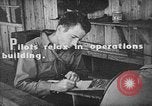
U.S. pilots in 19th Fighter Squadron operations building at Aslito Airfield, Saipan during World War II.
U.S. Army Air Forces 19th Fighter Squadron personnel on the Island of Saipan, Mariana Islands in World War 2. Pilot writing a letter at Aslito Airfield, Saipan Island. Interior operations building showing the men lounging around and relaxing. Barber giving a haircut in outside area, P-47 Thunderbolt planes in background. Airman taking a nap. Bulletin board of the fighter squadron with chalk reference to 19th Bomb Squadron (possibly meaning fighter-bomber Squadron).Contains a note reading: "Minimum buzzing alt 50 ft." Alert duty roster is posted with names of pilots, shifts they will pull, & assigned aircraft numbers. Pilots cleaning and inspecting their sidearms.
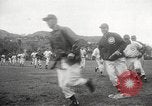
Chicago Cubs get ready for the 1950 baseball season on Catalina Island, California
The Chicago Cubs run onto the field during spring training for the 1950 baseball season. Mountains and tall trees visible in background. General manager Wid Matthews and manager Frankie Frisch confer. Cubs players pose for the camera. Several players warm up throwing arms, including #17 Bob Rush and #53 Johnny Schmitz. More players pose for camera; in shot with three players, man on the left is Hank Sauer, who would win the 1952 National League MVP for the Cubs. Cubs players take practice swings, including outfielders Andy Pafko (#48) and Bill Serena (#6).
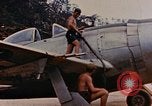
USAAF 464th Fighter Squadron crew members refuel P-47N on Ie Shima, near end of World War II
Shirtless U.S. Army Air Forces ground crew members refuel a 464th Fighter Squadron, 507th Fighter Group, P-47N airplane, on Ie Shima Island, Ryukyu Islands, preparing to attack Kyushu, in final days of World War 2. Picture of a girl and the words 'Winkie Jean' painted on the nose of the P-47.
CRITICALPAST.COM: About Us | Contact Us | FAQs - How to Order | License Agreement | My Account | My Lightboxes | Shopping Cart | Advanced Search | Featured Collections | Website Terms & Conditions | Privacy Policy ©2026 CriticalPast LLC.
License Agreement |
Terms & Conditions |
Privacy Policy
©2026 CriticalPast LLC.