


 Francais
 Deutsch
 Italiano
Refine Your Search
Crimea Ukraine 1942 stock footage and images
- Showing 91 to 96 of 2514 results more
more Hide
Hide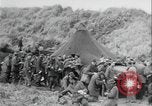
U.S. Military unload supplies to support an aerial bombing campaign of the Japanese in the Aleutian Islands, Alaska, 1942, during World War 2
U.S. troops gathered around a tent, eating, in the Aleutian Islands, Alaska, in 1942, during WW2. A line of soldiers carrying plates and bowls and cups waits to receive food. A man cooks food on a stove. Soldiers sit on the ground eating and warming by a fire. Wide view of the beach with ships and cranes out on the water. Crates of supplies stacked on the beach, soldiers move about. A soldier stacks an ammunition crate onto a large pile. Dozens of unfinned cylindrical bomb bodies on the shore. A crane, tractor, and bulldozer are unloaded from a boat. Panoramic view of a wide flat area to be built into an airfield, covered in shallow lakes.
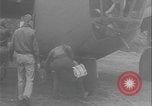
U.S. Army Air Force bombers raid Japanese-held Kiska Island in the Aleutian Islands, Alaska, 1942, during World War 2
U.S. Army Air Force (USAAF) soldiers wearing flight suits board bomber aircraft from a newly established U.S. position in the Aleutian Islands, 1942, during WW2. A soldier pokes his head out a window in the cockpit of one of the aircraft. Bomber aircraft take off from a runway constructed from marston mat (pierced steel planking), mountains in the background. Scenes of the bomber aircraft in the sky, taken from an on-board camera. Close up shots of gunners at their positions. The bombers fly over the foggy islands toward the Japanese base on Kiska Island. A Japanese warship appears in the water far below, one of the U.S. gunners strafes the deck of the ship. Close up of machine gun firing at the boat. Now over Kiska, bomb bays open and American bombs are unloaded. Smoke and explosions far below. A second load of bombs drops toward the Japanese base in slow motion. Wide shot of the target, now covered in streaks of smoke. Shot of the American bomber aircraft in the sky, turning to head back to base.
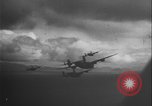
U.S. Army Air Force B-24 bombers return from a raid on Japanese-held Kiska Island in the Aleutian Islands, 1942, during World War 2
U.S. Army Air Force B-24 bombers fly back to base after bombing the Japanese base at Kiska Island, Aleutian Islands, Alaska, in 1942, during WW2. Narrator details the events of the successful mission. Close ups of the B-24 Liberators as they fly over water. Vast mountains of the Aleutian Islands in the background. The aircraft land back at the newly established U.S. base in the Andreanofs of the Aleutian Islands. Close ups of the bombers, now on the ground. U.S. soldiers exit the aircraft, inspect damage taken from Japanese fire on the fuselage. A group of U.S. pilots and crew walk across the airfield. Soldiers circle around and chat. Ending scene of soldier standing with cloudy Aleutian mountain rising in the background.
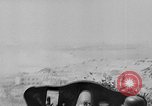
German artillery including German 800mm 'Gustav' railway gun shells Russian positions in Sevastopol, Ukraine.
Heavy bombardment by the Germans on Russian positions in Sevastopol, Ukraine. German heavy artillery fired in outskirts of Sevastopol. Russian troops fight Germans on streets. Troops advance through wrecked buildings and rubble. Body of a dead Russian soldier. Troops street fight. German troops firing heavy artillery Karl-Gerät self propelled siege mortar (Thor or Mörser Karl, 60cm). Writing on side of the mortar says, "Thor" . German 800mm 'Gustav' railway gun is prepared to fire on Russian positions. German crew loads Gustav with 800mm shell. Gustav is fired. Heavy explosion on Russian position throwing billows of smoke in air. Heavy artillery explosions. Men roll 800mm shells. (World War II period).
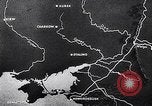
Nazi infantry troops supported by tanks and artillery advance in Ukraine on eastern front during World War II.
Map of Eastern front around Charkow, Ukraine. German Army troops advance in that region during World War II. Nazi Pz.IV tanks advance in Ukraine supported by infantry and artillery. A motorcycle messenger crosses the snowy eastern front. Soldiers on motorcycles cross streams. Nazi artillery fire at and completely destroy a building. Infantrymen take aim and fire at Soviet defenders. Infantrymen and tanks of 1SS Liebstandarte Adolf Hitler advance through the frozen roads of Charkow. Firing breaks out in a building. A sniper fires from inside a building. Buildings destroyed due to battle. Head bandaged on wounded German military officer.
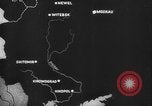
German artillery and rockets being fired during counter attacks as prisoners captured in Kirovograd, Ukraine.
Germans in Ukraine during World War II. Map of Ukraine shows Kirovograd. German artillery being fired. German tanks advancing. German grenadier troops advance in snow, wearing white winter outerwear. German officers watch through binoculars. View of shortwave antenna and radio operator with headphones. Closeup of German Nebelwerfer rocket artillery. Multitube rocket gun being fired as German soldier manipulates firing mechanism. German soldier in deep square fox hole trench firing artillery remotely. Tanks seen in ditches as prisoners are marched away.