


 Francais
 Deutsch
 Italiano

Refine Your Search
Crimea Ukraine 1942 stock footage and images
- Showing 955 to 960 of 2514 results more
 Hide
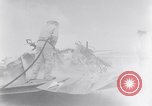
Montage of several airplane crash sites in World War II, with Navy firefighters extinguishing flames in wreckage
Views of several different crash sites at U.S. Naval bases in World War 2. Firefighter in protective suit directs stream of foam on smoldering wreckage of what appears to be a crashed low wing single engine monoplane. Several sailors and an officer also help and are seen putting out the last remaining flames. An armed marine guard watches over destroyed parts of an engine, propeller and cowling sitting in a field. In change of scene, an officer directs a firefighter in protective gear as he hoses foam on the wreckage of a larger crashed aircraft. Shallow hole in ground is shown. Another scene shows sailors working around numerous pieces of aircraft wreckage laid out on the ground. Next sequence shows sailors running toward a smoking crash site.A vehicle with flag on it's bumper is parked nearby. Sailors direct hoses on the wreckage and smoke rises from it. Armed Marines walk about the area. The smoldering wreckage indicates this was a relatively small aircraft. In final scene, firefighters in protective gear, without helmets, direct hoses on another crash site. Flames persist.

Plane crew climbs up past waist hatch and gunners put 50 caliber machine gun into PBY- 5 Catalina float plane in South Pacific.
Gunners put parachutes and 50 caliber machine gun into PBY- 5 Catalina float plane in South Pacific. Plane crew climbs up past waist hatch. Pilot and co-pilot climb up into waist hatch in preparation for patrol.
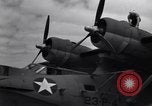
PBY-5 Catalina starts, taxis across ramp and into water during World War II. it taxis in water and returns again
Plane's Captain and a sailor check oil on engines of a U.S. Navy PBY Catalina amphibian before starting during World War 2. Plane Captain and sailor turn props through by hand in preparation for starting. Engines started on PBY-5 Catalina. This sequence is repeated from different angle. It taxis across the hard ramp, past a sandbagged antiaircraft gun emplacement. The aircraft proceeds down a ramp into the water, where it continues taxiing slowly. In next sequence, it is seen returning again.
African American farmers doing agricultural activities such as pick cotton and process sorghum in United States.
Excerpt from U.S. Deparment of Agriculture film "The Battle Is In our Hands." African American tenants pick cotton and process sorghum in fields. Farmers doing agricultural activities. Cattle at field. "Walls of Jericho" is sung by Paul Robeson in the background. (World War II period).
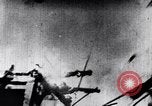
Civilians run with their possessions as cities are bombed in World War 2
Various scenes of bombing in Europe during World War II. Scenes in the United Kingdom, France, and other European locations. Buildings burning at night following an aerial bombing raid by German aircraft. Defense soldiers on the ground working to spotlight enemy aircraft and return fire with anti aircraft guns. Buildings on fire and smoke rises. Workers try to extinguish a building fire as the building collapses. Large crowds of civilians fleeing including children. Burned building. People on streets of a European city fleeing an aerial bombing raid. Enemy planes in sky. Refugees run with their possessions, fleeing war zones.
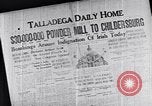
Growth of housing, military facilities, and military industries in Talladega, Alabama for World War 2
Growth of war industries in Talladega Alabama during World War II. Newspapers of Talladega, Alabama. A large crowd on barge, coming to land. Scene of an office. Workers at a construction site in Alabama. A man operates a crane. A big cylindrical elevator at hook of the crane lowers down. A truck at house. Dog outside house. A man operates a full track tractor at construction site. African American workers lay railway tracks for a railroad train service. Many scenes of the African American work crew working on the railroad tracks, and taking a break to drink water from a ladle. (Background sound track during these work scenes is a man singing the African American spiritual song "Joshua Fit the Battle of Jericho." A side rail pulls down as attach to hook of a crane. Tanks on rail coaches. Food loads arriving by railroad train cars to feed the growing population of war workers. Potatoes in sacks. A cook prepares food. People in war time production industry eat food at dining table in groups in a mess hall or dining hall. People do various construction jobs building infrastructure for war workers. A man operates a crane. A cylindrical box lowers down. Children play outside a mobile home trailer. A child with a cat. An open air theater. A bunk house with beds for rent. People at a cafeteria. A woman with children. Cars outside a cafeteria. A board reads 'Field Office'. Large crowd.