


 Francais
 Deutsch
 Italiano
Refine Your Search
Crimea Ukraine 1942 stock footage and images
- Showing 979 to 984 of 2514 results more
more Hide
Hide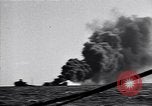
A torpedoed, sinking commercial ship off New Jersey, United States, observed by a patrolling airplane and another ship.
A burning ship broken from middle, sinking in the ocean off the coast of New Jersey after being hit by German submarine torpedo attack in World War 2. The ship gives away immense cloud of smoke. A patrolling airplane passes by the ship. Another ship passes from very near to the sinking ship. The ship ultimately gets below the water and only the smoke can be seen on the horizon.
Soldiers, equipment, airplanes, training centers, commanders and others forming the organization of the United States Army.
Organization of the United States Army in World War 2. Massive group of soldiers doing exercise calisthenics on a parade field. Large groups of soldiers march and salute the U.S. National Flag. A tank production factory with war production workers. Soldiers boarding a troop transport ship. View of the USAT Edmund B. Alexander troop ship (formerly USS America, ID-3006) at a harbor filled with U.S. Army troops in transport. Graduation ceremony underway at a military service academy (possibly Westpoint) and awards given. Selection of soldiers for the U.S. Army. Infantrymen and artillerymen fighting in a battle. Generals and Chiefs of Army staff at a discussion and facing the globe in U.S. Capitol. Animated flowchart showing various levels of service and departments in the U.S. Army. Secretary of War is the Supreme Commander, followed by Chief of Staff and a Deputy Chief; general staff succeeds the hierarchy. Operations division has three major constituents: - Strategy and Policy group, Theater Group and the Logistic group. Nine theaters of operations are shown on globe. Military officials at work. Soldiers working in clerical duties and message centers. Personnel typing and filing papers. A soldier emptying a bin of shredded papers. Soldiers in intelligence operations listening to message transmissions and wearing headphones. Letters of soldiers transported in a bomber aircraft seen taking off. Commanders discuss, training to ground, air and navy soldiers. Westpoint cadets in a training exercise with transit sighting devices in a field. Officers including a U.S. Army 4 star general (possibly General Malin Craig) review a map. Trucks ready to supply equipment at war front. Construction site of the Pentagon, with dirt, trucks, and buses in the foreground. Pentagon in the background and Washington Monument in the distant background. Four groups of general staff, G-1, G-2, G-3 and G-4 are there to look after various departments such as induction, promotion, information, policy, mobilization, size, conflicts, transport and supply.
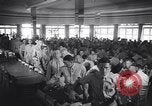
Organization of the United States Army and its divisions responsible for coordination during combat missions.
Organization of the United States Army in World War 2. Men stitch uniforms of soldiers at a factory. Animated flowchart showing various levels of service and departments in the U.S. Army. Secretary of War is the Supreme Commander followed by Chief of Staff and a Deputy Chief. Ground, Air forces and Supply services. Procurement of ammunitions and equipment is directly looked after by Secretary of War. Trucks for supply for army. Soldiers during combat missions. Task Force, Defense Command and Theater command aligns the forces during such missions. Sailors on a navy ship.

Map showing the organization of Army Ground Forces of the United Stares Army, its training centers and various subdivisions.
Organization of the United States Army. Organization of Army Ground Forces. Soldiers under training of ground combat missions. Animated map shows the organization. Commanding General followed by Chief of Staff and ground staff. Various subdivisions of ground forces. Soldiers firing rifle at target. Map of United States showing training camps and graph showing the number of trained soldiers increasing year after year. (World War II period).
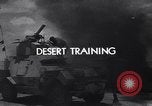
Soldiers of the United States Army given training about desert warfare, amphibious war training and airborne troops training (WW2)
Organization of the United States Army during World War II. Soldiers given training about desert warfare training at the center in California. Tanks fire on enemy and advance in field. Position held by soldiers behind stone bunkers on a hill. Anti aircraft gunners firing towards target. Soldiers point rifles towards enemy. Amphibious training to the troops at amp Edwards Airborne troops drop soldiers by parachutes. Soldiers with parachutes land into enemy area and advance towards their targets.
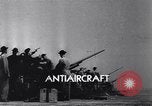
Training of United States Army Soldiers for anti aircraft guns, amphibious war and tank warfare training at military bases (WW2)
Organization of the United States Army. Soldiers given training about firing and operating anti-aircraft guns at Camp Edwards in western Cape Cod, Massachusetts, during World War II. Trainee soldiers fire on target balloons. Amphibious troops trained. Tanks ride rough mountainous terrain, cross small rivers. Tank destroyer training, a dummy tank destroyed.