


 Francais
 Deutsch
 Italiano
Refine Your Search
Crimea Ukraine 1942 stock footage and images
- Showing 1345 to 1350 of 2514 results more
more Hide
Hide
Japanese Army General Masaharu Homma gets off an aircraft and is greeted by an officer in Manila, Philippines.
Japanese troops in Manila, Philippines during Japanese occupation of Philippines and Japanese colonial rule during World War II. Balloons support a huge sign "War Is Over". A truckload of Japanese troops, followed by a line of civilian cars, drives through Manila streets as civilians cheer. Flags flutter near a memorial. Japanese troops stand in formation. Soldiers blow bugles. The soldiers stand at attention. Japanese Army General Masaharu Homma gets off an aircraft and is greeted by an officer. General Homma talks to an officer seated in front of him at a desk. An aide stands nearby.
Japanese Army General Masaharu Homma reviews Japanese victory march at Luneta in Manila, Philippines.
Japanese victory march at Luneta in Manila, Philippines during World War II. Civilians stand at the side of a road. Japanese troops parade during colonial rule and occupation of Philippines by Japan. Japanese Army General Masaharu Homma reviews the parade sitting on a dais. Soldiers march holding Japanese flags. Women soldiers march. Civilians holding Japanese flags cheer. Civilians with Japanese flags in their hands march. Military officers sitting on the dais watch. Civilians march holding a huge Japanese flag. An officer addresses the crowd. A band plays. An aircraft in flight. People raise Japanese flags and cheer.
Japanese Army General Masaharu Homma reviews soldiers and army vehicles at Luneta in Manila, Philippines.
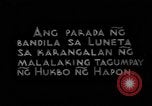
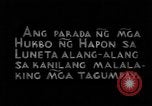
Japanese occupation of Philippines in World War 2 and beginning of colonial rule by Japan during the war. Japanese victory march at Luneta Park in Manila, Philippines during World War II. Slide in Filipino reads “Ang parada ng mga Hukbo ng Hapon sa Luneta alang-alang sa kanilang malalaking mga tagumpay” (“The Japanese Army’s parade in Luneta to celebrate their immense victories” in English). Japanese tanks in a row in Luneta Park (Ermita, Manila, 1000 Metro Manila). Soldiers blow bugles. Soldiers near the tanks. Japanese Army General Masaharu Homma on a horse followed by other men. They ride past soldiers on foot going in the opposite direction. The General reviews the troops. Cavalry units pass in review. The General salutes. Army vehicles pass in review. Soldiers in formation. Aircraft in flight. Army vehicles roll past cheering crowds standing at roadsides. People wave small Japanese flags. The vehicles move across the Ayala Bridge over the Pasig River. Sign over bridge reads “Welcome General Homma Welcome”.
Tanks are assembled as treads, motors, guns and turrets are joined in place in a factory in the United States.
A film titled 'Tanks' on the manufacture and uses of M-3 medium tanks in the United States. Exterior of a tank arsenal. An M-3 medium fighting tank moves along a street. Men work in a factory. They work on the production of tanks. Tanks are assembled. Mass production of tools and equipment in the factory. Men at work on different parts of tanks. A semi finished tank body being hoisted. The armor turret of the tank. The parts of the tanks are assembled. The tanks move along a track. Fire power being installed. Motors and guns being placed in the tanks. (World War II period).
Men work on several equipment and machines in a factory in the United States.
A film on the manufacture and uses of M-3 medium tanks in the United States. Equipment and machines in a factory. Men work on the equipment in the factory. Several parts which are used in defense production in crates. A tank being hoisted. Tanks move along.
M-3 medium tanks stage an attack at Fort Knox in Kentucky, United States.
A film on the manufacture and uses of M-3 medium tanks in the United States. The headquarters of the armored forces of the nation at Fort Knox in Kentucky. A sign board reads: "U.S. Military Reservation, Danger, Keep Out, Range firing in this area Unauthorized persons entering this area, do so at their own risk, By order of the Commanding General." Soldiers aboard tanks. The tanks move on the practice fields. A tower in the background. Smoke rises as the tanks fire. A ship in a harbor. Tanks loaded aboard the ship. Men work. The ship underway. (World War II period).
CRITICALPAST.COM: About Us | Contact Us | FAQs - How to Order | License Agreement | My Account | My Lightboxes | Shopping Cart | Advanced Search | Featured Collections | Website Terms & Conditions | Privacy Policy ©2026 CriticalPast LLC.
License Agreement |
Terms & Conditions |
Privacy Policy
©2026 CriticalPast LLC.