


 Francais
 Deutsch
 Italiano
Refine Your Search
Crimea Ukraine 1942 stock footage and images
- Showing 1447 to 1452 of 2514 results more
more Hide
Hide
United States President Franklin Roosevelt checks facts and figures about aid sent to Allied countries.
United States provides aid to Allies. United States President Franklin Roosevelt seated in his office. Lend Lease Administrator Edward R. Stettinius reports to President Roosevelt about the aid provided to her allies. Lend-Lease shipments prepared and shipped. Merchandise, tanks, planes sent to Soviet Union and Britain. Rail cars carry crates of machine tools made by Bullard Company in Bridgeport, Connecticut. These crates are seen being loaded in a ship destined for the Soviet Union. A ship at sea. Smoke rises up from smokestack. (World War II period).
Canadian Mosquito Bomber and United States Army observation plane are demonstrated early in World War II
Canadian De Havilland DH.98 Mosquito aircraft is shown to the public for the first time, in Canada, early in World War 2. Air Force officers stand near the aircraft. British test pilot Geoffrey Raoul de Havilland Jr., son of the famed British aviation pioneer and aircraft designer, pilots the airplane in a demonstration flight. The plane taxis for takeoff. De Havilland circles and buzzes the field several times to demonstrate its speed and maneuverability. At one point, he feathers the right engine and demonstrates its excellent single-engine flight characteristics. Complete change of scene, to Wayne, Michigan, in the United States and a snow-covered air field where a Stinson Model 76 observation aircraft (registered NX27772) demonstrates its extreme short takeoff and steep climb capability.. Aerial view of the airplane maneuvering aloft and then landing in the snow, whereupon, it spins about in a 180 degree turn and immediately takes off, again, in very short distance and a steep climb. (Note: NX27772 was the final prototype for the L-5 Sentinel airplane, as it was named, when delivered to the U.S. Army.)
USS San Francisco (CA-38) docks in United States and Admiral King decorates the Commander of the cruiser.
United States cruiser USS San Francisco (CA-38) returns home, after heroic engagement against Japanese forces in the Naval Battle of Guadalcanal, during which Admiral Callaghan, its skipper, was killed. Sailors aboard the ship. The heavy cruiser docks in United States. Lieutenant Commander Bruce McCandless, the Commander of the ship who replaced Callaghan and guided the ship through the rest of the battle and safely home, stands with his wife. Admiral King decorates McCandless with the Medal of Honor. Crew stands in the background. Admiral King shakes hands with the Commander. (World War II period).
Alaskan railroad re-opened by United States Army in World War 2, to carry supplies.
Supplies are carried by trains and trucks in Alaska. Ships unload food and supplies at Skagway, Alaska. Smoke rises from smokestack of the ship. Men unload the supplies. Train of the Yukon railroad, under operation by the United States Army is loaded with food and supplies for troops guarding arctic outposts in World War II. A Yukon Railroad train moves along railroad tracks. A sign reads "Whitehorse, Yukon" at the Whitehorse stop in Yukon territory of Canada. Truck on the new Alaska Truck Highway passes by with freight it received at Whitehorse.
U.S. High Command Leaders hold war planning parley in United States (WW2)
United States High Command holds World War II war planning parley. The U.S. High Command leaders stand and talk. General Henry (Hap) Arnold, General George Marshall, Admiral Ernst King, Admiral Land, Admiral William Leahy, Presidential advisor, Harry Hopkins, Paul V. McNutt, Civilian Head of Manpower, and Elmer Davis, Head, Office of War Information, in the conference. The personages are seated on a table. Food served on the table.
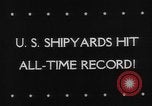
Flat-bottom tank carrrier ships launched.Henry J Kaiser with model of victory ship.Launch of the "Robert E. Peary" Liberty ship
United States shipyards launch ships flat-bottom tank carriers. A large number of vessels are produced in order to meet the requirement of World War. Henry J Kaiser assembles model of a victory ship. A ship named 'Robert E Peary' is built in record time. Huge crowd gathered during the launch of the ship.
CRITICALPAST.COM: About Us | Contact Us | FAQs - How to Order | License Agreement | My Account | My Lightboxes | Shopping Cart | Advanced Search | Featured Collections | Website Terms & Conditions | Privacy Policy ©2026 CriticalPast LLC.
License Agreement |
Terms & Conditions |
Privacy Policy
©2026 CriticalPast LLC.