


 Francais
 Deutsch
 Italiano

Refine Your Search
Crimea Ukraine 1942 stock footage and images
- Showing 187 to 192 of 2514 results more
 Hide

British Prime Minister Churchill salutes USS Quincy (CA-71) carrying President Roosevelt at Malta, in 1945
Allied leaders at the Malta Conference (Code name: Argonaut, Phase I, Cricket) during World War II. A ship at a harbor in Yalta, Crimea. Smoke rises from stacks in the background. British Prime Minister Winston Churchill on the bridge of the British Royal Navy Cruiser, HMS Orion, salutes as the U.S. Cruiser USS Quincy (CA-71) assisted by a tugboat, passes, carrying U.S. President Franklin D. Roosevelt, in Valletta Harbor, Malta. Crew members aboard the cruiser salute British Prime Minister Churchill.
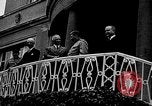
Allied National Leaders hold numerous conferences to plan and coordinate their efforts during World War II
First scene shows President Harry Truman shaking hands with Joseph Stalin on a porch of the Cecilienhof ( home of Crown Prince Wilhelm) in Potsdam, Germany. The two leaders are accompanied by their respective foreign ministers, James F. Byrnes, U.S. Secretary of State, and Soviet Minister of Foreign Affairs, Vyacheslav Molotov. Stalin descends steps from the building followed by Truman. View of the back lawn at Cecilienhof. View of its front entrance. Various views of the house and grounds. American, Soviet, and British flags flying from the building. Cars carrying the leaders on road to the Cecilienhof. President Truman and James Byrnes entering outside gate, followed by other attendees. Then Stalin is seen entering followed by Soviet officers and officials. U.S. General Dwight D. Eisenhower, Supreme Commander Allied Expeditionary Force (SCAEF) in Europea and U.S. Army Chief of Staff. George Marshall are seen walking together in a wooded glade on the meeting grounds. British Field Marshal Bernard Law Montgomery, entering the grounds for the meeting. British Prime Minister Winston Churchill, President Harry Truman, and Joseph Stalin stand on a step before an entrance to Cecilienhof. Truman places their hands together in a mutual handshake, at which Churchill and Stalin laugh. Views of the Kremlin and St. Basil's Cathedral, in Red Square, Moscow, Russia where foreign minsters of the United States, Britain, and the Soviet Union are seen meeting meeting in conference at the Spiridonovka Palace in October, 1943. Closeup of Soviet Prime Minister Vyacheslav Molotov, British Prime Minister, Anthony Eden, and U.S. Secretary of State, Warren Hull, successively signing a document. Scene shifts, to a C-47 transport aircraft flying over great pyramid of Giza in Cairo, Egypt. Next, the front of the Soviet Embassy in Teheran, Iran, is shown. The "Big Three" (Stalin, Roosevelt, and Churchill) sit on the porch of the building. Military officers from their countries stand behind them. Narrator (Franklin D. Roosevelt) says they agreed to launch a gigantic attack on Germany. Scene shifts to Germany, where German military is paraded on public display, showing artillery, Panzer I tanks carried aboard army trucks, Heinkel He 111 bombers in formation overhead, and marching troops giving Nazi salute silhouetted against bright pavement. View shifts to the Livadia Palace, in Yalta, Crimea, Russia. Brief view of the "Big Three" and their staffs sitting around a conference table. Change of location to San Francisco, California, where flags of many nations are displayed along with a United Nations Logo. Representatives of the many nations sign the Charter of the United Nations, founding the U.N. organization on 26 June 1945. Film shifts to Germany where victorious American, British and Soviet troops shake hands and celebrate victory. They share drinks and toast victory.
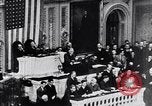
President Franklin D. Roosevelt addresses the Congress during "Four Freedoms" speech of 1942; also war production scenes
President Franklin D. Roosevelt addresses the U.S. Congress in his "Four Freedoms" speech during the State of the Union address on January 6, 1941, in Washington DC, United States. During his address, various war production worker and war materiel manufacturing images are also shown (before the entry of America into World War 2, but during lend-lease production): Tanks, airplanes and flying boat aircraft are shown. Workers at war production factories making artillery shells and munitions. Scenes at a manufacturing plant building bomber aircraft warplanes during World War 2. They appear to be B-25 Mitchell bombers. Workers work installing plexiglass nose cone gunner shield. They assemble various parts of airplanes. Scenes of biplane aircraft in formation and diving. Large, flat landing barge filled with American soldiers approaches a landing area.
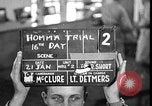
Major Tisdell talks about American surrender to the Japanese in 1942 during the trial of General Homma in Manila, Phillipines.
U.S. Army Major Achille C. Tisdell testifies before a military tribunal in Manila, Phillipines during the trial of Japanese Army General Masaharu Homma for World War II crimes. Major Tisdell, aide-de-camp to Commanding General of the American forces in Luzon Major General Edward King, speaks about the American unconditional surrender in Bataan before the Japanese forces. He recalls that an interpreter told American Commanding General Edward King to get U.S. Army General Jonathan Wainwright. General King expressed that there were no means to contact General Wainwright. He says that General King presented four conditions of surrender to the Japanese that included his return to the headquarters to notify the surrender and a 12 hour armistice. But Japanese declared that the surrender must be unconditional. General King asked if U.S. troops would be well treated. The Japanese replied that they were not barbarians.
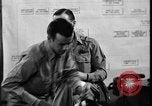
Major Tisdell says that U.S. officers were disarmed after American surrender in 1942 in Manila, Phillipines.
U.S. Army Major Achille C. Tisdell testifies before a military tribunal in Manila, Phillipines during the trial of Japanese Army General Masaharu Homma for World War II crimes. Major Tisdell, aide-de-camp to Commanding General of the American forces in Luzon Major General Edward King, speaks about the American unconditional surrender in Bataan before the Japanese forces. He recalls that an Japanese officer asked General King how many guns and tanks they had. The Japanese asked General King whether they would surrender and the General nodded his head. After this all American officers were disarmed.
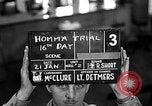
Major Tisdell speaks about events after American surrender in 1942 during the trial of General Homma in Manila, Phillipines.
U.S. Army Major Achille C. Tisdell testifies before a military tribunal in Manila, Phillipines during the trial of Japanese Army General Masaharu Homma for World War II crimes. Major Tisdell, aide-de-camp to Commanding General of the American forces in Luzon Major General Edward King, speaks about the Americans being taken to various prison camps. He says that Major General Edward King and General Jones were taken to Camp O'Donnell. He says that other officers including him were taken to a warehouse near San Fernando and from their they were taken to U.S. head quarters. Major Tisdell recalls that leaflets were dropped for the prisoners. He hands over a leaflet to a member of the tribunal. Tisdell reads out the part of the leaflet related to treatment of prisoners of war.