


 Francais
 Deutsch
 Italiano
Refine Your Search
Crimea Ukraine 1942 stock footage and images
- Showing 325 to 330 of 2514 results more
more Hide
Hide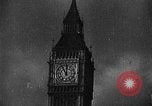
Axis forces of Rommel's Afrika Corps in full retreat after facing heavy Allied attacks in El Alamein, Egypt.
Second battle of El Alamein in Egypt, North Africa, between Allied Forces and German Forces in October, 1942, during World War 2. View of Big Ben clock tower in London, England, United Kingdom. In a UK war material production facility, British women war production workers stop work to listen to BBC announcement over public address speaker that Axis forces of the Afrika Corps (Africa Corps) under German commander Rommel are in full retreat in El Alamein, Egypt. Scenes in North African of British tanks advancing past many pieces of destroyed German armor, tanks, and artillery. Views of captured German planes, artillery, tanks and prisoners. Some artillery and tanks destroyed or still smoldering from recent attack on the retreating German forces, including smoldering Panzer tanks (Pz IV). Destroyed and bombed out German Luftwaffe aircraft parked on the ground. Five divisions of Italian soldiers in the South, abandoned by Rommel are swept up by Allied forces as prisoners of war. Italian prisoners kneel at a ditch and drink water from it. German prisoners march under British guard. German General Wilhelm Ritter von Thoma, captured near the hill of Tel el Mampsra, marches on sand under British guard. Aerial views of British Royal Air Force planes bombing retreating German positions on ground. Bombs away views from aircraft, and explosions and clack smoke arises from ground. View of British RAF pilot in cockpit flying De Havilland DH 98 Mosquito aircraft and strafing German trucks and armor as they retreat across open desert. Low level views of British Mosquito aircraft as it strafes German positions, as seen from cockpit of Mosquito aircraft.
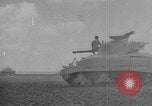
Axis forces withdrawing in El Alamein and British troops advance through Libya and Syria in World War 2.
Second battle of El Alamein in Egypt between Allied Forces and German Forces in October, 1942. Tanks advance and Axis powers in full retreat. British advance with tanks. British flag is raised. British advance on road and on mountain terrains. Water and other supplies brought by Navy. British troops advance through Matruh and Sidi Banari in Egypt; Tobruk and Bengasi in Libya; and Homs in Syria. Harbors littered by wrecked and abandoned German equipment. Fuel barrels unloaded from ship. British soldiers in combat with enemy in outskirts of Tripoli. Wounded soldier taken on litter. Artillery is fired. Smoke arises from explosions.
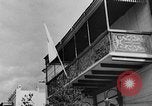
General Bernard Montgomery reviews British Eighth Army soldiers parading after surrender of Tripoli by Governor of Libya.
Surrender of Tripoli by Governor of Libya after battle of British Eighth Army with German forces in Tripoli, 1942. General Bernard Montgomery and other British Generals. British Eighth army tanks and troops advance on road and through city. Crowd lined up sidewalks. Troops and band march. General Montgomery reviews troops. The British flag is raised in Tripoli. View of letter to Prime Minister mentioning completion of mission. Generals Alexander and Montgomery review the marching troops. Royal Air Force planes in skies. Military vehicles during the parade. (World War II period).
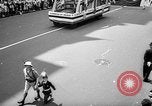
War bond parade on Fifth Avenue in New York City includes many floats, including from USSR, Belgium, Norway, and South America .
World War 2 war bond parade on Fifth Avenue, in New York City, United States. Soldier, in pith helmet, walks with a young boy in uniform.A float with beauty queens from South and Central American countries. A dinosaur-dragon float, representing the Axis powers. A float portraying the devastation and suffering at Bataan and Corregidor. A float showing George Washington rolling up his sleeves, and lined all around with soldiers, sailors,Marines, air raid wardens, and the like. An open car, surrounded by motorcycle policemen, carrying Parade Grand Marshal, Lieutenant General Hugh A. Drum, and a New York City official. A float of the Union of Soviet Socialist Republics, depicting Stalin on a white horse, and a sign saying: "Victory in 1942." A float with Soldiers,Sailors, Marines, American flags, and pretty women, with sign reading: " Sign Your War Bond Pledge June 14-24." United States flags fly on the buildings. A contingent of Norwegian Air Force, followed by Norwegian sailors and a large float of a ship, with sign reading: "Norway's Seamen, Norway's Front Line Soldiers, 3rd Largest Fleet in United Nations." A float of Belgium. Contingent of Greeks, led by one dressed as ancient Athenian warrior, followed by group carrying a small replica of the Parthenon.They are followed by Greek women in traditional costumes of Amalia and men in traditional uniforms of Evzone. A huge crowd gathered on the sidewalk. Marchers carry placards 'Destroy Hitlerism'.
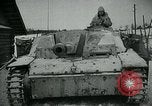
Military Operations on the Eastern Front during World War II, from the German perspective
At start of film, a German Stug III tank destroyer with single crew member is seen in a snowy landscape on the Eastern Front during the winter of 1942 in World War 2. Another Stug III, with large protective side plates installed, is seen sitting in the snow next to a barn. A third one is seen parked in snow with no soldiers present. The scene changes to German infantry in white cold weather parkas, at a battle front. One soldier looks through binoculars. German radio operator seated operating a radio, at a field communications center. Officers review maps and instructions. Infantry begin marching forward through the snow. Some load supplies on a half-track prime mover. Tiger I tanks of s.Pz.Abt.503 (503rd Heavy Tank Battalion) accompany infantry spread widely across flat snow-covered field. A locomotive and train passes nearby. Several dead Soviet soldiers are seen in the snow. Infantrymen capture two soviet soldiers and take them prisoner. A German soldier digs up a heavy box-shaped land mine. A rough posted sign warns of mines. Troops fire field artillery. Several views of destroyed Soviet armor and artillery pieces.
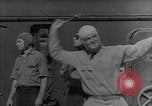
The USS Lexington entering World War II in the Pacific Theater and unrelated scenes of aircraft carrier warfare
A newsreel compilation of several unrelated shots. A P-40 of the 57th Fighter Group takes off from deck of the USS Ranger (CV-4). In an unrelated shot, a view looking back past tail of an aircraft after takeoff, with the USS Enterprise behind. A Douglas SBD Dauntless airplane takes off from a Yorktown class carrier. View back past its tail in a pre-war shot as an airplane leaves the Lexington behind. On Feb. 20, 1942, during World War 2, while en route to attack Rabaul,in New Guinea, the Lexington is attacked by eighteen Japanese planes. She shoots down several of them. Machine gunners firing. Bombs bursting in water near the ship. An F4F with collapsed landing gear near edge of flight deck. Black smoke rising from burning Japanese plane in water. Sky blackened with flak. Machine gun tracer bullets visible. Inserted scenes show the stern of a British carrier, and views of a bombing attack in the Mediterranean against a British Illustrious class carrier. Another inserted scene shows a lone sailor running the length of the flight deck on the USS Enterprise in the Battle of Santa Cruz. A Japanese airplane bursts into flames. Another is struck and dives trailing smoke.( An inserted view of U.S. Douglas TBD Devastators peeling off and launching torpedoes.) Douglas Dauntless aircraft recovering back on the Lexington. Flight deck full of aircraft as the Lexington makes way in the Pacific. Animated segment showing numerous drawings of aircraft carriers and airplanes headed toward Japan. (Inserted view of Four U.S. aircraft carriers, USS Lexington, USS Ranger, USS Yorktown, and USS Enterprise seen together in prewar maneuvers.)