


 Francais
 Deutsch
 Italiano

Refine Your Search
Croydon London England United Kingdom 1932 stock footage and images
- Showing 6253 to 6258 of 16124 results more
 Hide
Color Sound

Group including Henry Ford and Thomas Alva Edison dine at a table out of doors while camping in the United States
Henry Ford founder of Ford Motor company and others camp in the United States. Thomas Alva Edison an American inventor at the table out of doors. Group including Henry Ford and Thomas Alva Edison at table as they dine. Waiter serves the people seated at the table. Vehicle parked in the background. Trees in the background.
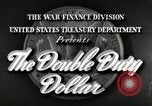
World War 2 film promoting public investment in War Bonds and stamps to aid the war effort and temper inflation
World War 2 era film that also includes some World War 1 scenes. Show girls or chorus girls in follies-like show, costumed as U.S. silver dollars and marching to tune and lyrics alluding to dramatic increase of currency in circulation, over the years. Animation with stacks of coins shows increase in national income from $46 billion,in 1933, to $71 billion, in 1939, and $142 billion in 1943. Back to the "follies dollars," a boy asks why, and then scenes of the Japanese attack on Pearl Harbor,are shown, with U.S. battleships being sunk. Wartime arms plants are shown. An M2A3 Light Tank rolls off a production line. Ships being constructed in a shipyard. B-24 Liberator bombers being built in a factory. Artillery shells being produced. Defense workers receiving their pay. The "follies dollars" group themselves to illustrate the fractions of income devoted to taxes and savings. But other spending is curtailed by wartime shortages. A woman talking with clerk in a drug store. U.S. Army troops crossing a pontoon bridge in open trucks, towing 75mm M1A1 howitzers. Infantry on the march. Animation showing industrial production devoted to war materiel and lots of dollars chasing few civilian goods. A grocery clerk offers to sell a woman customer butter for more than the established price, and she agrees. The "follies" performers then introduce the idea of an "inflationary dollar," and some history of past U.S. inflations. Animated examples of price inflation are shown. Glimpses of World War I scenes are seen, circa 1917 -1918, including: a 12-inch railway gun firing; a huge explosion from shell bursting near the camera; various scenes of United States infantry soldiers and French soldiers in battle action, running to bomb craters for cover and emerging from trenches to go up "over the top" into no-mans land during combat. Meanwhile, singing narration refers to the home front inflation due to competition for limited civilian goods. Map shows Europe and singing narration cites rising prices for food in occupied France and other countries suffering ravages of World War II. Montage of scenes showing needy civilians obtaining food in those countries. Animation shows increases, by 1944, in cost of U.S. civilian goods since the Pearl Harbor attack. "Follies" character called "Double-duty dollar," appears explaining he serves the war and curtails inflation on the home front by being saved through investments in War Bonds and stamps.

Segment of World War 2 film promoting sales of War Bonds and stamps to aid the war effort and stimulate postwar recovery
Film opens with singer on stage singing that he is a "double-duty dollar." He is backed by showgirls costumed as silver dollars. He explains that American dollars are now purchasing guns ammunition, planes, and tanks, to win the war. He alludes to how dollars will be used to fund the peace, after the war. An illustration shows schools, homes, and similar postwar investments in the country's infrastructure. Another shows futuristic cars, helicopter, and television sets. Scenes of pre-war highways filled with moving automobiles. Men playing golf. Gun club members in an outdoor shooting competition. A factory parking lot filled with automobiles and workers leaving the building at end of shift. (Message is that dollars no longer spent on war will revive private sector industry, again.) Film ends with appeal to "Buy an EXTRA War Bond TODAY!"
Story of Manhattan Project. Plutonium generated and separated at University of California. Manhattan project undertaken.
Story Camp Hanford during the Manhattan Project in World War II. Scenes of Dr. Glenn Seaborg and colleagues: Arthur Wall, Edward McMillan, and Emilio Segre, who generated and isolated Plutonium at University of California in 1941 A sign on a container reads 'First Pure 94 (239) isolated from chain reaction source'. A model of the atomic pile under the stadium at the University of Chicago, where Enrico Fermi, an Italian physicist, demonstrated controlled nuclear fission, on December 2, 1942. A map shows various sites chosen for Manhattan Engineer's District. Views of desert in Southeast Washington State. The Columbia River, for cooling. Electrical towers for power supply. An aerial view of project buildings in Hanford. Construction workers selected for the project in Hanford. Construction sites. Trailer houses for the workers. An aerial view of the plant ready for operation. Inserted view of Camp Hanford abandoned, in later years.

Women training and working at war materiel factories in the United States (WW2)
Soldiers on tanks fire artillery mounted on the tanks. Aircraft in flight. Views of explosions in the battlefield. Soldiers walk in lines. The soldiers in front of tents. Anti-aircraft artillery crew fire at enemy aircraft during World War II. New recruits in civilian clothes arriving for training in military armed forces in the United States. Men are trained for the army. Workers in an American factory make war equipment and war materiel. Men work on airplanes. They carry tire tubes for aircraft. People move inside an aircraft production building. Women stand in a line. Women workers report at a war production plant. A woman is being interviewed. Female war materiel workers are seated on benches and an official briefs them about the job. The women receive uniforms including a one-piece coverall uniform, wiping cloth, a cap, hairnet, and safety glasses or safety goggles, and a towel. A woman takes out uniforms from shelves in a closet. A woman wears a pair of glasses and a cap. Women move inside the production factory on the factory floor. A female worker teaches another woman how to operate a lathe. A liquid comes out of a pipe of the machine in operation. Two women work on the lathe. A truck in front of the receiving department. Women at a table make a note of the incoming material. Women work with hammer on a sheet. Women check for flaws in the raw materials. American flag seen on the wall above the women workers.
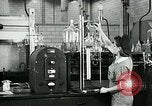
Women work on equipment in a laboratory and on various machines in the United States (WW2)
Female war production workers working in a laboratory during World War II. The women work with chemicals and on specific equipment. A woman takes out a material from a flask containing a liquid with the tongs. Bottles of chemicals kept on a table in the laboratory. Women weigh chemicals on a weighing machine. Narrator mentions their work making turbo superchargers and other parts for military aircraft. Women war production workers operate milling machines, lathes, grinders, tapping machines, punch presses, Natco multiple drill press, hydraulic presses for war materiel manufacture.
CRITICALPAST.COM: About Us | Contact Us | FAQs - How to Order | License Agreement | My Account | My Lightboxes | Shopping Cart | Advanced Search | Featured Collections | Website Terms & Conditions | Privacy Policy ©2026 CriticalPast LLC.
License Agreement |
Terms & Conditions |
Privacy Policy
©2026 CriticalPast LLC.