


 Francais
 Deutsch
 Italiano

Refine Your Search
Croydon London England United Kingdom 1932 stock footage and images
- Showing 7009 to 7014 of 16123 results more
 Hide
Color Sound

Ringling Brothers Barnum and Bailey circus comes to a town in America
As film begins, attendants riding atop elephants are seen from the rear as they parade along a the street of an American town. Front view of a circus wagon pulled by a team of horses and followed by numerous camels tethered behind it. A circus hand escorts a zebra and two other animals. Behind them are two automobiles. Next, local people are seen lined up to enter the fairgrounds where the circus tents are set up.
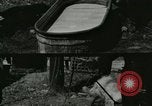
Workers of Ringling Brothers Barnum and Bailey Circus camping at the fair grounds in an American town
The first scene of the film shows a circus hand washing a dog outdoors in a metal wash tub. local people watch him. The next scene shows a worker hanging wash on lines set behind the circus tents where they are camping.
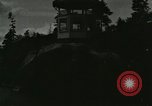
An octagonal house built on a rock near a lake in the United States
As film begins, camera focuses on a wooden octagonal house (possibly a small lighthouse) perched on a rock near a lake. Camera then pans across the rocky shore and continues across the lake without revealing a shoreline opposite the house.
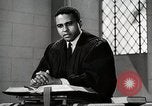
Role and training of African American soldiers in World War 2; also Louis versus Schmeling 1938 boxing scenes.
A film titled 'The African American soldier' about the role of African American soldiers during World War II. A dramatization : Exteriors of various cathedrals and churches in the United States. African American children enter a church. A service being conducted in a church. African American soldier sings music song at the service, with gospel choir behind him. African American minister addresses the congregation after the service. A service flag in the church. Various African American Army officers and a WAC (Women's Army Corps) at the church. Past events (actual footage) show African American boxer Joe Louis during boxing rematch bout against German boxer Max Schemling at Yankee Stadium June 22, 1938. Shows Schmeling being knocked out by Louis. African American paratroopers train as they climb up a ladder and jump to the ground. African American soldiers undergo training and drills as they cross obstacles and run across a forest readying for service in World War II. A copy of the Constitution of the United States. African American pastor reads out a portion related to African Americans from Hitler's Mein Kampf.
Major events of American history like the Boston Massacre, the independence and establishment of democracy.
A film about the role of African Americans in the history of America. A dramatization shows an African American priest tracing the history of America and the role of African Americans. The Granary Burying Ground in Boston. Pictures of the Boston Massacre. The Bunker Hill Monument (Monument Sq, Charlestown, MA 02129, United States) with soldiers in the foreground. A copy of 'Valley Forge'. Events leading to and after the independence of America. Men cut trees in a forest. Pictures related to the American Civil War of 1861. Ships in water as the war is fought. The Statue of Abraham Lincoln at the Lincoln Memorial (2 Lincoln Memorial Cir NW, Washington, DC 20002, United States) in Washington DC. An African American couple in the countryside. A railroad track is seen.
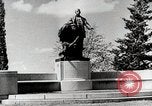
Achievements of African Americans in art, literature, music science, and medicine in the United States, in the late 1930s and 1940s.
A film about achievements of various African American men and women citizens in the United States. A statue of Booker T. Washington, founder of Tuskegee University in Alabama. View of African American scientist and inventor George Washington Carver, as an elderly man, working with another scientist in a laboratory. African American judge of New York city court. African American explorer Matthew Henson is seen looking at a globe (he was with Admiral Peary planting the American flag at the North Pole in 1909), and an unnamed African American surgeon at work in an operating room in New York. Next scene shows famous "father of the blues" musician and composer W.C. Handy (William Christoper Handy) smiling. Next is seen the financier and publisher of the Amsterdam News, Dr. C.B. Powell (Clilan Powell) greeting three uniformed African American women during a World War 2 war bond drive, and handing them a check (close up is shown) for 25,000 dollars, dated January 4, 1942, for the war bond drive. It is from the account of the Victory Mutual Life Insurance Company which Dr. Powell also owned. The check is signed by C.B Powell and Philip M.H. Savory (Dr. Savory was co-owner of the New York Amsterdam News). The next scene shows Elise Johnson McDougald, better known as Gertrude Elise Ayer, who was the first black full-time public school principal after the consolidation of New York City schools in 1898. She was also a noted woman writer during the Harlem Renaissance. She is seated in her office at her desk, likely in P.S. 119 in Harlem, since this is approximately year 1945 and she was at P.S 119 at that time. Her name plaque is visible on the front center of the desk. Principal Ayer smiles as a woman delivers a document to her. Next is seen the African American historian, author, and professor, Lawrence D. Reddick, serving in his role as the curator of the Schomburg Collection of African American Literature. In an art studio is seen the famous "Harlem Renaissance" African American sculptor and painter Charles Alston, at work on a sculpture. Next scene shows the famous African American contralto singer, Marian Anderson, receiving a bouquet of flowers and smiling after a performance. This transitions to a view of African American orchestra conductor Dean Dixon leading an orchestra in a performance of Beethoven's 9th Symphony. Several views of different sections of the orchestra performing under Dixon's direction. Clip closes with brief shots of campuses of several historically black colleges and universities in the United States like Howard University, Hampton, Tuskegee, Fisk, Prairie View. A football game underway in one of the colleges, and view on the field as quarterback throws a pass.
CRITICALPAST.COM: About Us | Contact Us | FAQs - How to Order | License Agreement | My Account | My Lightboxes | Shopping Cart | Advanced Search | Featured Collections | Website Terms & Conditions | Privacy Policy ©2026 CriticalPast LLC.
License Agreement |
Terms & Conditions |
Privacy Policy
©2026 CriticalPast LLC.