


 Francais
 Deutsch
 Italiano
Refine Your Search
Croydon London England United Kingdom 1932 stock footage and images
- Showing 757 to 762 of 26293 results more
more Hide
Hide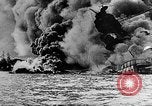
Japan extends its empire into Manchuria, Mongolia, and China in 1931 and 1932
Brief opening scenes show ships being engulfed in flames and smoke from Japanese attack on Pearl Harbor, December 7, 1941 in World War 2. Focus is primarily on the USS Arizona. Scene shifts to Japanese troops assembling on a pier and boarding troop transport ships bound for Manchuria and China, following the Mukden Incident of September, 1931. Japanese troops are then seen marching into Manchuria on September 18, 1931. A formation of Japanese soldiers presents arms. In another formation, they shoulder swords. Closeup of a Japanese soldier in a steel helmet with chin strap in place. A steam locomotive pulls a train into the Chin Hsien station on the South Manchurian Railway. A Japanese train on that line had been dynamited, triggering a Japanese push into Mukden. View from behind a train leaving Chin Hsien on the South Manchurian Railway. Japanese battalions place bundles of straw across a stream to facilitate troop crossing. A column of Japanese troops is seen crossing the water on the makeshift straw crossing. Japanese troops advancing along with supplies carried by pack animals. Troops traverse a sandy berm past an abandoned two-wheel cart. A formation of 12 Japanese G3M bombers flies overhead in a "V" formation en route to bomb Mukden. View of Chinese population running for shelter from the bombing. Chinese walk past some civilian casualties lying in a street. The League of Nations headquarters in Palais Wilson, Geneva, Switzerland. A memorial to Woodrow Wilson at the Palais Wilson reads: "A La Memoire De Woodrow Wilson President des Etats-Vnis,Fondatevr DL La Societe Des Nations, La Ville de Geneve." A car driving away from the entrance of the League Headquarters. Closeup of doorway with sign identifying it as the entrance for delegates and members of the Press. League delegates are seen inside its meeting hall. Japanese warships are seen next, attacking 15 miles from Shanghai with naval gunfire.Three Mitsubishi 2MR4 (Type 10)Reconnaissance biplanes are seen in flight above the barrel of a large naval gun. Japanese troops marching into Shanghai, as people on the roadside wave Japanese flags. Next, they are seen marching out of Shanghai at the insistence of the League of Nations. After signing a truce with China, on May 4, 1932, Japanese troops are seen entering Mongolia, in September, 1932, which they reconstituted as the Puppet State of Manchuko. A Japanese soldier standing atop a building waving a Japanese flag. Japanese statesmen resigning and leaving the League of Nations in protest after it labeled Japan an aggressor. Japanese forces fire a long barrel Type 89 cannon (150mm) as they push into China proper. Group of Japanese artillerymen use range finders, Periscopic viewers and binoculars to guide the gunners. Shell explodes raising large amount of earth. More views of artillery firing and infantry advancing. Infantry crossing a bridge and raising siege ladders to scale a fortress. Engines running on Japanese Ki 30 Type 97 airplanes, as pilots get final briefing and orders. They salute, board their aircraft, and are seen in formation aloft, dropping bombs. View from the air of bombs striking below. View from a bomber of its bombs dropping from the aircraft (bombs away view) and exploding on the ground. A column of Chinese soldiers moves along a section of the Great Wall of China heading into the interior of China. Civilians moving all manner of equipment and machinery into the interior.
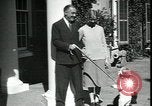
Governor Franklin D Roosevelt addresses people at the 1932 Democratic National Convention in Chicago, Illinois.
The 1932 Democratic National Convention in Chicago, Illinois. New York Governor Franklin Delano Roosevelt with his daughter Anna Roosevelt and granddaughter Anna Eleanor Roosevelt Dall (sometimes known as Sistie) outside a building circa 1930. Roosevelt holds a cane while leaning against a column and plays with his grandson using the cane. People gather in the convention hall for the 1932 Democratic National Convention. Roosevelt addresses them, speaking of the need to "break foolish traditions" and "to win in this crusade to restore America to its own people." The people applaud.
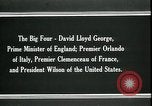
David Lloyd George, Vittorio Emanuele Orlando, Georges Clemenceau, Woodrow Wilson meet for the Versailles Peace Treaty.
Events during the Paris Peace Conference after World War I. The Big Four- Prime Minister of United Kingdom David Lloyd George, Prime Minister of Italy Vittorio Emanuele Orlando, President of United States Woodrow Wilson, and Prime Minister of France Georges Benjamin Clemenceau are seen. They were the dominant diplomatic figures in the Paris Peace Conference and played a major role in designing The Treaty of Versailles.
Final days of WW I, and aftermath. Riots in Russia. Treaty of Versailles. League of Nations. Harding elected President
Final throes of World War I and postwar situation. German submarines sinking allied ships. American workers work in war plants. U.S. Army General John Joseph Pershing visits France. American soldiers disembark from a ship in France. Germans defeat Russians on Eastern front and divert troops to the Western front. German soldiers on horse drawn wagons and others walk carrying guns as they move. Riots in Russia after it collapses in war. American soldiers fire field artillery. U.S. President Woodrow Wilson writes letters to countries at war like Germany. Papers with the 14 points to maintain peace. The soldiers of Germany and America on battle field. Dead soldiers on ground. Soldiers carry another injured soldier on a stretcher. The people protest during a rebellion in Germany. Soldiers of America cheer signing of Armistice. Cemetery. .Americans on streets in the U.S. after the war. President Woodrow Wilson goes on a tour of Europe. He sails to different places. Prime Minister David Lloyd George of the United Kingdom, Prime Minister Vittorio Emanuele Orlando of Italy, Prime Minister Georges Clemenceau of France, and President Woodrow Wilson of the United States in France during the signing of the Treaty of Versailles. Map shows the different nations formed after the war. The president returns after his visit. Henry Cabot Lodge, a U.S. senator. President visits different places to explain the peace treaty. Sketches show the President suffering a paralytic stroke and his wife takes his important decisions. Sketch depict the opponents of the peace treaty and the defeat of the league of nations. Warren Gamaliel Harding elected as the new President Harbinger of the future: views of Adolf Hitler on the rise in postwar Germany.
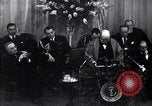
Churchill addresses people at the Westminster College in Fulton, Missouri and talks about the situation in Europe.
Prime Minister of United Kingdom Winston Churchill delivers a speech at the Westminster College in Fulton, Missouri (501 Westminster Ave, Fulton, MO 65251, United States). US President Harry S. Truman and other officials sit behind him on the stage. Churchill talks about the need to develop understanding with Russia and the situation in Europe. This is an excerpt from his speech entitled “The Sinews of Peace” (popularly known as the ‘Iron Curtain Speech’) and contains that reference. Churchill said “From Stettin in the Baltic to Trieste in the Adriatic, an iron curtain has descended across the Continent. Behind that line lie all the capitals of the ancient states of Central and Eastern Europe. Warsaw, Berlin, Prague, Vienna, Budapest, Belgrade, Bucharest and Sofia, all these famous cities and the populations around them lie in what I must call the Soviet sphere, and all are subject in one form or another, not only to Soviet influence but to a very high and, in many cases, increasing measure of control from Moscow.”
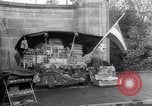
The Ministry of Foreign Affairs in Netherlands with half staffed flags.
The ministry of Foreign Affairs in Netherlands. Cars are parked outside the building. The building has several flag posts with the national flag of Netherlands all flying at half staff. People can be seen on the roads. Another building shown with flags of the United States and the United Kingdom. Footage is from timeframe of anti-communist rallies and violence in Amsterdam, in support of the Hungarian Uprising of 1956.
CRITICALPAST.COM: About Us | Contact Us | FAQs - How to Order | License Agreement | My Account | My Lightboxes | Shopping Cart | Advanced Search | Featured Collections | Website Terms & Conditions | Privacy Policy ©2026 CriticalPast LLC.
License Agreement |
Terms & Conditions |
Privacy Policy
©2026 CriticalPast LLC.