


 Francais
 Deutsch
 Italiano
Refine Your Search
Croydon London England United Kingdom 1932 stock footage and images
- Showing 817 to 822 of 26293 results more
more Hide
Hide
The birth of Princess Margriet of the Netherlands in Ottawa during the Dutch royal family's exile to Canada (WW2)
Princess Margriet, third child of Princess Juliana of the Netherlands, is born in Ottawa, Ontario, Canada during World War II. View of Netherlands flag flying on Parliament Hill (Wellington St, Ottawa, ON K1A 0A9, Canada). View of the Ottawa Civic Hospital (1053 Carling Ave, Ottawa, ON K1Y 4E9, Canada) after King George VI of the United Kingdom temporarily declared the hospital as “extraterritorial”. Prince Bernhard of Lippe-Biesterfeld, consort of Princess Juliana and father of Princess Margriet, carrying his infant daughter inside the Ottawa Civic Hospital. Prince Bernhard writes down Princess Margriet’s name during the registration of her birth. Two Dutch officials stand as witnesses during the registration of the royal birth. Princess Margriet's name on the registration document is shown. Prince Bernhard plays with his daughters, Princess Beatrix and Princess Irene, and pet dog in the snow.

Franklin D Roosevelt, Churchill and Charles de Gaulle meet at Casablanca.
A guard marches in the compound of a hotel. United Kingdom's Prime Minister Winston Churchill seated. French General Charles de Gaulle. General George Marshall with U.S. Air Force Chief, Lieutenant General Henry H. (Hap) Arnold. General Marshall with British General Brooke. Sir Dudley Pound, British Naval Chief, with American counterpart, Admiral William D. Leahy. Winston Churchill and President Franklin D Roosevelt seated and other British and American officials stand behind. American and British troops meet in Tunisia. Troops share cigarettes in the battlefield. General Eisenhower shakes hands with British General Montgomery. British troops advance in the battlefield. Aircraft of Allied Forces strafe German targets on the ground. American tanks advance. German prisoners marched off by French soldiers. German prisoners captured. Crowd cheers in a French city which was occupied by Germans earlier. French soldiers and crowd celebrate. (World War II period).
The Rise of Japanese militarism in the 20th Century
Film opens showing reenactment of Japanese attack ostensibly against Formosa, in 1894. Japanese troops and artillery are shown. The event is depicted in a critical political cartoon. Next, Japanese Admiral Heihachiro Togo is seen in 1904, standing with other naval officers. Then, Japanese warships are shown, firing barrages of naval gunfire at the Russian fleet in Port Arthur, Manchuria. Huge black clouds arise from burning ships. Scenes of Japanese people celebrating their naval victory. Date shifts to 1910. Cartoon depicts Japanese annexation of Korea. Cartoon illustrates Japanese actions in World War I when, siding with the Allies, Japan acquired the German-held Shandong (Shantung) Peninsula of China, as well as German-held Marianas, Carolines, and Marshalls islands in the Pacific. Japanese representatives are seen participating in Post World War 1 international activities. They signed the so-called Five-Power,Four-Power, and Nine-Power treaties, and participated in the League of Nations. Glimpse of two Japanese officers, followed by cartoon depiction of the Mariana, Caroline, and Marshall Islands, that Japan insisted on keeping. Cartoon shows them being fortified. A Japanese military marching band parades down a city street while being cheered by spectators on the sidewalks. Next, Japanese military General, Baron Tanaka Giichi, is seen in uniform with other officers. Cartoon illustrates the so-called Tanaka Memorial document that Baron Tanaka allegedly presented to the Emperor, in 1927, outlining a strategy to conquer the world. Cartoon then illustrates plan of conquest by acquiring Chinese manpower; Manchurian iron and coal; Siberian timber, coal, wheat, and metals; Tin,oil and rubber from Malaysia and the East Indies. The United States is shown as the last conquest. Views of ordinary farm and factory activities in the U.S. Cars parked in the Ford Motor Company factory lot. Japanese officials and legislators meeting in the Diet (Parliament). Japanese theater patrons and a Japanese woman singing with an American-style band, are shown as examples of activities the Japanese Government sought to discourage. A Japanese female ensemble in traditional dress, playing traditional instruments, is shown as more desirable. Western dancing and western hollywood movies are shown and narrator states they were forbidden by the Japanese government. Japanese movie scene depicts ancient martial arts. A musical production on stage displays German Nazi swastika flag , Japanese rising sun, and symbol of Kingdom of Italy, celebrating the axis alliance. Japanese men are shown playing the ancient game of Chu Shogi, instead of playing Western card games. People are shown in a library, where Western books are replaced by more militaristic tomes, such as: "If we fight" by Admiral Shinsaku Hirata, March 15, 1930 (shown on film slate). Slate goes on to quote about attack on Hawaii as the first battle in war of the Pacific. Film cites another approved Japanese publication: "Arguments Against American Policies" by Kawashima Seichiro, Christmas Day, 1924. It discusses distruction of the American fleet and subsequent landing on the U.S. West Coast.
The City of Paris, France, before and after the Nazi invasion of 1940, and America preparing for World War II
Views of Paris in the late 1930s, prior to World War II. The Arc de Triomphe de l'Étoile (Arch of Triumph). The Tuileries gardens (Jardins des Tuileries) with bed of tulips in full bloom in foreground. The Eiffel Tower (la tour Eiffel). The fountain of River Commerce and Navigation at the Place de la Concord, Paris, with the Madeleine church (L'église de la Madeleine) directly behind, the Hotel de Crillon,barely seen at left, and its twin building, the French Naval Ministry, opposite, on the Rue Royale. People strolling and shopping on the Boulevard Haussmann. Awning of Les Deux Magots café and patrons seated at tables outside, in the Saint-Germain-des-Prés area of Paris. People relaxing in the Tuileries gardens, with Arc de Triomphe du Carrousel and Musée du Louvre in background. An artist at work, seated at a bench in the foreground. The west facade of Notre Dame Cathedral. Parisians looking at posters, reading in parks, visiting bookstores. Sign directing visitors to the Congres des Ecrivains (Congress of Writers) held at Maison de la Mutualité conference center at 24 Rue Saint-Victor, 5th arrondissement of Paris, France.in June, 1935. Several writers seated at a table with others standing around. Closeup of three. Closeup of British writer, Aldous Huxley, wearing eyeglasses. Two writers conversing. Scene shifts to Paris at night. Car traffic on streets of Paris at night. Illuminated sign at Moulin Rouge cinema theatre, topped with illuminated arms of a windmill. Lighted sign of nightclub, Le Rat Mort, in Place Pigalle. Interior of a Paris nightclub with sophisticated clientele. French entertainer musician playing a guitar. An official posting an announcement called "Counseil de Revision," calling for conscription (military draft recruitment) of citizens for military service. Parisians preparing defenses in the city, in front of the Eiffel Tower. Man deep in a trench preparing a shelter. Men carrying sandbags up a ladder to protect a national monument. Copy of the New York Times newspaper annnouncing the German attack on Poland. Copy of New York Daily News announcing fall of Holland. The New York World-Telegram paper announcing capitulation of France. German Panzer II tanks and motorcycle troops entering Paris. German infantry marching through the Arch of Triumph, on the Champs-Élysées. A Frenchman wiping his eyes as he watches the occupying troops. Hermann Goering with other officers riding in an open car along a Paris street. Closeup of Arch of Triumph. Adolf Hitler, accopanied by staff, looking at the Eiffel Tower. Nazi flag flying from the tower. Closeup of Hitler looking around. The U.S. Capitol building in Washington, DC. President Franklin D. Roosevelt, in Academic garb, at the University of Virginia commencement ceremony, in Memorial Gymnasium, on June 10, 1940. (FDR's son Franklin Jr. was among the graduates assembled, from the UVA Law School). Roosevelt expresses American sympathy and support for nations invaded by the Nazis. American street scene. Women preparing gifts intended for France. A poster showing a French soldier, entitled: "Le Paquet Au Front." American draftees in training at an army post in the U.S. Smoke billowing from American industrial facilities. Workers at an American shipyard. View of warships under construction at the yard. A Huge gun barrel being moved on special rail dollies, in a U.S. arms factory. U.S. Navy F4U Corsair Production Line during World War II. M3 Lee medium tanks being manufactured in U.S. factory. Closeup of finished one being transported via transverse crane. M4 Sherman tanks moving on flat rail cars. A speeding steam locomotive pulling freight cars. Martin PBM-5 Mariner in flight over an Atlantic convoy carrying war materiel to the United Kingdom. Sailor wearing headset, standing near depth charges at stern of a ship. British Naval Ensign flying from mast of a ship.

Largest Tanker ship ,"Myrina" being launched at Harland & Wolff shipyard in Belfast, Ireland.
Launching of the "Myrina, " the largest tanker ship ever launched in the United Kingdom. The ship measures 1050 feet long and weighs 191thousand tons. She is seen going down the ways at Harland & Wolff shipyard, Belfast, Northern Ireland. During her launching, a gust of wind catches her, before tug boats can assist, and she goes aground. But she is quickly pulled free and proceeds on her way.
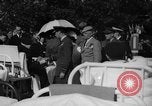
King George VI and Queen Elizabeth visit disabled soldiers during their tour of the University Hospital in Edmonton, Alberta.
King George and Queen Elizabeth visit disabled soldiers in Edmonton, Alberta. The King and the Queen receive a royal welcome from ex-servicemen as they stop during their tour at the University Hospital. The Queen speaks to the soldiers. A soldier holds a United Kingdom flag in his hand.
CRITICALPAST.COM: About Us | Contact Us | FAQs - How to Order | License Agreement | My Account | My Lightboxes | Shopping Cart | Advanced Search | Featured Collections | Website Terms & Conditions | Privacy Policy ©2026 CriticalPast LLC.
License Agreement |
Terms & Conditions |
Privacy Policy
©2026 CriticalPast LLC.