


 Francais
 Deutsch
 Italiano
Refine Your Search
Croydon London England United Kingdom 1932 stock footage and images
- Showing 1261 to 1266 of 26292 results more
more Hide
Hide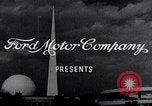
Scenes of New York City buildings and of the New York World's Fair in 1940
From the Ford Motor Company produced film, "Scenes From the World of Tomorrow" documenting the 1939-1940 World's Fair in New York City. View of buildings of the New York World's Fair of 1940. The Brooklyn Bridge. Aerial view of Manhattan Island, New York City. Skyscrapers of New York City including the Chrysler Building and the Empire State Building. New York Harbor and ships in the harbor. View of the buildings of the New York Worlds Fair in the distance in Flushing Meadows-Corona Park, as seen from high in a skyscraper of New York City. The Fair's Trylon and Perisphere stand out. People walk along the sides of fountains and waterways at the fair. Crowds milling about, bands marching, dancers performing. Flags of many nations flying on the flag poles. Celebration of the 150th anniversary of George Washington, as the first President of the United States and a statue of George Washington. A bus moves on the street. Fountains and a small bridge near a waterway. Pavilions of nations of England, Japan, and Italy. The USA building and some of the buildings of U.S. States including Maine and Florida. Fountains and waterways of the fair. Woman and two girls eat ice cream cones. A Raymond Loewy - designed S1 experimental streamlined locomotive created for the Pennsylvania Railroad. Pavilions of American Telephone & Telegraph and of United States Steel Corporation, also of Westinghouse, Goodrich, Chrysler, and General Motors.
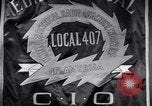
Pairs of American and British workers on exchange visits meet workers at American cities across the country
Logo of United Electrical, Radio, and Machine Workers Union Local 407 in New Jersey is shown. Narrator says it it one of the places a group of 4 English and 4 American Working men were to see on their exchange visit to America. View of their luggage The group is seen examining a map of the United States as they plan to make their visits in pairs to save time. They decide that each British worker would visit the hometown of an American counterpart. One pair leaves to visit Bethlehem, Pennsylvania. The pick up their luggage. Another pair are going to Detroit, Michigan. They pick up their luggage. The third pair is going to St. Louis, Illinois. They pick up their luggage. The final pair are going to Los Angeles, California. They pick up the last remaining pieces of luggage. One pair of workers is seen entering the Chrysler plant in Detroit. The American was welcomed home to America from his trip to England. View inside the plant of an African American woman working beside an older man, where they were making tank and marine engines. The visitors examine the gang drill presses containing multiple drills operated by a single operator. They stop to say hello to the American's daughter who also works at the plant, checking to assure parts met tolerances. It was noted that she was paid the same as any man doing the job. The pair of visitors are met at the American's home by some company union workers. They sit together on the step outside the house and get acquainted. An infant inside the house looks out the window at them. Scene shifts to Los Angeles where another English-American visiting pair is seated outdoors and the wife of the American brings out some bottles of beer for them to all share. Change of scene shows the pair visiting the offices of the Screen Actors Guild in Hollywood, where they meet celebrities Edward Arnold, George Murphy, Dick Powell, Alan Hale, Jane Wyman, Helen Hayes and Lena Horne. Edward Arnold, President of the Guild's Board, speaks with the pair, alone explaining how every actor in Hollywood belongs to the Guild which is affiliated with the America Federation of Labor (AFL). Arnold shows the pair his union card. Closeup of the card.
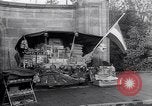
Flags of different countries flying at half mast in wake of assassination of President Kennedy.
Flag at sidewalk stall flown at half-mast in wake of the assassination of United States President John F. Kennedy. Flags on buildings flying at half-mast. The Ministry of Foreign Affairs building in The Hague. Building sign as "Ministerie van Buttenlandse zaken". The Dutch flag flying half-mast behind stone sculpture of the Amsterdam coat of arms. Flags of different countries including United States and England flying at half-mast.
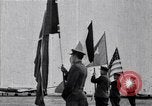
German surrender in WWII: Arrival of delegations at Tempelhof airfield in Berlin, tour through destroyed Berlin
Flags of Allied nations hoisted by soldiers at a ceremony at Tempelhof airfield in Berlin. Military Generals of England and the United States descend from a plane. Lord Tedder and United States Army Air Force General Carl Spaatz shake hands and talk with Russian officers including Marshal Sokolovsky. German Field Marshal Keitel and others in his delegation arrive at the airport. Military band plays and Russian honor guard marches as British, American, and Soviet officials observe, while Keitel and his staff consult over paperwork in a car. Motorcade drives through ruined city of Berlin. Many views of various damaged and destroyed buildings and bridges filmed from a moving vehicle in the motorcade. Rubble all over the city roads and citizens moving about the streets, some observing the motorcade. Views of the building in Karlshorst, in a suburb of Berlin, where signing of the Nazi surrender takes place. Views of the Meeting hall (converted from a mess hall) before the signing . Views of the various military officials in the building before the signing of the surrender. Excerpt from Japanese newsreel. (World War II period).

Timeline summary of the events and achievements of President Eisenhower's administration.
"The Eisenhower Story": A pre-election pro-Eisenhower propaganda film designed to highlight Eisenhower's qualifications for reelection as President in the 1956 election. Factory whistle blows and men entering a factory. Car chassis factory assembly line. Locomotive engineer blows train whistle and railroad locomotive with cultivators on a flat bed car. Cultivators harvesting grain. Woman carries groceries from shop to a 1950's sedan car parked on street. View of 1950's automobile highway traffic and aerial view of highways being built under his plans for highway construction and road expansion. View of Eisenhower at swearing in ceremony during his inauguration as President in 1952. In his speech, Eisenhower emphasizes that, "we stand ready to engage with any and all others in joint efforts to remove the causes of mutual fear and distrust among nations..." Newspaper headline 'Korean Truce Signed' at time of armistice during Korean War. American troops disembark ship and greet family. Secretary of State Dulles talking with German chancellor Konrad Adenauer. Secretary John Dulles seen also with British Prime Minister Winston Churchill. Eisenhower and Churchill at Geneva conference, along with Soviet leader Khrushchev and Marshal Nikolai Bulganin. Eisenhower speaks before United Nations about efforts to form an "atom pool." He notes United States "determination to help solve the fearful atomic dilemma...." Newspaper headlines 'Eisenhower Signs Sea Way Bill'. Construction of Saint Lawrence Seaway. 'Budget' and 'tax cuts' news in newspapers, including headline, "White House ends all wage controls...." Farmer plows field with tractor. Construction of new buildings and highway construction through Eisenhower programs. Views of the newly established Department of Health, Education, and Welfare. Workers filing cards in giant room of file drawers and cabinets. Nurse draws vaccine into syringe. Children are vaccinated (likely polio vaccine). President Eisenhower meets leaders from different countries at White House, including England's Queen Mother and King Paul, Queen Frederica of Greece, and Prime Minister St-Laurent of Canada. Eisenhower at press conference discussing disarmament notes importance of the "elimination of opportunity of surprise attack." View of shore towers and listening platforms and missiles rising on platforms to protect America from attacks. First nuclear submarine, the USS Nautilus (SSN-571 ) launched on January 21, 1954 by Mrs. Mamie Eisenhower in Connecticut. Plane taking off from aircraft carrier USS Forrestal (CV-59) while underway at sea. Formation of Northrop F-89 Scorpion aircraft in flight.
U.S. President Franklin Roosevelt addresses the nation regarding the lend lease aid to Britain (WW2)
U.S. President Franklin Roosevelt addresses the nation from Washington DC in World War II. Clip includes portion of his "Great Arsenal of Democracy" speech. Roosevelt states that the United States is determined to aid Britain through the Lend Lease program. He states that the United States will be in constant danger if the Axis powers win the war. The U.S. must supply England and Europe with arms. “We must be the great arsenal of democracy… I believe that the Axis powers are not going to win this war. I base that belief on the latest and best of information.” President Roosevelt said.
CRITICALPAST.COM: About Us | Contact Us | FAQs - How to Order | License Agreement | My Account | My Lightboxes | Shopping Cart | Advanced Search | Featured Collections | Website Terms & Conditions | Privacy Policy ©2026 CriticalPast LLC.
License Agreement |
Terms & Conditions |
Privacy Policy
©2026 CriticalPast LLC.