


 Francais
 Deutsch
 Italiano
Refine Your Search
Croydon London England United Kingdom 1932 stock footage and images
- Showing 1339 to 1344 of 26292 results more
more Hide
Hide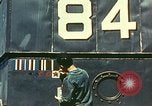
U.S. Landing Craft, in England, preparing for the Normandy invasion during World War II
U.S.Coast Guard crewmen painting battle star on superstructure of Landing Craft Infantry (Large), LCI(L) number 84, during World War 2, in France. (This craft was already a veteran of North African and Italian campaigns, and is preparing to take part in the Normandy invasion.) Another Guardsman questions whether it will be as good as other stars already painted. Others keep pestering the painter about this and he reassures them all. (View of perfect finished red star.) Landing craft Gunners display the landing craft's Oerlikon 20-millimeter Mk 4 automatic antiaircraft cannon. Views of LCI(L)s numbered 85, 89, 92,90, and 496, all tied together at a port in England. Sailors on LCI(L) 85, at their Oerlikon 20-millimeter cannon. U.S. Navy Union Jack displayed nearby. U.S. Coast Guard officers viewing sky with binoculars.
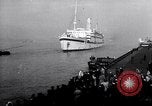
Hospital Ship, Atlantis, carrying exchange wounded Allied Prisoners of War back to England In World War II
In the first exchange of Allied and Axis wounded prisoners of war, the British Hospital Ship, Atlantis, with number 33 painted on her side, steams into port, at Leith, Scotland, (and then on to Liverpool, England) during World War 2. She is returning Allied wounded from Germany, by way of Goeteborg, Sweden. British soldiers are carried off ship on stretchers. Several ambulatory American soldiers leave ship on foot. Railroad train seen right at the port.
Russian air-cadets get trained in England, during World War I.
Russian air-cadets being trained at the Royal Flying Corps' No 1 School of Military Aeronautics, at Coley Park Aerodrome, Reading, Berkshire, England, during World War 1. Cadets march with their officer to a tarpaulin covered hangar. Next they are seen inside the hangar, removing a double wing from a bi-wing aircraft. . They sit, wearing earphones, at a table outdoors, learning wireless telegraphy. They examine the parts of a Clerget 9B nine-cylinder rotary aircraft engine, and sit for a lecture about inline engines. The instructor holds up a bearing and connecting rods from the inline engine. They look at an aeronautical chart and take notes. Cadets climb aboard a canvas-covered army truck and stand in it. They wave as it drives away.
English equestrians preparing to ride to the hounds at Sibbon Park, near Folkestone, Kent, England, in world War I
Equestrians riding in Sibbon Park,near Folkestone, East Kent, England,during World War 1. A group gathering along a path in the background. In the foreground, several horse riders in traditional foxhunting attire, proceed along a park path behind a large group of fox hounds. Following behind them is a youth on a pony, and behind him the rest of the riders, including: a mix of military officers in uniform, men in traditional attire and women riding habit. Scene shifts to dirt roadway near farm fields, where riders and hounds assemble.
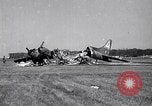
Wreckage of crashed B-17 aircraft at an Air Force base in England.
Remains of B-17, tail number 42-37789, which crashed during a post -maintenance test flight on April 24, 1944, at Grafton Underwood Airfield in Northampshire, England. The Aircraft belonged to the 544 Bomb Squadron of the 384th Bomb Group and was flown by Lieutenant Colonel Alfred Nuttall, who survived the crash and went on to lead a number of bombing missions thereafter. The aircraft was destroyed by fire that ensued after the crash. Firefighting foam residue can be seen covering the wreckage. This scene was filmed on April 29, 1944, five days after the crash. (World War II period).
Edward, Prince of Wales, King George V and Queen Mary attend a baseball game in England, during World War I.
Edward, Prince of Wales, King George V and Queen Mary, are seated in the stands at a baseball game in England during World War 1. The young Prince of Wales displays enthusiasm for the game. The King smokes a cigarette using a long cigarette holder. (WWI; WW1)
CRITICALPAST.COM: About Us | Contact Us | FAQs - How to Order | License Agreement | My Account | My Lightboxes | Shopping Cart | Advanced Search | Featured Collections | Website Terms & Conditions | Privacy Policy ©2026 CriticalPast LLC.
License Agreement |
Terms & Conditions |
Privacy Policy
©2026 CriticalPast LLC.