


 Francais
 Deutsch
 Italiano

Refine Your Search
Croydon London England United Kingdom 1932 stock footage and images
- Showing 13705 to 13710 of 16124 results more
 Hide
Color Sound
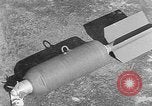
Optimum mix of fragmentation and incendiary bombs is determined during tests at Eglin Field, Florida, during World War II
Conclusions of tests conducted by U.S. Army Air Forces, at Eglin Field, Florida, seeking best way to attack Japanese homeland during World War 2. Actor Lee J. Cobb, portraying an Air Force Captain, smoking a pipe in his "office." Views of M-41 fragmentation bomb and a bundle of M-69 incendiary bombs. The Captain holds a model of a B-17 bomber and uses it to discuss bombing techniques. B-17 in flight. Views of effects of fragmentation bomb, showing numerous small holes produced by it. Aerial view of the test area houses. Mixture of M-69 incendiary bombs and M-41 frag bombs being dropped by the plane on the test area. Various views of resulting damage and effects. Test report is shown, concluding that demolition bombs are not effective against congested wooden structures; that M-41 frag bombs deter early firefighting efforts; and that a mix of 80 percent M-69 incendiaries and 20 percent M-41 frag bombs is optimum. Views of Japanese cities burning, from such bombing, during the war.
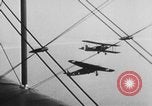
The U.S. Army Air Service Fokker C-2A named "Question Mark" being refueled in midair from a Douglas C-1, in 1929.
Mid air refueling experiments in January, 1929. A U.S. Army Air Service Douglas C-1 tanker plane, with hose trailing below it, flies above a modified Atlantic-Fokker C-2A named "Question Mark." The hose is let down to the Question Mark, where a crew member seizes it and makes a connection for fuel transfer. After transfer of fuel is complete, the crew member throws the fuel line off and it is retrieved by the tanker plane. The Question Mark lands at Metropolitan Airport, Van Nuys, California on January 7, 1929, and taxiis in to park. The crew members, including Major Carl A. Spaatz, Captain Ira C. Eaker, Lieutenant Harry A. Halverson, Lieutenant Elwood R.(Pete) Quesada, and Staff Sergeant Roy W. Hooe, all exit the airplane and gather under the wing with well wishers. The five crew members pose for photographs beside their airplane, the "Question Mark." Ground crew tows the aircraft with a tractor.

Albert Einstein speaks at a reception in California.
Albert Einstein seated with his wife Elsa Einstein at a reception in California, United States of America. Man on microphone introduces Einstein. Crowd claps as Albert Einstein takes his place on stage. Einstein dressed in tuxedo makes a speech.

A radio show called "Jubilee" featuring Rochester, Timmie Rogers, and Lena Horne
A U.S. soldier radio announcer introduces the radio program "Jubilee" as a band of Army musicians, in uniform, plays a fanfare. Opening montage features a man writing a V-mail fan letter to "Jubilee" to the Armed Forces Radio Service. Montage also shows V-mail staff women processing mail. Announcer Ernie 'Bubbles' Whitman then introduces 'Rochester' from the Jack Benny program. Lena Horne comes to mic and crowd applauds. Rochester and Lena Horne sing "Consequences." Timmie Rogers and Private Bate Wallace then perform, with Timmy Rogers singing, "Bring Enough Clothes for Three Days." Lena Horne is introduced again, finishing the program with the song, "That Man I Love." (World War II period).
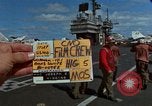
Airman services F-14 Tomcat aircraft of Squadron VF-1 aboard USS Ranger, California.
Activities aboard USS Ranger (CV-61). Digits '61' on island of the USS Ranger. Airmen converse on flight deck. Pilot in cockpit of aircraft F-14A on deck. Airman inspects lower section of F-14A. Man signals pilot from deck. Airman at landing gear of plane.

Crewmen aboard USS Ranger prepare F-14 Tomcat aircraft from Navy Wolfpack Squadron VF-1 for take off
Activities aboard USS Ranger. Crew members on flight deck of USS Ranger. Crewmen preflight F-14 aircraft. Pilot in cockpit of F-14 helmet painted in Wolfpack design. A crewman passes under nose of the aircraft. He works under and on one side of the plane. Crewman near tail hook under plane. Crew and pilot prepare for take off.
CRITICALPAST.COM: About Us | Contact Us | FAQs - How to Order | License Agreement | My Account | My Lightboxes | Shopping Cart | Advanced Search | Featured Collections | Website Terms & Conditions | Privacy Policy ©2026 CriticalPast LLC.
License Agreement |
Terms & Conditions |
Privacy Policy
©2026 CriticalPast LLC.