


 Francais
 Deutsch
 Italiano
Refine Your Search
Croydon London England United Kingdom 1932 stock footage and images
- Showing 187 to 192 of 26294 results more
more Hide
Hide
Recovery and improved economic conditions during the beginning of the Marshall Plan in Europe.
A documentary 'The Years of Decision' reviews the beginning of the Marshall Plan in response to recovery needs of the European people following World War 2. Busy streets and sidewalks filled with pedestrians in London as people walk in the city. Double decker buses and other vehicles driving past on a road in the background. People in France walking on streets of city, sitting in cafes, and buying food, produce, textiles and other items from market vendors with stalls and carts. Men and women buy things from shops. Scene changes to the Netherlands, with many men riding bicycles arriving or departing work at Heineken Brewery in Amsterdam (Heineken Brouwerij on Stadhouderskade). The Dutch words “Stoom Bierbrouwerij” (Steam Brewery) are seen on the building. A Dutch man in a textile factory works at a weaving machine. Scene changes to a coal mine area in the United Kingdom. British coal miners sitting in a train headed into a mine. A worker at the Fiat factory in Turin, Italy measures a small steel part used in manufacturing cars. Cattle on a farm walk near barns. A French farmer in France driving a tractor.
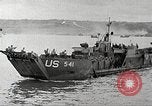
German prisoners of war leave Normandy en route to the U.S.A. , via England, in World War II
German prisoners of war in Normandy, during World War 2. LCI(L) 541 is seen departing from Omaha beach, filled with German prisoners of war. Scene shifts to a pier in England, United Kingdom, where the German soldiers and officers are boarding an American Coast Guard troop ship, for transport to Prisoner of War centers in the United States. Aerial view of an ocean liner, converted to a troop ship, underway. Views of German POWs on a ship's deck.
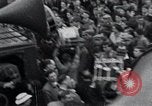
British Union of Fascists (BUF) leader Oswald Mosley with a cheering crowd marching in Manchester.
British Union of Fascists (BUF) leader Sir Oswald Mosley seen after he delivers a speech in Manchester, England, United Kingdom. Oswald Mosley steps down from a dais and passes through cheering crowd some of who deliver fascist salutes to him. Crowd is mostly men but includes some women. Background banner behind crowd reads, "Fascism Means War." BUF parade continues along streets of Manchester. Point of view from elevated camera position embedded with men marching in the street, with some cars moving slowly beside the marchers. Oswald Mosley speaks to a man along the road with parked buses behind.
British RAF bombers of No 2 Group bomb the Philips Electrical works at German-occupied Eindhoven, Holland, during World War II.
Film starts wirh slate reading: "R.A.F. Blasts Holland." At an Royal Air Force (RAF) base in England, United Kingdom, ground crewmen work on a British Supermarine Spitfire aircraft. Closeup of RAF pilot in cockpit of an airplane. Closeups showing fires burning and severe destruction of the Philips Electrical works at Endoven, the Netherlands, in aerial photographs taken during a bombing attack by RAF 2 Group, on December 6, 1942. Animated map illustrates the flight path of the attacking bombers from England, across the North Sea and the German occupied Holland, to Endoven. View of a de Havilland Mosquito bomber with propellers turning and then one of a Mosquito bomber in flight overhead. View from a warship of several RAF 2 Group aircraft flying low over the North sea. Glimpse of a Mosquito bomber flying low enough to affect the ocean surface. View from another aircraft in the formation, of a Mosquito bomber underway low over the water. View of a pilot in a cockpit, wearing learher helmet with earphones and an oxygen mask. View from aircraft approaching the coast of Holland, with two others already low above the mainland. More views of the bombers flying extremely low over Holland. View from a bomber showing agricultural land and the Philips Electrical works at Endoven, dead ahead. German flak guns fire and the bombers return fire by strafing the target building. The camera aircraft pulls up climb above the building and maneuvers over a river and city. Scene shifts to views from a high altitude group of RAF 2 Group, over the target. Views of their bombs bursting on target complex, causing fires and heavy smoke. Scene shifts, again to the bomber aircraft recovering at their home base in England. (Narrator states that 12 aircraft did not make it back.) View of a mosquito bomber crash landed. A severely damaged Lockheed PV-1 Ventura bomber. A crash landed Douglas A-20 Havoc bomber. Air crews conversing after arriving back from the mission. (Note: Losses to 2 Group were heavy, with 14 aircraft brought down by flak and enemy fighters, a 20% loss rate. Three more aircraft crash-landed on returning to England. Fifty-seven aircraft had been damaged and needed repairs.)
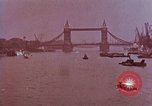
President and Mrs. John F. Kennedy visit London on the way back from Paris and Vienna, in 1961
Views of London Bridge and the Houses of Parliament in London, England. Closeup of Big Ben. Views of St. Paul's Cathedral, Trafalgar Square and Nelson's Column. Scene shifts to Royal Navy band, playing at London Heathrow airport, as the United States President's airplane, Air Force One, arrives. President John F. Kennedy and Mrs. Jacqueline Kennedy step from their aircraft and are greeted by The Lord Chamberlain, Roger Lumley, 11th Earl of Scarbrough, representing Queen Elizabeth II and by Prime Minister Harold Macmillan. The party walks on a red carpet and pauses for a salute from the Navy band. Lady Dorothy Macmillan and Mrs. Jacqueline Kennedy stand together next to the President's airplane, during these ceremonies. View of Admiralty House (temporary residence of the Prime Minister, due to renovation at 10 Downing Street). President Kennedy and Prime Minister Macmillan walk to the President's car following their consultations. President Kennedy and Mrs. Kennedy say their good-byes. Britons cheer as the car drives away. A new sequence shows guards parading during the Changing of the Guard at Buckingham Palace. Police strain to hold back crowds of spectators during arrival of President and Mrs. Kennedy, on June 5, 1961. But some manage to break through and approach closer as their car arrives, bringing the Kennedys for a private dinner with Queen Elizabeth II and Prince Philip, the Duke of Edinburgh. The next scenes show President Kennedy still in formal attire, from the Royal dinner, escorted to his airplane by Prime Minister Macmillan. U.S. Ambassador to the Court of St. James, David Bruce, is the last to shake hands with the President as he ascends the steps to Air Force One, which then taxis out for takeoff, at midnight. Scene shifts to the White House in Washington, DC, and President Kennedy's broadcast report on June 6th to the Nation about his trip.
1952 Kentucky Derby horse race in Louisville; Grand National Steeplechase in England.
Spectators gather as Hill Gail, the racehorse romped home to victory in the Kentucky Derby as Eddie Arcaro scored his fifth triumph in the turf classic in Louisville, Kentucky. People lined up at ticket windows to purchase tickets for the horse race. Hill Gail running. Scene changes to Britain and the Grand National Steeplechase at Aintree in England, United Kingdom. Several horses falling after leaping during the British race. Horse named "Teal" with jockey Arthur Thompson wins the race.
CRITICALPAST.COM: About Us | Contact Us | FAQs - How to Order | License Agreement | My Account | My Lightboxes | Shopping Cart | Advanced Search | Featured Collections | Website Terms & Conditions | Privacy Policy ©2026 CriticalPast LLC.
License Agreement |
Terms & Conditions |
Privacy Policy
©2026 CriticalPast LLC.