


 Francais
 Deutsch
 Italiano

Refine Your Search
Croydon London England United Kingdom 1932 stock footage and images
- Showing 2125 to 2130 of 26292 results more
 Hide

Formation of transport planes fly overhead at RAF Newbury (WW2)
Allied transport aircraft fly overhead at RAF Newbury in Berkshire, England during World War II. The transport planes release gliders. A Waco CG-4 Hadrian military glider bank as it lands on the airfield. Various military planes parked in the background. A formation of transport planes fly overhead. A British Airspeed AS.51 Horsa military transport glider. C-47 Skytrain transport plane tows a glider during takeoff.

German submarine UB-35 leaves port on mission during World War I
Early slates allude to failed attempts at peaceful resolution of issues between Germany and England, in World War 1, and the Kaiser's consequent decision on February 1, 1917, to intensify German submarine warfare against Britain. Slate refers to Churchill's admitted concerns expressed in the "Sunday Pictorial," about the resulting constraint on England's control of the seas around the British Isles, referring to the U-boats creating a magic girdle (Magischen Gurtel) around England, which becomes the title for the film. In the first part, Captain, Lothar von Arnauld de la Periere of the German U-boat UB-35, stands in a skiff as he is rowed out to his submarine. He exchanges salutes with his officers, as he boards the U-35, nestled against a German ship. He gives the order to cast off the lines and proceed half power in reverse. The crew scrambles to get underway. German sailors on the nearby ship watch from her railings. Sailors use a long pole to help move the submarine away from the ship. Officers and men on the ship wave as the U-boat pulls away. Views from the submarine deck as it moves on the surface of the water heading toward the Mediterranean Sea. (World War i; World War 1; WWI; WW1)

Images of European immigrants to America around turn of the 20th Century
Camera pans over still images of late 19th and early 20th Century immigrants to America. One group photo shows men standing around women seated. Voice of an old man, from Liverpool England, narrates as camera shows more views of immigrant families. Scene shifts to that man speaking of the hardships and poverty of immigrants he witnessed passing through the port of Liverpool, England.

Artists writing, composing, painting and sculpting; Children in classroom, and radio operators at work in a radio station.
Close-up view of hands of man writing on a notepad while smoking a cigarette. Close-up view of hands of male artist painting a picture on a canvas at an easel. Close-up view of hands of music composer writing a musical composition. A sculptor with a mallet working on his stone sculpture. Hands of a person such as a film editor seen examining a long strip of movie motion picture film. British children sitting at wooden desks in a school classroom in England reading books. Radio operators in a studio room working at large radio broadcast equipment. Close-up of hand of radio studio engineer operating a dial on radio equipment. A radio broadcaster in a studio sitting in front of a microphone.
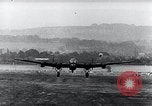
Design description of the British Lancaster Bomber and differentiation from other bomber aircrafts
Aircraft recognition training film. British Lancaster Bomber in England. Lancaster moves on runway and takes off. Lancaster is the modified version of Manchester bomber used earlier. Differentiation of Lancaster from other heavy bomber aircraft. Drawings contrast the design of the British Lancaster with the following: Manchester, Russian TB-7, German FW-200, British Halifax, American B-17E, British Stirling and American B-24 heavy bombers.

Air attacks on Britain by Germany and the counter-attack by British Royal Air Force during Battle of Britain in World War II.
British defense against German aerial warfare in Battle of Britain during World War 2. A British soldier looks through binoculars and another soldier sits. A soldier on a tank. German aircraft in flight above the English Channel. The planes drop bombs on the British ships. Explosions in the water of the English Channel. Royal Air force (RAF) pilots are scrambled on alert and run towards their planes. The planes take off. British planes attack the German planes and engage in aerial dogfights. A German plane falls in the ocean. Damaged German plane. 180 more German planes put to attack. A pictorial representation shows the places in England attacked by Germany. Explosions on the ground. Various British Spitfire and Hurricane aircraft in the air and on the ground. German attacks on Southampton and British ports. German bomber aircraft dropping bombs on British airfields, but British aircraft seen hidden individually near farms and homes and not grouped together in order to evade destruction by German Luftwaffe bombing campaigns.
CRITICALPAST.COM: About Us | Contact Us | FAQs - How to Order | License Agreement | My Account | My Lightboxes | Shopping Cart | Advanced Search | Featured Collections | Website Terms & Conditions | Privacy Policy ©2026 CriticalPast LLC.
License Agreement |
Terms & Conditions |
Privacy Policy
©2026 CriticalPast LLC.