


 Francais
 Deutsch
 Italiano

Refine Your Search
Croydon London England United Kingdom 1932 stock footage and images
- Showing 2179 to 2184 of 26292 results more
 Hide

North German Lloyd ocean liner Bremen, underway at sea heading for Southampton England
Starboard side of Bremen Ship underway at sea, at high speed. Bow wave and wake visible. Ship is heading for Southampton. Port side of the Bremen underway at sea. Smoke emits from the two stacks of the ship.
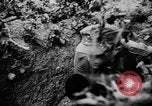
Germany launches V-1 flying bombs against England during World War II
Initial scene shows German soldiers setting up a camera, in a camouflaged location, during World War 2. . Views from the water, of the White Cliffs of Dover, on the English Channel coast. Suddenly, a jet-propelled V-1 flying bomb is seen racing past the camera and disappearing in the distance. Next the camera focuses on another V-1 and tracks it. Its body, wings, and jet engine affixed to its top, are clearly seen. as are pulses of flame from its engine. Another V-1 launches from near the camera and flashes past, disappearing in the distance. The final scene shows a V-1 in flight, even clearer than the earlier views. (Note: The V-1 was also known as a buzz bomb or doodle bug was the first cruise missile used in wartime.)
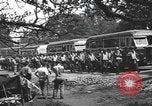
Allied forces assemble in England and depart for the invasion of Normandy in World War II
American paratroopers of the 82nd Airborne Division, boarding hired British commercial buses that take them to a marshaling point, in preparation for the invasion of Normandy, France, in World War 2. Views from below of U.S. Army Air Forces C-47 transport aircraft in formation, carrying paratroopers toward Normandy, France, on June 5, 1944. Aerial view of British and American invasion ships en route to rendezvous off the Isle of Wight. U.S. Army Air Forces B-26 and B-17 bombers in flight. B-17 dropping bombs on lines of communications in Normandy, to hinder German movements of reinforcements. Allied warships and transports beginning their move toward the coast of Normandy. British landing craft underway under cover of barrage balloons.
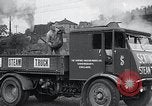
A new high capacity steam truck demonstrated at Bluefield in West Virginia, USA.
A new high capacity steam truck demonstrated at Bluefield in West Virginia, USA. The manufacturer's name, ' THE SENTINEL WAGGON WORKS LTD, SHREWSBURY, ENGLAND ' written on the truck. The loaded truck moves uphill. Additional information on this truck: This is the Sentinel S4 steam waggon, Number 9095. Built 1933 by Sentinel Waggon Works, Shrewsbury, England and exported as a demonstration vehicle to the USA with a works driver. Within a short time the vehicle was involved in an accident and overturned, requiring it to be returned to the UK. Many of the salvageable parts, especially those used to convert it to left hand drive were then fitted to a 6 wheel waggon No 9142 which was sent as a replacement. This vehicle was later purchased by the Pocahontas Coal Company of New Bedford. After a very short working life it was displayed at the Long Island Motor Museum, and Steamtown before being reaptriated to the UK in 2003.

Aviation History in France; early airplane history and notable French aviation pioneers.
Scene of a symbol which demonstrates man's desire for flight. Painting of Leonardo da Vinci. Drawing of Leonardo da Vinci's flying machine. Views of drawings of the attempts of man to fly. Photo of Clement Ader. Drawing of Ader's plane. Still photo of the first powered Wright Brother's plane. Still photo of one of Ader's planes. Photo of Louis Blériot. Gabriel Voisin's photo. Picture of Robert Esnault-Pelterie. Two French designers. Robert Esnault-Pelterie making a test by mounting a glider atop a truck. Gabriel Voisin towing a glider with boats on the Seine River. He stayed airborne for several seconds. Photo of Alberto Santos-Dumont. The plane in which he made several flights. A plane made by Gabriel Voisin "La Bagatelle" which was flown by his brother Charles Voisin. Scene of this flight. Henry Farman seated in plane. Several views depicting the first attempt to fly the English Channel. Three competitors were Count Lambert in a Wright Plane at Wissant, Hubert Lathan in Antionette IV at Sangatte and Louis Bleriot (winner) flying a monoplane of his own design from Los Baraques to Dover. Single of Bleriot's plane. Observers of the flight. The English Channel. The wreckage being salvaged by French boat. Wreckage of plane as it is lifted out of the channel. Wreckage being pulled down streets. Louis Bleriot walking on crutches. Bleriot standing in cockpit of plane prior to, attempting to fly the English Channel at Les Baraques. The takeoff. Observers watching the landing at Dover, England. Two men standing on roof top waving a flag. Field, tent and personnel at Dover, England where the landing was made. English people examining plane after landing. Ship on which Bleriot returned to France. Reception committee greeting him. Street scenes of his reception in Paris.

The freighter, SS Flying Enterprise, damaged by storms and foundering in the Atlantic ocean,
The freighter, Flying Enterprise, is seen listing some 80 degrees to port in the windswept approaches to the British Isles. After suffering damage from a storm on December 28th, she had been taken under tow toward England,by a succession of ocean-going tugs over a period of 15 days. Her present position is only about 30 miles from the coast of England, but her tow line has parted and she is foundering. Closeups of "Flying Enterprise" and "Isbrandtsen" painted on her hull. (Narrator states that the Captain, Henrik Kurt Carlsen,is still aboard.) Aerial view of several other ships around the stricken vessel. Officers and crew of the destroyer, USS Willard Keith (DD-775), are seen firing a line to the Flying Enterprise. Heavy seas are flowing over the foredeck of the destroyer. Another view of the listing ship. (During these scenes, Captain Carlsen is heard on the radio, in the background, describing the circumstances leading to their present trouble.) More views of the Flying Enterprise, helpless and battered by wind and seas, before eventually sinking (not seen). Narrator states that Captain Carlson was rescued. (Note: This ill-fated trip which ended in the sinking of the old Liberty Ship made world-wide news when it turned out that she was carrying paper money.)
CRITICALPAST.COM: About Us | Contact Us | FAQs - How to Order | License Agreement | My Account | My Lightboxes | Shopping Cart | Advanced Search | Featured Collections | Website Terms & Conditions | Privacy Policy ©2026 CriticalPast LLC.
License Agreement |
Terms & Conditions |
Privacy Policy
©2026 CriticalPast LLC.