


 Francais
 Deutsch
 Italiano

Refine Your Search
Croydon London England United Kingdom 1932 stock footage and images
- Showing 2203 to 2208 of 26292 results more
 Hide
Role of the Jeep in U.S. military operations during World War II.
A U.S. Army Air Forces (USAAF) Waco CG-4A-WO glider is seen descending and landing in a grass field. Upon touchdown, its front pops open and and an army jeep drives out. USAAF C-47 aircraft are seen next, offloading jeeps pulling small artillery pieces, and infantry who move rapidly from the parked aircraft. Jeeps traversing a high hump in a dirt road. A jeep towing an M-3 Antitank Gun 37mm, and others driving through underbrush and bouncing over rough road while towing 37mm guns and trailers. Soldiers stepping from jeeps to set up machine guns. American soldiers playing a game of horse and rider, during a break in duties. Soldiers setting up mortars. Jeeps driving through bodies of water. Two M4A1 (76)W Sherman tanks, with cast steel hulls, drive into a stream. Troops setting up several 37mm guns on a river bank. Two soldiers in a communications jeep. Army officers perusing a map laid out on the hood of a jeep. U.S. field artillerymen using periscopic binoculars on tripods, to spot and direct gunfire. Military vehicles, including jeeps, moving across desert terrain. Artillery crews firing M59 (M2 Long Tom) 155mm guns. A Douglas A-26 Invader aircraft flying overhead. Jeeps in various roles, bouncing along in the desert and laying smoke screens. Jeeps equipped with M3 anti-aircraft guns and others with stretchers for wounded affixed to their sides. U.S. Army Ford GPA "Seep" amphibious jeeps plunging into water and continuing on as boats. A jeep production and assembly line in a U.S. factory showing stages of assembly and finished jeeps driving out of the plant into yards containing hundreds of them. A convoy of jeeps driving over a bridge, and others carrying a U.S. military brass band in a parade in England. A Hollywood actress (Gloria Swanson?) being lifted into a jeep by several men. Glimpse of an unidentified actress with an American soldier, in a jeep. Hollywood stars, Stan Laurel and Oliver Hardy clowning in the front seat of a jeep with Desi Arnaz and two women riding in the back. Several jeeps carrying these and other Hollywood personalities during a war bond parade in Washington DC. The Capitol looming in the background as the jeeps move away from it toward the camera. Jeeps being prepared for transport to overseas destinations. Jeeps being partially disassembled and loaded into wooden crates and placed on rail cars for transport. Jeeps being hauled by cranes and placed aboard ships. Landing crafts mechanized (LCMs) transporting infantry and vehicles, including jeeps. An M4A1 Sherman tank driving out of a landing craft into surf. A jeep being driven onto beach at Adak,in the Aleutians,from a landing craft of the USS J.Franklin Bell (AP-34), in 1942. In 1943, this transport ship was reclassified as APA-16.) American troops with jeep on a South Pacific island in World War 2. A soldier on motorcycle, skids in mud on road in North Africa, and jeeps drive past him. American soldiers ride camels and some drive in a jeep near the Great pyramid and Sphinx in Egypt. Jeeps seen in China, with Generals Joseph Stilwell and Claire Chennault. One parked next to a Flying Tiger P-40 airplane. Soldiers in a jeep in Alaska, next to a tent and sign pointing to "Tokyo." Local tribesmen literally carrying a jeep, on long poles, across a river in Timor. General Douglas MacArthur, accompanied by staff officers, being driven in a jeep along a jungle road in New Guinea, past a line of local tribesmen. Wendell Wilkie, serving as Ambassador-at-large, during the war, speaks to U.S. officers in a jeep. Britain's King George VI in a jeep followed by another carrying Queen Elizabeth. President Franklin D. Roosevelt riding in a jeep to review troops. He removes his hat as they pass the American flag. Sign on a building in North Africa reads "Bizerte." General George S. Patton, standing in a jeep during a victory parade in North Africa. Soldiers at an outdoor religious service during the war with the hood of a jeep serving as a make shift altar.Various views of jeeps driving with soldiers in them.
Conditions leading to the dust bowl on the American Great Plains
A homestead on a farm in the U.S. Great Plains. Horse carts break the plains. A woman sweeps stairs. A man and a child stand on the plains near the plow. An explosion on the land. World War 1 news headlines: 'England declares war on Germany, Belgium invaded, French win at sea' and 'War news tumbles securities, Stock Exchange Closed, Wheat Prices Soar'. A man drives a tractor with a plow on a plain land and dust cloud rises. The plow breaks the plains. News headlines: 'Wilson proclaims war, Spy ring arrested, German ships seized' and 'War sends wheat soaring, Grain up 13 points, Pit in Pandemonium'. The postwar decline of the wheat market results in overproduction: Farm machinery is used to sow the land. Wheat grains are poured into a thresher. A steamer at a sea. Tractors are driven and plows break the plains. A dust storm in the foreground during dust bowl era. Overproduction of wheat. Notice of 'Farms for Sale' in lower prices. Farm machinery is used. The sun rises in the background. A notice of 'Own a farm away from home'. Overproduction of wheat is shown. Over-exuberance in roaring 20s market is shown by a stock market or commodities market ticker running large amounts of ticker tape and a scene of a 1920s African American jazz musician drummer playing the drums enthusiastically and smiles while another band musician in the background plays bass.
Beginnings of successful powered heavier-than-air flight. Wright Brothers flights in U.S. and Europe. General Hap Arnold
History of aviation. A balloon in flight. Historic glider such as that which interested U.S. War Department as early as 1898. In 1903, a crew of men moving a Wright Flyer into position. Two men turn over propellers on a Wright Flyer, and the engine starts. View of the Wright-designed water-cooled engine. View of Orville Wright. The famous first powered flight, at Kitty Hawk, North Carolina, with Orville Wright at controls. Animation shows that 120 foot flight juxtaposed against a B-36 wing. Wilbur Wright in Europe, in 1908, gesturing as he converses with interested parties. A gallery of spectators including the President of France, King of England, King of Spain, and King of Italy. Wilbur Wright places a wheel under the right wing of a Wright Flyer and lashes it to the strut. A team of horses pulls the plane across the field. Men maneuver the plane onto a monorail on the ground. Men pull on a heavy rope to raise a weight in a tower, for a catapult. Two men spin the propellers and the Wright Brothers airplane motor starts. Wilbur Wright and his passenger, a French journalist, board the plane. The catapult weight drops, launching the aircraft which flies low over the field. U.S. President Theodore Roosevelt speaking (He is seen on a podium campaigning for the Bull Moose Party nomination at the Kansas State Fair in Hutchinson, Kansas on September 22, 1912.) War department issues specifications for a heavier-than-air craft. Reenactment of a Wright brother signing a bid contract. A Wright Flyer airborne at Fort Myer, Virginia, as the Wrights meet the Army specifications and sell, U.S. Army airplane number 1, to the War Department, in 1908. Gold Aviator wings being pinned on the uniform of a U.S. Army pilot. Photograph of Army Air Forces Chief, General Henry (Hap) Arnold, wearing his original aviator wings on his service uniform. A Glenn Curtis training airplane starting up and taking off. View of a DH-4 airplane and a Wright Flyer taking off together.

U.S. Army training film entitled: "Barrage Balloon, Low Altitude, Cable Armament."
Behind opening slate, is a closeup of Barrage Balloon with cables attached. Next, a formation of German Ju-87, Stuka dive bombers peels off and begins diving attack against Allied target in Europe during World War 2. Closeup of bombs dropping. A formation of German Heinkel He-111 bombers in flight. A German Dornier Do-215 long range bomber in flight (notable features: twin tail and tail wheel). A German Messerschmitt Bf-109 rolling over to attack a ground target. Low flying German warplanes attacking bases and supply depots. German planes strafing an Allied air base. A fire raging from bombing somewhere in England. Scene shifts to a formation of American barrage balloons creating a maze of wire cables to prevent low flying enemy aircraft from striking important ground targets.
Farm machinery is used and postwar (WWI) decline of the wheat market results in overproduction in the Great Plains in the U.S.
A homestead on a farm in the U.S. Great Plains. Horse carts break the plains. A woman sweeps stairs. A man and a child stand on the plains near a plow. The homesteaders look towards the sky in hope of rain. An explosion on the land. News headlines: 'England declares war on Germany, Belgium invaded, French win at sea' and 'War news tumbles securities, Stock Exchange Closed, Wheat Prices Soar'. A man drives a tractor with a plow on a plain land and dust cloud rises. The plow breaks the plains. News headlines: 'Wilson proclaims war, Spy ring arrested, German ships seized' and 'War sends wheat soaring, Grain up 13 points, Pit in Pandemonium'. The postwar (WWI) decline of the wheat market results in overproduction and spurs dust bowl conditions: Farm machinery is used to sow the land. Wheat grains are poured into a thresher. A steamer at a sea. Tractors are driven and plows break the plains. A dust storm in the foreground. Overproduction of wheat shown. Farmers celebrate the production of wheat. Tractors driven in the Great Plains.
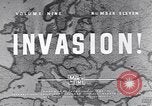
News media military analysts discuss the problems of Allies invading Europe to defeat Germany in World War II
Map of Europe and label "Invasion." Westbrook Van Voorhis leading a panel discussion about the problems arising from the Allied invasion of Europe in World War 2. He introduces panelists: Hanson Baldwin (military editor of the New York Times) Dewitt MacKenzie (Associated Press military analyst), and Paul Schubert (of Mutual Radio Network). He asks Mr. Baldwin about the importance of aerial bombing campaigns. Baldwin also stresses importance of a land invasion of Europe. Relief map of Europe highlighting major German cities. Asked about the merit of invading Italy on the way to Germany, Mr. Schubert cites the problem of the Alps and suggests other more effective invasion routes. Van Voorhis asks Mr. MacKenzie about best route into fortress Germany. He considers the criterion of ease of supply as most important, and suggests the Atlantic coast, near a good port and not far from England. Animated map shows this idea. When asked about this, Mr. Baldwin agrees completely, calling the conflict "a quartermaster's war." He adds, "The problem of victory is the problem of supply."
CRITICALPAST.COM: About Us | Contact Us | FAQs - How to Order | License Agreement | My Account | My Lightboxes | Shopping Cart | Advanced Search | Featured Collections | Website Terms & Conditions | Privacy Policy ©2026 CriticalPast LLC.
License Agreement |
Terms & Conditions |
Privacy Policy
©2026 CriticalPast LLC.