


 Francais
 Deutsch
 Italiano
Refine Your Search
Croydon London England United Kingdom 1932 stock footage and images
- Showing 235 to 240 of 26294 results more
more Hide
Hide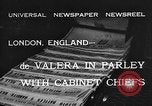
President of the Executive Council of Ireland Eamon del Valera meets cabinet chiefs in London, England.
President of the Executive Council of Ireland Eamon del Valera in London, England. Eamon del Valera and English cabinet chiefs come out of a building after a meeting. Del Valera shakes hands with cabinet chiefs. He leaves in a car. Car moves down a road as civilians look on.
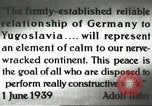
Tripartite Pact signed by Germany, Italy and Japan in Berlin, Germany. Ensuing attacks by Germany and Japan in World War II
This film is a scattering montage of World War 2 scenes from 1939 through 1945. Part of an agreement between Nazi Germany and Yugoslavia is shown in English. It is dated June 1, 1939 and ostensibly signed by Adolf Hitler. Next, German Ju 87, Stuka dive bomber aircraft are shown peeling off from formation, on April 6, 1941, to attack Yugoslavia. Bombs bursting on the ground. Closeup of a Stuka airplane in a dive, making its characteristic whine, and dropping bombs. Bombs exploding just outside some concrete walls. German infantry running along railroad tracks and entering backyard of house in a village. German soldiers observing from overlooking hill; climbing over rubble; and marching along a road toward a village. Animated map showing German invasion areas early in World War II, extending through most of Europe and into Norway, by 1941. Animated map shows further invasions into France, Belgium, low countries, the Balkans, and Eastern front towards the Soviet Union. Map highlights Tokyo, Rome, and Berlin. Delegations walking in hall of Reich Chancellery in Berlin, to sign Tripartite pact, on September 27, 1940. The group is led by by Count Galeazzo Ciano (Italian Foreign Minister, and Mussolini's son-in-law); Joachim von Ribbentrop, Germany's Foreign Minister and Japan’s Ambassador Saburō Kurusu. The diplomats are seen, next, standing near a table as Adolf Hitler enters rendering Nazi salute. He shakes hands with Count Ciano and Ambassador Kurusu. Hitler is seated to watch the proceedings. Von Ribbontrop is seen signing for Germany. Next scenes show German armored units heading East in Operation Barbarossa (June of 1941). A sign identifies the town of Eydtkau (Eydtkuhnen) on the German-Lithuanian border. German armor and artillery moving eastward. German troops destroying international crossing barriers. German troops firing siege guns. Montage with glimpses of German battle scenes showing tanks, guns, rockets in action with attendant explosions, fires, and destruction. Formations of German warplanes in flight, including Junkers Ju-52s that carry troops, including paratroops. View from above of Junkers Ju-87 Stuka dive bombers in formation. Battle of Britain scenes, with view of St. Paul's Cathedral in London, England (which miraculously survived the Blitz). The Tower Bridge in London, seen through a haze following blitzkrieg. German Junkers 87 Stuka dive bombers peeling off from formation to attack. British anti-aircraft searchlights shining beams skyward. Diving bombers illuminated by the lights. Anti-aircraft guns firing. Nighttime scenes showing gunfire flashes, explosions, tracer bullets and fires in London. British fire brigades fighting fires in London buildings as some collapse from the German bombing during the so-called "Blitz." Scene shifts to Pearl Harbor, December 7, 1941, as a Japanese bomb explodes on a U.S. Navy warship. The USS Arizona billowing smoke and listing as it succumbs to Japanese bombing. Another view of the Arizona sinking. Smoke rising from Battleship Row, at Pearl Harbor. Glimpse of postwar Nuremberg trial.
European immigrants aboard ships and on their way to America via Liverpool
From a 1975 production on European immigration to America, with a mix of modern interviews, historical footage circa 1905-1910, and historic still images of immigrants. Elderly immigrant to the United States recalls his experiences. Picture of men with shaved heads having arrived at Ellis Island processing facilities after being sprayed and shaved for decontamination measures. European immigrants aboard ships. Band play music at port as immigrants embark on boats and ships. Animated map connects Hull and Liverpool. Vintage footage of old steam Passenger train as it runs on route from Baltic regions to Liverpool, England carrying European immigrants bound for America. View of Liverpool harbor and port areas. Ships at port in Liverpool. Passengers at railway station. Old man shares his memories of watching immigrants pass through Liverpool. People on horse-drawn carriages in Liverpool streets bound for Lime Street Station. One covered carriage with sign on side "London Northwestern Railway Collecting Van For Fast Train Traffic" passes by on Lime Street with St George's Hall in background. Another more simple carriage has a sign "Lucania" on it. Immigrants in Liverpool aboard ocean liners at dock, including the RMS Lucania (which clarifies this footage as before 1909). Passenger Ocean liner underway in heavy seas. View from ship with waves crashing over bow during heavy seas. Old woman shares her experience aboard the ship then, commenting on problems of seasickness among the immigrant passengers in the forward steerage compartments.
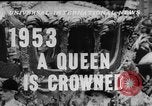
Elizabeth II crowned as the Queen of the United Kingdom
The 1953 coronation ceremony of Queen Elizabeth II at the Westminster Abbey in London, England. People gathered at the Parliament Square Garden at the northwest end of the Palace of Westminster, near the Big Ben. British nobles and peerage in elaborate attires. Prince Philip, Duke of Edinburgh, watches the ceremony. Coronation Maids (Lady Rosemary Spencer-Churchill; Lady Jane Vane-Tempest-Stuart; Lady Moyra Campbell, Lady Mary Russell, Lady Anne Coke) trailing behind Queen Elizabeth II. The Bishop of Canterbury Geoffrey Fisher crowns Queen Elizabeth with the St. Edward’s Crown. A large crowd gathered outside the Buckingham Palace. People cheer the new Queen as Elizabeth II acknowledges them.
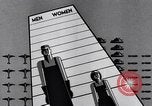
American women at home and work in the context of WW2
Graph compares the number of female factory workers to men during World War II. Factory workers producing war materiel in the United States. Workers using lathe. Welders welding machines. Tanks are loaded onto rail freight cars. Railroad freight yards and shipping. Posters advertising war jobs for women. Women interviewed for war jobs by men. Alarm clock rings as tired woman wakes up in bed. Women in front of Sterner's Department Store and buying fur coats. Women reading newspapers while smoking. Crowd trying to get onto an overcrowded bus. A mother comforts her boy who has skinned his knee. Men and women leaving a factory. Interior of World War 2 airplane factory. Soldier examines broken radio on battlefield. Wounded American soldiers carried on litters. A telegraph is delivered to a woman by a girl. Woman reads the telegraph. Woman crying in bed while reading the telegraph that announces her husband's death, while her son comforts her. Close up photo of deceased husband. Montage of graveyards with gold star of service superimposed on image. Newspaper headline "All Job Deferments Face Drastic Review" View of men inside Selective Service local board 226 office. Some men being drafted then in 1944 are shown, including older men, more fathers, and men who had been doing essential industrial work. Man working with metal lathe. American soldiers climbing mountain in snow in Italian mountains. American soldiers wade through deep water in a jungle region of the Pacific. View of a sinking ship or merchant ship, and two crew members jumping off the sinking ship into the water. View of London England blitz damage and devastation, and people digging through piles of rubble from bombing. Dead bodies of adults and children from war in Europe. Crying women, London Blitz. Woman holding boy in arms. Woman kissing girl. Old woman sewing in factory to help with the war production effort. Women picking crops to help with farming and supply of food for soldiers.
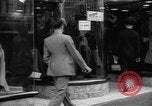
Regent Street, Great Smith Street and Bank Station in London, England. Signs at Oswald Mosley book stand and at Charing Cross.
The Regent Street in London, England near start of World War 2. A tailor shop. A poster in the shop reads 'Order now, prices may rise, so why wait'. Pedestrians walk along the street. A Fascist book shop in Great Smith Street, Westminster. Sign on the shop reads 'The Greater Britain, by Oswald Mosley'. Sign at shop reads, in part, "Declare with Mosley that Britons will fight for Britain only. Mind Britain's Business! The parties want war to save Czechoslovakia for a politicians' quarrel. Mosley says: Save Britain for Peace & People." People buy newspapers on streets in Central London. British civilians entering the underground at Bank Station tube entrance by the Bank of England. Sign above stairs says, "Public subways lavatories and Waterloo Line." Double decker buses and Central London buildings in background at Bank Junction. Royal Exchange building is seen. People buy newspapers. Headlines of the newspapers read 'To-day's Cabinet on Czech crisis'. Vehicular traffic and buildings in the background. Near Charing Cross station, with Eleanor Cross in background, newspaper vendor sells papers. Placard advertisement reads 'What Hitler Said'.
CRITICALPAST.COM: About Us | Contact Us | FAQs - How to Order | License Agreement | My Account | My Lightboxes | Shopping Cart | Advanced Search | Featured Collections | Website Terms & Conditions | Privacy Policy ©2026 CriticalPast LLC.
License Agreement |
Terms & Conditions |
Privacy Policy
©2026 CriticalPast LLC.