


 Francais
 Deutsch
 Italiano

Refine Your Search
Croydon London England United Kingdom 1932 stock footage and images
- Showing 25123 to 25128 of 26292 results more
 Hide

A smoke generator throws a heavy smoke screen at the IX Corps camp in California.
Tanks and troops moves across the desert at U.S. Army IX Corps camp in California during World War II. A smoke generator mounted on a truck throws a heavy smoke screen. Billows of smoke rise up.

U.S. soldiers decontaminate combat vehicles and tanks during training; also flashback WW1 mustard gas aftermath scenes
World War 2 training film teaching U.S. soldiers about decontamination of combat vehicles, at Aberdeen Proving Grounds in Maryland. Soldiers during a decontamination procedure with real mustard gas. The soldiers in armored vehicles. A group of soldiers prepares for the decontamination. An aircraft flying at low height. A stationary U.S. Army Pershing tank. Two soldiers in a jeep. Soldiers wearing gas masks decontaminate a vehicle. Flashback scenes to August 1918 in World War I in France, with many mustard gas attack victims being cared for at a field hospital (which narrator says is Field Hospital number 326). Medic washing eyes and face of a World War 1 gas attack victim. Next view is a soldier in 1942 with mustard gas burns on his hand, being treated by a medic. Next scene returns to World War 1 in 1918, showing mustard gas burns on arms, hands, legs, and feet of U.S. Army soldiers.
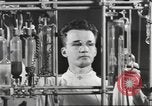
U.S. soldiers decontaminate various combat vehicles during a training in Maryland.
U.S. soldiers train for gas attack and chemical warfare decontamination at Aberdeen Proving Grounds in Maryland during World War II. A scientist working in a chemical laboratory with many vials before him. Two soldiers spreading a protective ointment in their hands. A soldier decontaminating a tank. A soldier wearing a mask spraying a protective liquid on a gun. A soldier spreading the protective ointment on his helmet. Many soldiers in front of U.S. Sherman tanks decontaminating cloth covers. Soldiers sitting on a tank cover it with a decontaminated cloth. Two soldiers issue impregnated clothing to a soldier. A World War 2 soldier covers himself with a protective cellophane cover. A soldier decontaminating a half track using Decon filled with DAMC. Soldiers filling a truck with chloride of lime containers.
U.S. soldiers demonstrate vehicle decontamination at Aberdeen Proving Grounds in Maryland in WWII.
U.S. soldiers demonstrate gas attack and chemical warfare decontamination techniques at Aberdeen Proving Grounds in Maryland during World War 2. An aircraft generates a heavy smoke screen. Another aircraft sprays the smoked area with a chemical. Soldiers on a half track put on cellophane cover and, once covered, they put on gas masks. They then practice attacking the aircraft while wearing the protective equipment. The cellophane and the combat vehicles are heavily contaminated by the chemical. The soldiers remove the cellophane cover and throw them out. Soldiers take on decontamination procedures.
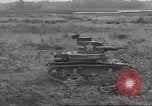
U.S. soldiers demonstrate decontamination of a combat tank at Aberdeen Proving Grounds in Maryland.
U.S. Army soldiers demonstrate decontamination of chemical agents such as mustard gas from a combat tank at Aberdeen Proving Grounds in Maryland, during World War 2. A tank moving on a training ground. Two soldiers decontaminate the vehicle using a spray (second echelon decontamination using Decon 3 devices, which are 3 gallon sprayers). One soldier stands on the tank and decontaminates it. Under carriages heavily encrusted with mud. Two soldiers spreading lime on the ground. A tanker passes through the lime mud slurry to coat the track and wheels. Two soldiers spraying a tank with high pressure water to remove mud from the under carriages. Now they spray the tanks with lime. A water tanker arrives. An aircraft passes over at a low height. A heavy smoke screen in the background. Soldiers wearing cellophane protective covers. Narrator states that the training procedures shown were conducted with real mustard gas.

World War II veterans adjusting to civilian life after discharge after WW2
First scene shows the State Capitol building (350 State St, Salt Lake City, UT 84103) in Salt Lake City, Utah. Next a sign identifies a military separation center in Fort Douglas during post-war demobilization. Soldiers in uniform are being processed for separation from the U.S. Army. A sergeant salutes an officer and receives his discharge papers. Narrator identifies Corporal Kirk being processed by a sergeant. He later salutes and receives his discharge papers. Corporal Kirk steps down the stairs from a house, arm and arm with his girlfriend. They are seen enjoying a soda together. Next, they shop together for a civilian hat for him. Then they share shopping for a complete civilian wardrobe. They share time skiing together. Glimpse of some national parks in Utah and of the great Salt Lake. View of people floating easily in the dense waters of the salt lake. Views of the Mormon Salt Lake Tabernacle (50 N W Temple St, Salt Lake City, UT 84150). The couple stroll streets of Salt Lake City. They visit the Veterans' Information Service. He sits with an advisor. View of Provo, Utah and the Geneva Steel Company there. Exterior views of the industrial steel plant. Hot coke being discharged into special rail cars. Steel plant operations with fiery molten steel being poured from Ladles. Billets of steel being formed. Open rail cars full of ore at the Columbia Iron Mine, Cedar City, Utah. A steam shovel loading ore into a truck. Coal mined and moving on conveyers. Miners leaving a mine in open box cars. Miners in rail cars entering a mine. A sign reading: "Welcome, Binghan Canyon, Home of the World's largest Open Cut Copper Mine, Drive Carefully!" Views of the open mine with numerous terraces cut into the walls. A steam shovel digging and loading copper ore into rail cars that carry it away across rail bridges. A sign for the Eitel-McCullough, Company, Inc. where radar tubes are currently being made. Several women employees in the plant.
CRITICALPAST.COM: About Us | Contact Us | FAQs - How to Order | License Agreement | My Account | My Lightboxes | Shopping Cart | Advanced Search | Featured Collections | Website Terms & Conditions | Privacy Policy ©2026 CriticalPast LLC.
License Agreement |
Terms & Conditions |
Privacy Policy
©2026 CriticalPast LLC.