


 Francais
 Deutsch
 Italiano

Refine Your Search
Croydon London England United Kingdom 1932 stock footage and images
- Showing 3559 to 3564 of 26293 results more
 Hide

Dey Mansion being turned into George Washington's shrine in the United States.
Dey Mansion (199 Totowa Rd, Wayne, NJ 07470, United States) in United States. People gathered around the Dey mansion for a ceremony. Two horsemen in the center as people remain seated. Men climb up the stairs of the mansion. An American flag hoisted at the ceremony. A stone being unveiled as the house is turned into George Washington's shrine.
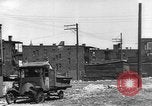
Slum dwellers move into newly and well constructed apartments in United States.
Urban renewal after World War II. Improvement in housing facilities in postwar era in the United States. Dilapidated slum and tenement housing dwellings in poverty stricken areas of the United States. Poor housing conditions in slums as children play outside houses. A woman throws dishwater out into back yard. Clothes being hung on clothes lines. A boy entering an outhouse at a home where there is no indoor plumbing. A man pumps water outside his house. A woman with her child in the balcony of an older city house. Slums being razed. Workers using crowbars to break down brick walls. Worker lifts hopper allowing demolition debris from gutted building to slide into his dump truck. Slum dwellers move out of older homes with help of horse-drawn moving wagons, and they move into newly constructed multi-story apartment buildings. Trucks loaded with household belongings outside the apartments. People move into their new and better houses. Belongings being unloaded from the trucks as a group of young boys gather outside and watch.
The use of colored grenades by a unit cut off from its headquarters during combat in WW2.
The types, uses and importance of colored smoke grenades during combat in WWII. An enactment shows a unit in a forest which has been cut off from its headquarters. The leader of the unit sights a friendly reconnaissance plane and throws a green smoke grenade to signal their position. Another grenade burns indicating their immediate need. The pilot of the aircraft throws a sign grenade. He signals them the way to be followed by throwing a red smoke grenade along the road to be followed.

Franklin D Roosevelt signs peace time draft and troops march with flags in hand in United States.
Franklin D Roosevelt signs peace time draft to boost armed forces in United States. United States troops assemble at camp base. Troops march on open field with American flags in hand.

United States Army soldiers use sound deception to deceive the German in Film 'Sonic Deception'.
Film 'Sonic Deception' shows the use of sounds to deceive the enemy (sometimes described as the "Ghost Army" in World War 2). Dramatization shows United States troops crossing river in small boats and arriving on beach. They establish beachhead on river bank and defeat German troops located there, having arrived by suprise. Film recounts through actors how a German spy at a German army corps headquarters informs about the presence of United States tanks and trucks. Film demonstrates how sound recordings were used by U.S. soldiers to create false impression of troop activities including bridge building and tank and vehicle movements, in order to serve as a decoy and mislead Germany enemy forces about U.S. Army activities. Dramatization shows German officials consulting and looking at maps. German soldier looks through binoculars and informs officials through phone. Tanks cross a bridge and artillery on field. Actual scenes of front gate of Army Experimental Center station headquarters at Pine Camp in Great Bend, New York (upper New York State). U.S. Army soldiers are shown recording via microphone the sounds of actual bridge construction at the center. The microphone routes to a recording truck where a turntable for pressing recordings is running, creating a phonograph recording of the bridge building decoy sounds. Recording of other sounds is shown, including sound of a bulldozer at work, sounds of men unloading trucks, and sounds of tanks crossing a bridge. Soldier is seen selecting a phonograph record from the Army Experimental Station Library.

United States citizens give isolationist views regarding potential war in Europe; New Deal programs in America in 1930s
The background of World War II. United States citizens state isolationist and anti-war views. They give their views regarding the beginning of war in Europe, and their desire for the United States to stay out of the war. Board reads 'No foreign Entanglements'. View of idle and closed factories during the Great Depression. Ground level, track level view of a railroad train approaching. Elevated view of homeless and unemployed hobo men riding on top of a train car. President Franklin Roosevelt signs Fair Labor Standards Act of 1938 assuring a minimum wage and maximum work week. View of factory workers arriving at a large factory or production plant for a work shift. Newspaper headlines read 'Social Security Laws Go into Effect'. Civilian Conservation Corps (CCC) workers seen hanging telephone lines, digging ditches, and building roads. Aerial view of new highways and clover leaf overpasses.
CRITICALPAST.COM: About Us | Contact Us | FAQs - How to Order | License Agreement | My Account | My Lightboxes | Shopping Cart | Advanced Search | Featured Collections | Website Terms & Conditions | Privacy Policy ©2026 CriticalPast LLC.
License Agreement |
Terms & Conditions |
Privacy Policy
©2026 CriticalPast LLC.