


 Francais
 Deutsch
 Italiano

Refine Your Search
Croydon London England United Kingdom 1932 stock footage and images
- Showing 5023 to 5028 of 16124 results more
 Hide
Color Sound
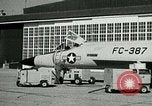
Pre-flight inspection including power on checks of the U.S. Air Force F-102A Delta Dagger interceptor aircraft.
Pre-flight inspection of the U.S. Air Force F-102A Delta Dagger interceptor aircraft. Plane on the runway. Crew chief performs power on checks in the cockpit. He climbs into the cockpit and inspects the lights, switches and gauges. Two crewmen check the engine compartment for fuel leakage under the plane. They close the panel after inspection and sign off the forms. The plane on the runway.
Loading and firing of Falcon air to air missiles from a U.S. Air Force F-102A interceptor aircraft. in United States.
Loading and firing of Falcon air to air missiles from a U.S. Air Force F-102A Delta Dagger interceptor aircraft. Several men load Falcon missiles into an F-102A at Holloman Air Force Base, New Mexico. Three contractor representatives going over graphs and charts in a conference room. The representatives going up steps of the Convair General Office Building at San Diego, California. Two Convair technicians check electrical connections and firing circuit of a Falcon missile on flight line at Holloman AFB. They load a Falcon onto launcher of a F-102A and insert the ignitor into the motor. The rockets are drawn into the aircraft and the bay doors closed. The F-102A taxis on flight line and takes off. F-102Ain flight, bomb bay doors open. The Falcon missiles are extended and fired in two salvos of three each. F-102A flying to the right.

United States soldiers demonstrate Individual concealment and camouflage.
United States soldiers demonstrate individual concealment and camouflage during World War 2. A soldier walking in the forest. He stands and surveys the surroundings. He is hot. Soldier during individual concealment at the bivouac area. A soldier camouflages his helmet. He places a strong rubber band around the helmet and hooks it in place. He sticks leaves and a few branches into the rubber band. The supervising officer corrects the soldier about too much foliage. Two soldiers paint faded equipment and bottles to blend with the terrain. They use dark olive green paint with an issue die. They darken every portion carefully. A soldier blackens his face, neck and hands with mud. Soldiers in camouflage line up in preparation for an attack. An officer inspects their camouflage. The soldiers advance.
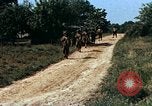
United States Army soldiers advance under camouflage during World War II
World War 2 United States soldiers demonstrate individual concealment and camouflage. Soldiers advance under individual concealment. They walk on a dirt road with grass and flowers on wither side. They walk such that their shadows are thrown off road. An enemy air observer amidst the clouds in the sky. The soldiers are spotted, they jump into the trees by the road. They take cover in a thickly wooded area. Soldiers in camouflage with guns. Guns fired. Soldier in prone position fires. A soldier takes cover in a slight depression in the ground and works his way forward. They spread out and advance. Run among long dry grass in groups. Soldiers take cover, camouflage themselves and lie low among bushes, trees and other foliage. An observer emerges from behind a hill and runs. A soldier in prone position fires. Another one runs and takes cover in a shell hole. Soldiers use trees and their shadows for camouflage. One looks over a bush. Enemy fire. Soldier observes through a bush. Soldiers run out from behind a bush amidst enemy fire. They move across an open stretch in. A soldier runs, hits the ground and throws a grenade. One looks through binoculars to survey the surroundings.
Realistic example: U.S. Army 1st Battalion 87th Infantry prepares for a night operation.
Night vision techniques and the use of metascope and starlight scope by the United States Army. Relaistic example of a night operation. Command post of the Alpha Company, 1st Battalion, 87th Infantry. Captain Wald briefs Sergeant King about a night mission to be conducted the same night. Soldier on the radio nearby. The two officers draw and mark the route on a map. Captain Wald salutes the Sergeant and gets on the radio. Animation shows the functioning of a starlight scope, a portable battery operated telescope. Includes the functions of illumination and magnification. A soldier prepares for the night mission. He walks up to a log and sits behind it. He mounts the starlight scope onto the rifle, selects a target, takes a comfortable position with support and then turns the power switch on. After that he takes aim, adjusts the eye piece focus and the range focal ring, and fires.
Realistic example: U.S. Army patrol reaches the Listening Post and scans the area for danger during a night operation.
Night vision techniques and the use of metascope and starlight scope by the United States Army. Relaistic example of a night operation. 2100 hours: 1st Battalion, 87th Infantry patrol clears the parameter. Sergeant King checks if the soldiers' eyes are adapted to darkness. Animation depicts parts and operation of camera, parts and functioning of human eye, comparison between the two, and functioning of rods and cones. Listening Post (LP): Sergeant King confirms the patrol's coordinates, the LP in turn alerts the headquarters that the patrol has passed his position. An illuminated object falls from the sky to the ground. The soldiers cover one eye to retain night vision in the same. They advance through the jungle. A soldier sights danger area and signals the patrol to halt. Soldiers sit on the ground and scan the area. Scanning includes short, abrupt, irregular movement of the eyes over and around the area every 4 to 20 seconds. A stream in the area.
CRITICALPAST.COM: About Us | Contact Us | FAQs - How to Order | License Agreement | My Account | My Lightboxes | Shopping Cart | Advanced Search | Featured Collections | Website Terms & Conditions | Privacy Policy ©2026 CriticalPast LLC.
License Agreement |
Terms & Conditions |
Privacy Policy
©2026 CriticalPast LLC.