


 Francais
 Deutsch
 Italiano

Refine Your Search
Croydon London England United Kingdom 1932 stock footage and images
- Showing 5191 to 5196 of 16124 results more
 Hide
Color Sound
USAF Brig. Gen. Pfautz introduces a USAF documentary on Soviet military equipment and its use.
United States Air Force Soviet Awareness Program titled 'Heirs of Victory' depicts Soviet military equipment and its use in terms of purpose and jurisdiction. Introduction by Brigadier General James C. Pfautz, Deputy Assistant Chief of Staff, Intelligence, Headquarters U.S. Air Force. Brig. Gen. Pfautz gives details about the subject, translation, narration, and editing. The Soviet Communist hammer and sickle symbol. A Soviet long winged early warning radar keeps a watch in the sky. Soviet Air Force MiG-25 (Mikoyan-Gurevich) interceptor bombers with air to air missiles. Pilots board aircraft and they take off. The aircraft in flight. Soviet missiles and rockets protect the borders. World War II Soviet Air Force fighter pilot Nikolai Kozmoff talks to highly trained young Soviet pilots at a air base.
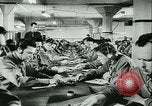
U.S. Army Signal Corps officers train at Fort Monmouth and production of signal communication items in the United States.
The role and contribution of the U.S. Army Signal Corps in combat and war. U.S. Army Signal Corps officers train at the Signal Corps Officer Candidate School (OCS) Fort Monmouth, New Jersey. Officers train at telegraph machines under the supervision of an instructor. Officers seated at desks in a classroom. Instructors take classes with the help of charts, diagrams and black boards. Officers seated atop electric poles for training. Two officers train in hand-to-hand combat at the OCS. Officers learn to use Radio Relay. Students listen to an instructor as he demonstrates the process. A U.S. soldier lays field wire across a hilly terrain to establish wire communications in the European Theater during World War II. Soldiers on the hill. Soldiers set up a sending station at the point where the wire can't go forward. A receiver is set up at the point from where the wire can go forward again. A soldier receives a photograph of a map through facsimile. Items of signal communication including radio relays, receivers, walkie-talkies, radio boxes and fuses to be produced and distributed by the USA Signal Corps to all other ground forces, navy and the Allies. New, modern, improved efficient signal communication equipment. A soldier displays two old type fuses and their counterparts.
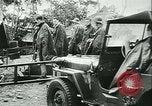
U.S. soldiers watch a film at a foxhole theater and films made for workers by the Signal Corps during World War II.
The role and contribution of the U.S. Army Signal Corps in combat and war. Army Pictorial Service films including screen magazines and GI movies are delivered to war fronts in all Theaters during World War 2. An officer arrives in a jeep with the films. Officers and soldiers around tents at the base. Soldiers in camouflage rain coats and hats seated at a foxhole theater. The soldiers watch the latest Joan McCraken Broadway hit Bloomer Girl. Scenes from the film. US: Pictures shown to workers depict the use of products manufactured by them at the war fronts. A poster reads 'B-52 Super Bombers, Bell Aircraft'. Men working inside the Bell Aircraft Corporation plant in NY. Huge machinery, equipment and aircraft parts being manufactured. Workers near stands piled with equipment and parts. A foreign version of the films made for Chinese allies. A U.S. officer talks to soldiers. The film dubbed in Chineese.
V-mail procedures including cutting, microfilming, transport, photographic enlargement, and processing during WWII.
The use of V-mail (Victory Mail) by the United States during World War II. V-mail procedures including cutting, microfilming, transport, photographic enlargement, and processing of V-mail letters and post. A poster promoting the use of V-mail. Women in a line at a post office. The post office staff at counter windows serves the customers. A woman collects a V-mail letter, writes her message and then addresses the letter. The preferred use of a softer pencil in V-mails. Cutting: Specially trained soldiers unpack the V-mails and use a cutting machine to open each mail. Processing: The experienced staff sorts mails into the respective destination groups at sorting tables. Soldiers open mails to photograph them. A soldier sorts mail that can't be photographed and are to be sent back. These mails include stamps, enclosures, snapshots and bad writing. The correct mails are then sorted into given numbers in bundles. Microfilming: Women use Airgraph machines to photograph each mail on 16mm films. 1600 mails on 100 feet of film. The complete reels are sent for developing. Women put in new reels of negatives into the cameras. Developers dry the film reels. Stacks of reels on a table containing images of thousands of letters. Soldiers packing and stacking many hundreds of sacks filled with V-mail letter microfilm images. A Boeing 314 Pan American Clipper flying boat sea plane (military designation C-98) is seen taking off to transport V-mail to major destination points. A bag of microfilm reels is delivered to an officer. He unpacks the reels and sends them to the printing room. Enlargement: Enlargement machines are used to enlarge the snapshots. Men and women operate the printing machines. Soldiers with the printed facsimiles on tables. Processing: Women slice the prints into separate letters. Machines used to insert facsimiles into V-mail envelopes and seal them. The mails are then sent to the exact destinations by ordinary post. Soldiers gather around as a comrade distributes mail at a U.S. military base in the combat area.
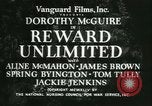
The need for cadet nurses and young girls to volunteer for military nursing service during World War II.
A film titled 'Reward Unlimited' starring Dorothy McGuire dramatizes the need for cadet nurses during World War II. Dramatization depicts why a girl called Peggy decides to become a nurse, and how she is trained. Peggy discusses marriage and future plans with her Lieutenant boyfriend. She decides to get a war job. She meets a woman who was a nurse and who gives her information about the U.S. Cadet Nurse Corps, Congress scholarships for nursing schools and duration of the courses. Peggy discusses her decision to join a nursing school with her parent. After she convinces her parents that nurses are needed, she enters training. She undergoes theoretical and practical training with many other girls in a hospital. Nursing students in classroom setting with teacher or professor at blackboard providing class instruction. Nurses receiving practical clinical instruction. Nurses using microscopes and taking notes, nurses attending patients in a hospital ward. Nurse cadet taking care of an infant baby. Nurse in surgery theater handing instruments to a doctor during operation on a patient. The graduation ceremony from the Army Nursing School. Peggy checks on a little boy called Jimmy. A government message urging young girls to volunteer for military nursing service with information about the U.S. Cadet Nurse Corps.
Dramatization depicts production, black marketing of gas coupons and citizens' responsibilities in supporting World War 2 gas rationing.
'No Alternative' dramatizes citizens' responsibilities in supporting gas rationing in the United States. Dramatization: Group of men seated playing card game. Tom interrupts a poker game to lecture on rationing, after Bob offers an illegal gas coupon to Frank. He talks about the production of automotive gasoline, increasing price and limited production of crude oil. Uses of crude oil: U.S. airmen and soldiers use crude oil to fuel aircraft and tanks. A U.S. aircraft drops bombs made with the use of crude oil. Workers produce synthetic rubber from crude oil at a plant. U.S. Navy ships, merchant fleets, railroads and war industries use crude oil. Tom explains how "black market" coupons cause shortages that affect war industries and military activities. Dramatization depicts safe breakers breaking into a ration board and stealing gas coupons worth 11 million gallons. Gasoline used by farmers in tractors, to take produce to the markets, finished ammunition, guns and tanks to the railroad stations so that they can be sent to the front. Tom points out ways to make rationing work and save gasoline including: formation of car pools, scorning illegal coupons, identifying coupons with the user's license number.
CRITICALPAST.COM: About Us | Contact Us | FAQs - How to Order | License Agreement | My Account | My Lightboxes | Shopping Cart | Advanced Search | Featured Collections | Website Terms & Conditions | Privacy Policy ©2026 CriticalPast LLC.
License Agreement |
Terms & Conditions |
Privacy Policy
©2026 CriticalPast LLC.