


 Francais
 Deutsch
 Italiano

Refine Your Search
Croydon London England United Kingdom 1932 stock footage and images
- Showing 5239 to 5244 of 16124 results more
 Hide
Color Sound

Officer Young explains proper spacing of Dits and Dahs in morse code words.
United States Army Officer Young explains proper spacing of Dits and Dahs in words. He explains about proper spacing in words and how the meaning can change with incorrect spacing with an example of two words 'Low' and 'Enemy' on screen. He states the importance of proper spacing of Dits and Dahs between words and groups by an example "We got here'.

Officer Young explains the importance of smooth hand sending by morse code signal operator.
United States officer Young explains the importance of smooth hand sending by Operator. The Operator operates on hand key. 'Take 3 basic steps' with Dits and Dahs written on screen. The first step is to adjust key. Musician tuning drum. Pistol lying on piano. Woman tuning piano.

Officer Young demonstrates the use of J-38 Hand key for morse code telegraph signal.
Officer Young demonstrates the use of J-38 Hand key for good hand sending of morse code via telegraph. He shows an enlarged model of the J-38 key for demonstration. He explains that the gap between the controls has to be right. The other officer opens the screws to loosen spring and align contact. The gap is set to a thickness of four folds of paper. Officer Jones tunes the hand key. Officer Young explains importance of developing technique. Woman plays piano to demonstrate technique. Man demonstrates technique through drum.

Army training film explains proper position of hand on telegraph key when sending Morse code messages
Army Master Sergeant, in training film about telegraphy. He illustrates proper position of telegraphers hand on telegraph key, with the help of a large dummy hand. Index and middle finger hold the button. Thumb on side with ring and little finger curled inside. Movements made with fingers keeping thumb steady. Third step being practice given on screen. A Sergeant listens to the recorded tape and uses RD-60 code recorder. Screen displays a good and bad example of using hand key. That soldier sits in a jeep and demonstrates use of a field telegraph key strapped to his leg. He transmits invitation to a woman, to dine with him. She imitates his Morse code message on a piano.. She agrees to join him for dinner. The soldier sends the letter "V" (for victory) repeatedly over the telegraph. Film ends with the couple dining in a restaurant.
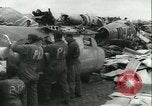
Reclaiming salvaged materials during and after World War II.
A United States post-war report about salvage and reclamation efforts to reuse supplies and reduce costs both during World War 2 and after the war. Technicians create aluminum plates for Army mess gear from salvaged aircraft parts during World War 2. Reclaimed parts used to make washing machine of gasoline drums, field telephone wires, air force tire trailer. The army salvaging and reclaiming cranes, chains, tents, tanks, shoes, axes, medical equipment, musical instruments, fire lamps, fire extinguishers. Technicians load crates of reclaimed materials on conveyor belts. An Army signal corps cameraman holding a motion picture camera. Films being picked up in bags from an Army van. Films being edited, cut, rebuilt and run on film projector equipment.

Major General Kyle gives command to General Sawyer of United States Marine Corps at Camp Pendleton, California.
Major General Kyle exists from a sedan and is assisted in putting on his coat by a Marine corpsman. His wife greets another woman. Marine Corps officers march with USMC emblem marked flags on Parade ground at Camp Pendleton, California, United States. Major General Kyle and General Sawyer salute with gun fire shots in the background. Spectators watch the ceremony from stand. General Kyle hands over USMC flag to General Sawyer. Hoisting of flag. Major General Fields reads message.
CRITICALPAST.COM: About Us | Contact Us | FAQs - How to Order | License Agreement | My Account | My Lightboxes | Shopping Cart | Advanced Search | Featured Collections | Website Terms & Conditions | Privacy Policy ©2026 CriticalPast LLC.
License Agreement |
Terms & Conditions |
Privacy Policy
©2026 CriticalPast LLC.