


 Francais
 Deutsch
 Italiano

Refine Your Search
Croydon London England United Kingdom 1932 stock footage and images
- Showing 5689 to 5694 of 16124 results more
 Hide
Color Sound
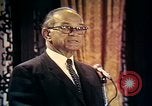
William J Fulbright, Chairman,Foreign Relations Committee, talks about the attitude of Senators in United States.
Debate on the 'Role of Congress in Foreign Policies' between John C Stennis and William J Fulbright in United States organized by American Enterprise Institute. Senator William James Fulbright, Chairman, Foreign Relations Committee discusses about the attitude of Senators to support the Congress. He says that he does not recall any incident when congress has rejected President's decision on any issue. He gives an example of an issue regarding war. He said that it is the responsibility of Congress to present a different view to President and the Senators have a collective wisdom on a particular issue. He states that better relations on non military grounds must be practiced. A comparison with policies and powers of other countries must be done. Fulbright says that no Senator has contested with the President on any issue.
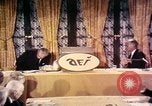
William J Fulbright, Foreign Relations Committee, talks about the issue of resolution passed during WWII in United States.
Debate on the 'Role of Congress in Foreign Policies' between John C Stennis and William J Fulbright in United States organized by American Enterprise Institute. William J Fulbright, Chairman, Foreign Relations Committee talks about the polls. He talks about the role Congress plays in policy making. He discusses the beginning of the war. Fulbright discusses in detail the disagreement among Foreign Relations Committee and the Congress.
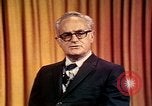
Moderator Peter Lasigor concludes and restates issues raised by Stennis and Fulbright in United States during a debate.
Moderator concludes debate on 'Role of Congress in Foreign Policies' between John C Stennis, Chairman, Armed Service Committee and William J Fulbright Chairman, Foreign Relations Committee in United States organized by American Enterprise Institute. The Moderator Peter Lasigor says that Stennis and Fulbright disagree on the issue of Congress's role in foreign policy. Stennis has said that the Congress has contributed in making 40 mutual treaties and plays a crucial role in making Foreign Policies. Stennis states the resolutions passed on the issues of Cuba, Berlin and others. Lasigor says that both of them agree on the point of reassessment. The points Fulbright raised were about the war making functions and deprivation of senate from the agreement on war issues.
Wilbur H. Durborough, America's famous Press photographer, goes to Germany during World war I
Closeup scenes show Wilbur H. Durborough-America's famous press photographer, seated behind the steering wheel of a 1911 Alto touring car parked on a street in Chicago, Illinois, getting ready to depart for Germany, during World War 1. Sitting behind him is his assistant cameraman, Irving G. Ries. Both have goggles pushed back on their foreheads. and both smoke cigars. Some spare tires are seen behind Mr. Ries. As camera moves back, they are seen surrounded by numerous friends and well-wishers as they prepare to depart from Chicago. Next, Durborough is seen standing on the bridge of the Holland-America steamship, S.S. Nieuw Amsterdam, with ship's Captain Jan Baron, who is on lookout for mines and submarines. Captain Baron passes his binoculars to Mr. Durborough. Captain Baron and Mr. Durborough stand on the deck looking at some documents. Lifeboats on davits behind them are ready for emergency. Durborough drives his car from the ship terminal onto a street in Rotterdam, with Captain Baron standing on a running board. The car is loaded down with luggage and equipment. He drives away as the Captain and others wave goodbye. Displaying an American flag on the hood, Durborough arrives at the German border. Dutch officials examine the car's contents, including a look into the engine compartment. Next, Durborough is stopped by German border guards, who examine his passport and greet him in a friendly manner. Durborough is seen in the offices of U.S.Ambassador James W.Gerard, as he describes his plans for visiting. He is honored by a visit from Prince of Reuss of German General Staff, Prince Max of Baden and Count Von Bernstorff- son of German Ambassador to the United States, who are seen chatting with him, before entering their car to depart.
U.S. Navy training film about escape from ditched modern jet fighters that sink faster than the old propeller airplanes
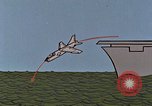
An F6F Hellcat ditches in the sea. It floats long enough to allow pilot to abandon it before sinking. Next an A-4 Skyhawk ditches. Narrator remarks about the short time for escape from such aircraft on the surface of the water. Views of tests conducted by the U.S. Navy to test the sink rates of jet aircraft from various heights and attitudes. A dummy is placed in the cockpit of a derelict F9F Panther, which is lifted by a crane and is dropped into water from a low height. It is seen floating. (Narrator states that even with no structural damage, it sinks in less than a minute.) Next an FJ-2 Fury is dropped from about 55 feet. Due to structural damage, narrator states such an aircraft may sink in a few seconds, and generally between zero to 55 seconds. View of crane operator and then of an airplane sinking rapidly. Scene shifts to James F. Roth of U.S. Navy Attack Squadron 42,(VA-42) the "Green Pawns," in the closed cockpit of a Navy jet airplane. Next, an F-4 phantom jet is seen being catapulted from an aircraft carrier. Animation shows that the airplane falling into the sea right after takeoff will sink ballistically and can descend as deep as 100 feet in 10 seconds.
A pilot ejects from a test jet aircraft that has been plunged into water.
Animation shows method of escape from a jet when it submerges in water. It shows how the pilot has to come out from the cockpit in case of emergency. Pilot tests the method of escape from the jet in case of emergency. He takes the model of cockpit in the water reservoir made for the purpose. Then he ejects himself from the canopy, leaves the cockpit and ascends to the surface. Information given to the pilot: disconnect yourself, leave cockpit, ascend to the surface.
CRITICALPAST.COM: About Us | Contact Us | FAQs - How to Order | License Agreement | My Account | My Lightboxes | Shopping Cart | Advanced Search | Featured Collections | Website Terms & Conditions | Privacy Policy ©2026 CriticalPast LLC.
License Agreement |
Terms & Conditions |
Privacy Policy
©2026 CriticalPast LLC.