


 Francais
 Deutsch
 Italiano

Refine Your Search
Croydon London England United Kingdom 1932 stock footage and images
- Showing 5935 to 5940 of 16124 results more
 Hide
Color Sound
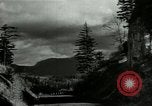
American landscape views 1930s; contributions of U.S. soldiers in the history and development of the USA.
The involvement of the American soldier in the history and growth of the United States from early 1900s until roughly 1938 before World War 2. Views of western United States countryside and mountain areas, including Mount Hood in Oregon, as seen from a slow moving car or other vehicle on a roadway. Wide, expansive landscape views in the U.S. Two Confederate and one Union uniformed veteran soldiers of the American Civil War walk together in the Arlington National Cemetery, in Virginia. U.S. Army soldiers marching at a an Army base, likely early 1930s, and wearing World War 1 era helmets. U.S. Army soldiers marching in a parade in Washington DC with U.S. Capitol in the background. Views of cities and towns in which U.S. Army posts were established, in the United States. Wide view of downtown Colorado Springs, Colorado, with Antlers Hotel in the distance and Pikes Peak in the far distance. Next shot is an unidentified downtown main street in the U.S. 1930s, followed by a scene of an industrial plant with a large water tower and snow covered low mountains in the distance. Next scene is the San Francisco skyline in the 1930s with the Bay Bridge in the far distance. Army troops and cavalry creating trails and paths, and eventually railroads, in wilderness areas of the United States. A railroad locomotive approaching beside the camera position at high speed, and then passing by pulling train cars. View of the Presidio Army Base and the Golden Gate Bridge, California. Subtle references to U.S. Army accomplishments, including curbing Mississippi River floods (Corps of Engineers) and conquering Yellow Fever (Army Doctor Walter Reed). Point of view (POV) shot from moving railroad train in a Colorado canyon; a side wheeler River boat on the Mississippi River; a sugar cane field in Cuba. View of locks in the Panama Canal. Statue of World War I soldiers.
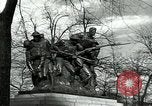
History and contributions of the U.S. Army infantryman to development of the United States of America
Memorial statue in Central Park, New York, to the 7th U.S. Army Regiment of World War I (World War 1, WWI, First World War). American infantrymen run with rifles from C-47 transport planes. U.S. soldiers in battlefield in Europe, and parading in tanks and marching,along the Champs Elysee,in Paris, France, with the Arc de Triomphe behind them. Soldiers march with flags. People watch. Korean War era U.S. soldiers march with rifles. West Point cadets march in New York City. Houses and buildings along the sides of the street. U.S. Army soldiers in various modes of operation: riflemen, artillerymen, paratroopers,ski troops, and Army engineers building bridges. One scene shows a woman soldier working as a mechanic. Soldiers training on an obstacle course, traversing a polar region with dog sleds. A gun emplacement in Hawaii and U.S.troops parading in the Philippines. A ship traversing the Panama Canal. View of U.S. Army tent Camp in Puerto Rico. A U.S. soldier sentry standing guard beside the ocean, in summer, in Iceland. An American soldier poses on a hill in New Jersey, silhouetted against backdrop of the Manhattan skyline with tall skyscrapers of New York City seen behind him. Sergeant James Mansfield talks about Colonel William Wilson Quinn. Colonel William Wilson Quinn on the show discusses the blue badge of the combat infantryman. The badge framed on a wall. He says that the badge has a blue background which is the color of the infantry. Copy of a rifle on the badge is surrounded by a circle with a star.
History of 1st Infantry Division, or Big Red One, focusing on deployment and action during Operation Torch in North Africa
Colonel William Wilson Quinn introduces an episode of "The Big Picture" that tells about the history of the 1st Infantry Division of the United States, called the "Big Red One." We see the boots and the shoes that 1st Infantry soldiers wore beginning with the Revolutionary War, through the Civil War, the First World War and the Second World War. Recruits are shown in training during World War 2 before deploying overseas in Operation Torch and the invasion of North Africa. Commanding General of the 1st Infantry Division, General Terry Allen, is seen during the Division's deployment to North Africa in World War II. Soldiers relaxing aboard troop ship. Naval barrage at night followed by amphibious assault on coast of Algeria. Animation shows the target areas of the division as they capture Oran. German counter attack is seen with bombers, tanks (including brief view of a German Tiger I tank), and artillery. American soldier standing with rifles shooting at low-flying German aircraft that are bombing their position. Scenes of German and American gun crews firing. Nazi German General Rommel seen in his staff car. Animation shows route of the Division with others towards the North. Heavy nighttime gunfire is seen. American soldiers meet and greet British troops of General Montgomery's 8th Army.
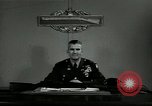
Colonel William Wilson Quinn talks about importance of the blue badge infantry soldiers of the United States Army
Colonel William Wilson Quinn on the show 'The Big Picture' in United States. Blue badge model framed on the wall in the background. He speaks about the importance of the blue badge of the rifleman or infantry man and the soldiers who wear the blue badge. He speaks about the great work of the infantrymen during the Korean War. He also speaks about the war at Sicily, the battle of the Bulge and the great work of various divisions. He says that the program 'The Big Picture' is the result of the great work of the Signal Corps combat cameramen who took the pictures and films of the Infantrymen.
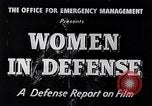
American women work as part of the National Defense Program, United States (WW2)
Wartime activities of women in United States during World War II, narrated by Hollywood actress Katharine Hepburn. A statue of a historic “Pioneer” American woman. American women work to save and help the nation. Women work at a laboratory as scientists. A woman looks under a microscope. Test tubes and other equipment on tables. Women handling chemicals in various flasks without protective gear. They work for the National Defense Program. A woman works near a machine that tests rubber or cloth for parachutes. Woman conducts abrasion test on clothing using a Wyzenbeek machine. She feeds guinea pigs and records their weights. Another woman works in the field of science. A woman gives a lecture on nutrition. A nutrition chart on wall. Other women attend the lecture. Women design working clothes for women. A woman wears a factory jumpsuit uniform.
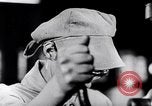
American women actively participate in the National Defense Program as war production workers in United States.
Wartime activities of women in the United States during World War 2. American women wearing uniforms work at machines in factories, assisting with the war production effort. They perform work in operating machines including drill presses, sewing, and fine detail work with precision instruments. They sew airplane wing fabric and parachutes. They assemble and inspect precision instruments employing tiny bearings. The women war workers operate drill presses and lathes in a machine shop.
CRITICALPAST.COM: About Us | Contact Us | FAQs - How to Order | License Agreement | My Account | My Lightboxes | Shopping Cart | Advanced Search | Featured Collections | Website Terms & Conditions | Privacy Policy ©2026 CriticalPast LLC.
License Agreement |
Terms & Conditions |
Privacy Policy
©2026 CriticalPast LLC.