


 Francais
 Deutsch
 Italiano
Refine Your Search
Cuba 1898 stock footage and images
- Showing 109 to 114 of 349 results more
more Hide
Hide
Aid from United States Air Force and soldiers to exile guerrillas and their surrender during Bay of Pigs invasion in Cuba.
Bay of Pigs invasion to overthrow the government of Fidel Castro in Cuba, by armed Cuban exiles. Exile leaders of Cuba at their base. Cuban warships on alert in sea. United States Air Plane and crew carries aid to the exile guerrillas. A United States soldiers with exile guerrillas in jungle. Captured exile soldiers guarded by riflemen. U.S. flag at exile base. Cuban soldiers and their commanders. Fidel Castro addresses his soldiers. Tanks during the battle. Surrendered guerrillas with hands raised.
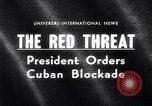
United States President John F. Kennedy addresses the nation and warns Soviet Union for making military bases in Cuba.
United States President John F. Kennedy addresses the nation about Soviet interference in island of Cuba during Cuban Missile Crisis. President imposes naval and air quarantine on the shipment of offensive military equipment in Cuba. He alleges Soviet Union of working contrary to their promises and building offensive missile and bomber bases in Cuba. He says that the U.S. would retaliate against Soviet Union of any missile fired from Cuba on any country of Northern Hemisphere. Flags of various nations hoist outside the building
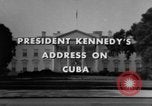
President John F. Kennedy addresses the nation about the missiles in Cuba from his office in the White House, Washington DC.
U.S. President John F. Kennedy addresses the nation during Cuban Missile Crisis. Exterior of the White House. President Kennedy in his office. He speaks about the series of offensive missiles found in Cuba and the range of these missiles. He names the cities that could be covered by medium range missiles and intermediate range missiles and thus are a danger to the western hemisphere. He also talks about Jet bombers capable of nuclear bombing. He refers to the constitution and the charter of the United States. He also discusses his talk with Soviet officials and their refusal to remove the weapons. President Kennedy condemns the nuclear weapons and expresses his concern about the Communist buildup in Cuba as it is dangerous to the United States. He talks about Americans policy to be patient and restrained. He warns that any nuclear attack from Cuba would be regarded as Soviet attack. He talks about an emergency meeting of the UN Security Council for withdrawal of all offensive arms from Cuba under supervision of the United Nations. Kennedy addresses Cuban people and says that they had been betrayed by their leaders. He asks all citizens to be patient
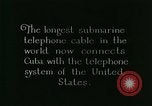
A cable ship laying a submarine telephone cable connecting Cuba with the telephone system of the United States.
Submarine telephone cable connecting Cuba with the United States. A cable ship at sea during the laying of the submarine telephone cable connecting Cuba with the telephone system of the United States. A few equipment on the ship. View of the submarine cable in the sea from the cable ship. Men at work on the cable ship. The cable being pulled by several men at a Cuban port. U.S. President Warren G. Harding, seated with other officials, during the commemoration of the completion of the cable to Cuba on April 11, 1921 in the United States. Harding and the officials talk on telephones using the newly completed cable line to Cuba.
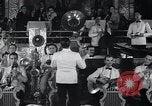
The Casino de la Playa Orchestra, led by Guillermo Portela, with singer Miguelito Valdes playing maraccas at the Casino La Playa club in Havana Cuba.
Casino de la Playa Orchestra performing at the Casino La Playa in Havana Cuba. Various musical instruments are played and the orchestra is led by conductor Guillermo Portela . Cuban dance music in which singer Miguelito Valdes, here seen playing the maracas, is featured. (Later, in 1940, Valdes was hired by Xavier Cugat as a singer.) People seen sitting behind the musicians. Nighttime illuminations on buildings. Patrons dining and dancing.
A dance performance and musicians playing Cuban dance music in Casino de la Playa night club, Marianao Beach, Havana, Cuba
Casino de la Playa, a night club in Marianao Beach, Havana, Cuba. People sitting at tables. A man and a woman give a dance performance. Lights focused on the center. Audience cheer the dancers. Musicians of the Casino de la Playa Orchestra under Guillermo Portela play Cuban dance music. Men and women dance. A young Walfredo de los Reyes seen playing trumpet. Trombone, saxophone, and clarinet players also seen in close ups.and maraccas player and singer is Miguelito Valdes who would later be Xavier Cugat star singer in the early forties