


 Francais
 Deutsch
 Italiano
Refine Your Search
Cuba 1898 stock footage and images
- Showing 241 to 246 of 349 results more
more Hide
Hide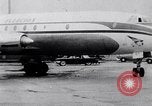
Fidel Castro and Nikita Khrushchev during the United Nations 15th General Assembly in New York.
Fidel Castro steps down plane during his arrival for the United Nations 15th General Assembly in New York. Castro's car stopped near a gate to greet a crowd of supporters cheering him. New York police huddle around the car and urge him to proceed on and not stop. Castro arriving by car in Harlem New York after transfer there from another hotel in midtown. Khrushchev meets Castro in the street in Harlem and they hug as police stand by for protection. View of United Nations building. The Cuban and Soviet contingents seen together greeting one another at the assembly hall of the United Nations. Castro goes to the stage to begin delivery of a record speech exceeding four hours. The chair is seen interrupting at one point in the interest of time. Castro addresses delegates. Castro boarding a plane supplied by the Soviet Union for his return to Cuba. Castro on stage surrounded by a crowd in Cuba. View of a lone Cuban farmer sweating as he works in the sun on a farm field.
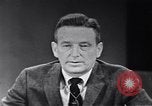
Newsreader reads Cuban Crisis news in United States.
A man reads news about the Cuban Crisis. World map in background. Photo of John F Kennedy appears in background. Map of Cuba appears in background. Illustration shows circling region of Cuba. Another circle around the first circle.
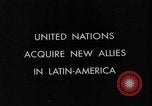
Fulgencio Batista greeted by President Roosevelt in Washington DC. Also Mexico, Brazil, and Chile side with Allies in World War 2
President of Cuba, Fulgencio Batista greeted by President Franklin D Roosevelt and Vice President Wallace in Washington, as Cuba expresses support for Allies in World War 2. Next scene shows armored tanks of Mexico rolling through Constitution Plaza in Mexico City, with Metropolitan Cathedral in background, as Mexico also side with the Allies. Next, President Vargas of Brazil waves from a balcony to cheering crowds in Rio de Janeiro as Brazil declares war. Chileans demonstrate for the United Nations in Santiago, Chile. Chilean demonstrators with flags and banners march on streets. Some carry large pictures of the Allied leaders.
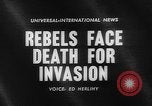
Relatives of Cuban invaders gather at the Headquarters of the Revolutionary Democratic Front to seek news of their relatives
In Miami, Florida, relatives of Cuban invaders gather at the Revolutionary Democratic Front Headquarters to seek news of their husbands, sons and brothers who were captured in the failed Bay of Pigs Invasion in Cuba. Women weep as they await news of their relatives who may face death in Cuba. Fidel Castro, a Cuban revolutionary leader, threatens a firing squad for all the captured insurgents. Fidel Castro makes his first public appearance on television since invasion, and speaks for four and a half hours denouncing the United States.
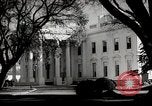
U.S. Government officials at White House and Pentagon during the Cuban Missile Crisis; President Kennedy informs America.
Activities during Cuban Missile Crisis in the United States. U.S. Government officials arriving at the White House in Washington DC to address the Cuban missile crisis. CIA Director John McCone and Vice President Lyndon Johnson seen arriving at the White House. President John F. Kennedy addresses the American people on October 22, 1962, announcing discovery of Soviet missiles in Cuba and imposing a U.S. naval "quarantine" on Cuba. Animation showing areas of naval quarantine. The U.S. Capitol in a night time view. Night view of the State Department Building and the Pentagon in Arlington, Virginia. Interior views in the Pentagon show offices and signs for Office of Secretary of Air Force; Office of U.S. Air Force Chief of Staff; Office of Chief of Naval Operations; Office of the Joint Chiefs of Staff; and Office of the Secretary of Defense. View in a meeting room of Robert McNamara, the Secretary of Defense, standing at a microphone.
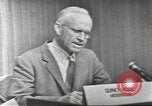
Vice President Nixon talks about Communist influence in the Western Hemisphere prior to presidential elections in the U.S.
The fourth presidential election debate held between Democratic nominee Senator John F. Kennedy and Republican nominee U.S. Vice President Richard Nixon in New York, United States on 21st October 1960. ABC news correspondent Quincy Howe speaks during the fourth Kennedy-Nixon presidential debate. He speaks that the candidates would answer and comment upon questions put by these four correspondents: Frank Singiser of Mutual News, John Edwards of ABC News, Walter Cronkite of CBS News and John Chancellor of NBC News. Frank Singiser puts the first question to Vice President Nixon. He asks Nixon the way he would handle Fidel Castro's regime and prevent establishment of Communist governments in the Western Hemisphere and why his policy is better for peace and security of the United States in the Western Hemisphere. Nixon answers that Senator Kennedy's policies and recommendations for the handling of Castro regime are dangerously irresponsible recommendations that he's made during the course of this campaign. Nixon speaks that what Senator Kennedy recommends is that the U.S. government should give help to exiles and to those within Cuba who oppose Castro regime, provided they are anti-Batista. Nixon says the United States have five treaties with Latin America, including the one setting up the Organization of American States in Bogota in 1948, in which the U.S. has agreed not to intervene in the internal affairs of any other American country. He further says that if the U.S. follows recommendations of Senator Kennedy then the country would probably be condemned in the United Nations and it would result in an open invitation to Soviet Premier Nikita Khrushchev to come into Latin America and to engage the U.S. in a civil war. He speaks about quarantining Cuban Prime Minister Fidel Castro by cutting off trade and diplomatic relations with Cuba.